

Turquoise Meaning: Lore, Birthstone Facts and How to Spot a Fake
Turquoise is a sky-blue to green copper mineral, often veined with brown or black host rock, and one of the oldest gems people have worn. In crystal tradition, turquoise is a stone of protection, friendship and good fortune, long carried by travelers and riders, and it is one of the birthstones for December. Many wear it as a small piece of sky to keep close.

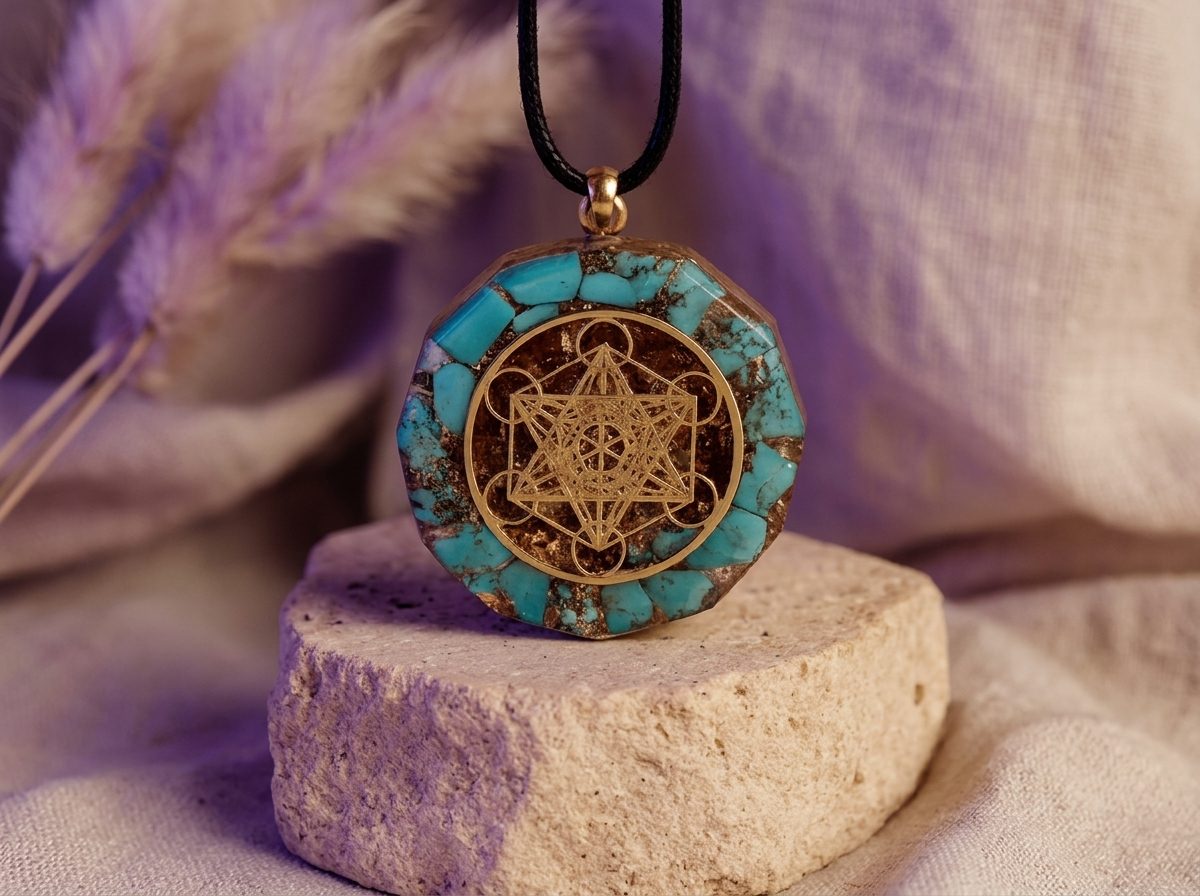
Orgonite Pendant Metatron in Turquoise
Turquoise set in orgonite around a gold-tone Metatron's Cube
See it · $36You can browse all our turquoise pendants as you read. Below: what turquoise means, its lore from Persia to the American Southwest, why it is said to change color, how to wear and pair it, and how to tell real turquoise from dyed howlite and plastic.
Turquoise quick facts
| What | Details |
|---|---|
| Color | Sky blue to blue-green and green; often webbed with brown, black or golden veins called matrix. Copper gives the blue, iron tilts it toward green |
| Mineral family | Hydrated copper aluminum phosphate, CuAl6(PO4)4(OH)8·4H2O |
| Mohs hardness | 5 to 6, softer than quartz, and porous |
| Main sources | Iran (Nishapur), the US Southwest (Arizona, Nevada, New Mexico), China, Egypt's Sinai, Mexico |
| Chakra (in tradition) | Throat |
| Zodiac (in tradition) | Sagittarius, the December sign |
| Birthstone | December, alongside tanzanite and zircon; also the 11th anniversary stone |
| Traditional associations | Protection, travel, friendship, good fortune, honest speech |
| Care | Put it on last and take it off first; keep it away from perfume, lotion, hot water and steam; wipe with a soft dry cloth |
What turquoise means in crystal tradition
Few stones have been loved by so many cultures at once. Across all of them, the turquoise meaning gathers around a few ideas:
- Protection. Turkish riders fixed turquoise to their horses' bridles in the belief that it kept them from falls, and travelers carried it on long journeys. Apache lore held that turquoise tied to a bow made the hunter's aim true. Today it is worn as a protection symbol, not a promise.
- Friendship and gifts. In European tradition a turquoise ring given as a gift meant "forget me not", and turquoise was a favorite present for bridesmaids. Many say turquoise is best received as a gift, which makes it a natural present.
- Good fortune. Turquoise has been called a good-luck stone for centuries, from Persia to Tibet, where it is often called the national gem. Wear it as a wish, not a promise.
- Honest speech. In modern crystal practice it belongs to the throat chakra, linked to clear and kind words.
Turquoise spiritual meaning
Turquoise is often described as a bridge between sky and earth: the color of open sky, formed in dry desert rock. That is the heart of its spiritual meaning. People use it to feel steady and open at the same time.
Its spiritual uses are simple. Some wear a turquoise pendant at the throat before a hard conversation, as a reminder to speak honestly and gently. Others hold one during a short meditation, or pack one when they travel.
History and lore
Egypt and Persia
Egyptians mined turquoise in the Sinai Peninsula thousands of years ago, and it is set into the burial mask of Tutankhamun. In Persia, the mines near Nishapur produced a pure, even sky blue that is still the reference gem dealers judge other turquoise against: "Persian blue".
The "Turkish stone"
The name comes from the French pierre turquoise, "Turkish stone". Turquoise is not mined in Turkey: it reached Europe from Persia along Turkish trade routes around the 13th century, and the name stuck.
The Americas
The Aztecs used turquoise in mosaic masks and ceremonial objects. In the American Southwest, Pueblo, Zuni, Hopi and Navajo artisans built carving and jewelry traditions around it that are still alive today, and turquoise set in silver became the look most people now picture.
The stone that changes color
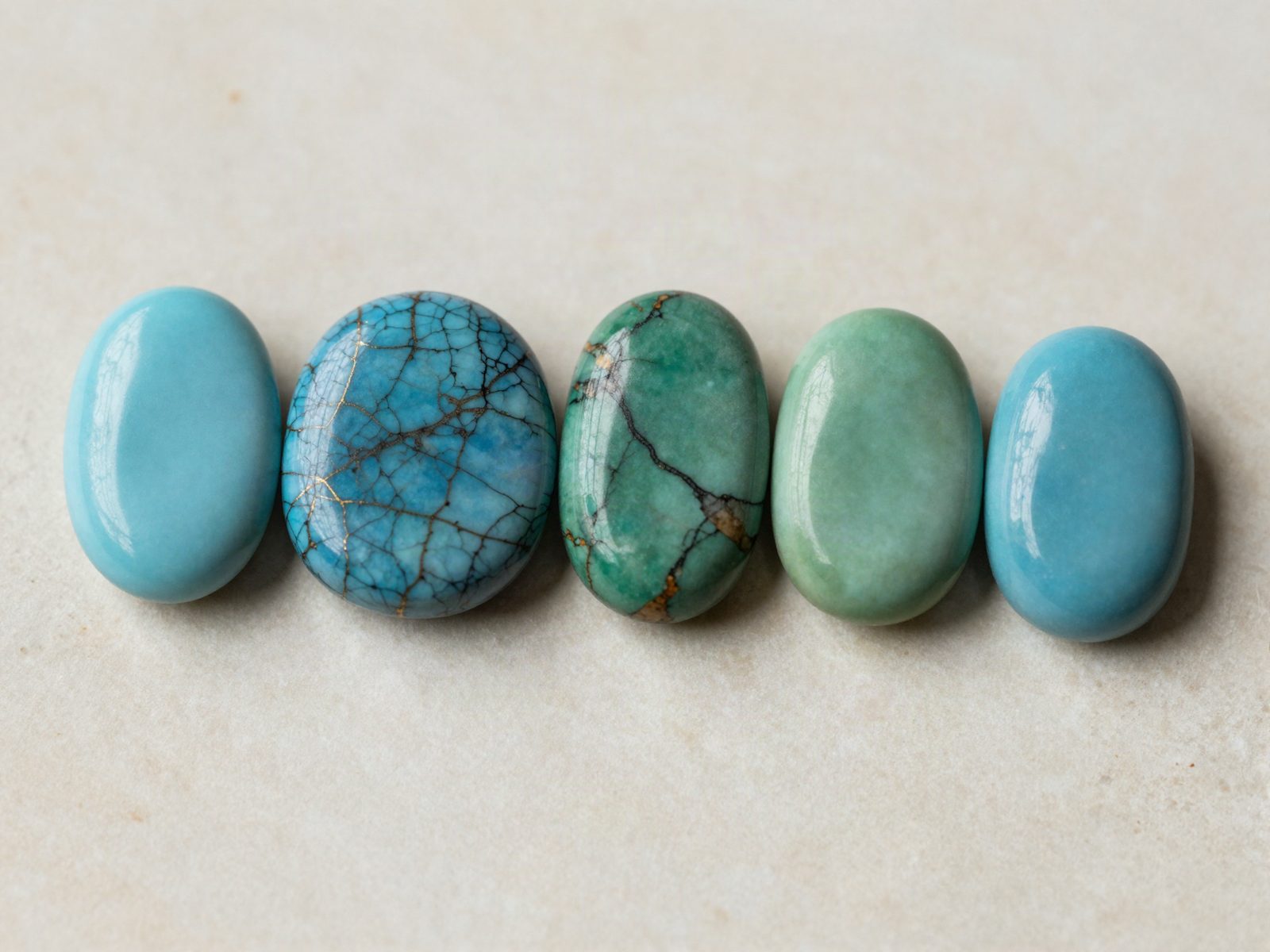
Old Persian lore said a turquoise that changed color was warning its owner of trouble ahead. There is a real reason behind the legend: turquoise is porous. Over the years it takes in skin oils, perfume, lotion and water, and the copper and iron inside react, so a sky-blue stone can slowly turn greener or darker. That is why old turquoise often looks different from new, and why the care rules below matter.
Is turquoise a birthstone?
Yes. Turquoise is a December birthstone, listed with tanzanite and zircon by the American Gem Trade Association and Jewelers of America; some lists add blue topaz. It is also the traditional gift for an 11th wedding anniversary. In astrology-inspired tradition it is linked to Sagittarius, the main December sign.
How to wear turquoise
- As a necklace. The traditional place for a throat stone. A pendant on a short cord sits close to the throat and is easy to take off at night.
- As a ring or bracelet. Classic, especially in silver, but hands meet soap, sanitizer and lotion all day. Take it off before washing your hands.
- Which hand. In one common tradition the left hand receives and the right hand gives. People who wear turquoise as a protection symbol often choose the left.
- Last on, first off. Put turquoise on after perfume, lotion and makeup, and take it off before the shower or the pool.
Where to keep turquoise
| Place | Why people choose it (in tradition) |
|---|---|
| Travel bag or car | The old travelers' stone, carried for safe journeys |
| Desk | A throat-chakra stone, kept as a reminder to speak clearly |
| Entryway | Placed as a protection symbol where people come and go |
| Jewelry box, apart from harder stones | A practical rule: quartz and diamonds scratch it |
What to pair turquoise with
- Tiger's eye: golden-brown and grounded next to turquoise's open blue; two of our turquoise pendants combine them. See our tiger's eye meaning guide and our tiger's eye pieces.
- Malachite: its copper cousin, green and banded; crystal guides pair the two for growth and courage.
- Lapis lazuli: a deeper blue for truth and wisdom in tradition. They look related but are different minerals; read more in our lapis lazuli spiritual meaning guide.
There is no fixed list of stones to avoid with turquoise. Choose by intention, and wear one stone at a time if a mix feels like too much.
How to cleanse turquoise
Because turquoise is porous, skip water soaks, salt and long hours in direct sun. Gentle ways that suit it: smoke, sound, moonlight, or a night beside a selenite plate. For each method step by step, read how to cleanse crystals. For a turquoise orgonite pendant, wipe it with a dry cloth only: no water and no cleaning products.
How to tell real turquoise from fake
Most turquoise sold today is real but treated, and that is normal. What matters is knowing what you are buying. Five kinds you will meet:
| Kind | What it is |
|---|---|
| Natural | Cut and polished, nothing added; the rarest and priciest |
| Stabilized | Real turquoise filled with clear resin so it holds its color and is less fragile; the industry standard |
| Dyed or color-enhanced | Real turquoise with added color, often a deeper blue than nature makes |
| Reconstituted | Turquoise powder or chips bonded with resin and pressed into shape |
| Imitation | Not turquoise at all: dyed howlite or magnesite, plastic, glass or ceramic |
Simple checks you can do without damaging the stone:
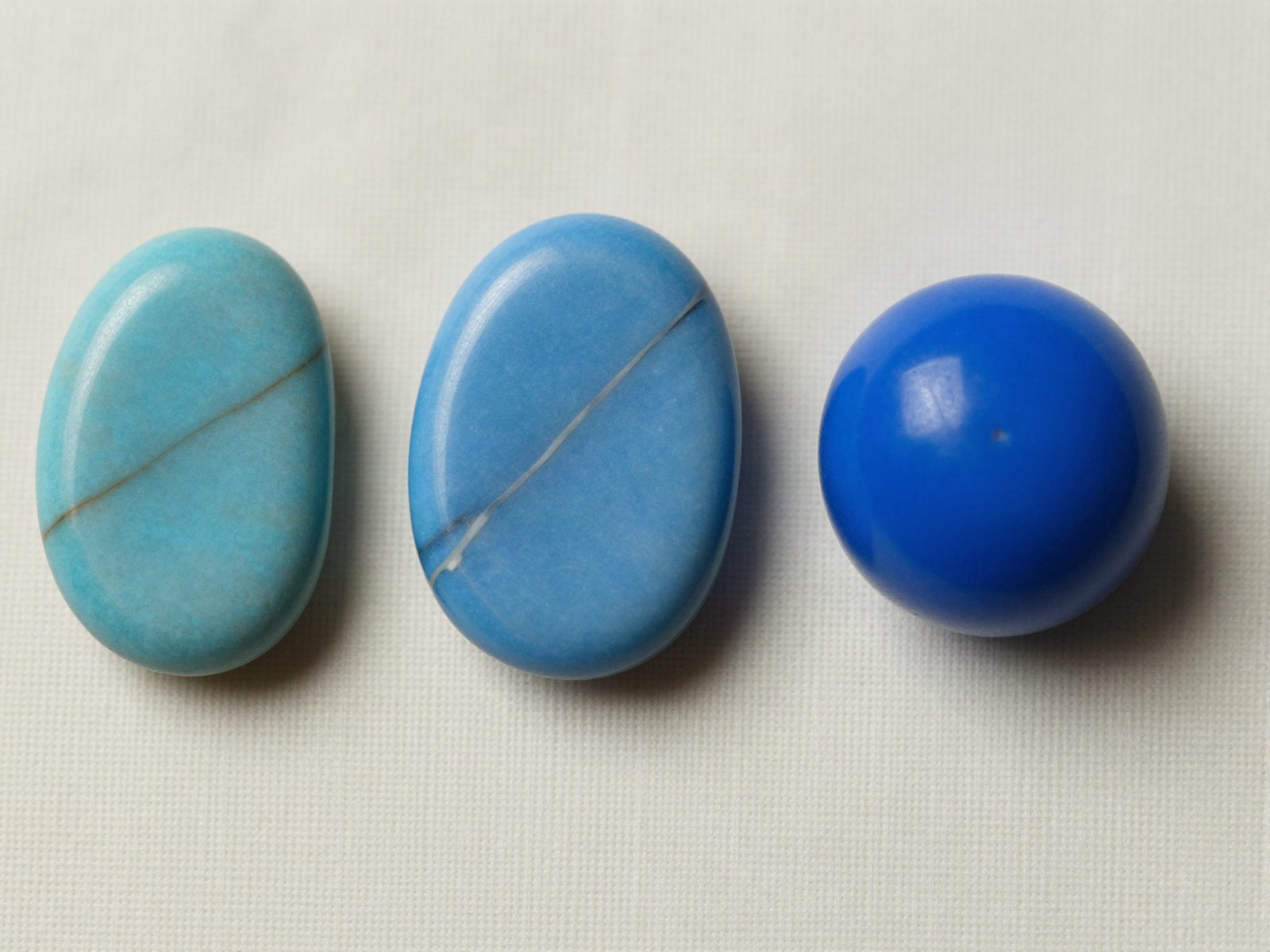
- Look at the veins. In turquoise, matrix sits flush with the surface and is brown, black or golden. Dyed howlite often shows gray or white veins that sit slightly lower than the blue.
- Look in the cracks and drill holes. Dye collects there as darker blue lines, and white can show at a chip or a bead's hole.
- Check the color. Real turquoise varies a little across a stone. A perfectly even, bright blue over many identical beads is a warning sign.
- Feel the weight. Plastic feels light and warms in your hand within seconds.
- Read the label and the price. Words like "howlite", "magnesite", "reconstituted" or "turquenite" tell you what it is. A strand of large, flawless "natural" turquoise for a few dollars is not natural.
How to choose a turquoise piece
- Pick your color. Sky blue is the classic; greener stones are just as traditional in the Southwest.
- Decide on matrix. Clean blue or web-like veins is a matter of taste; the fine web pattern called spiderweb is a collector's favorite.
- Ask about treatment. An honest seller tells you whether a stone is natural, stabilized or dyed.
- Protect the stone. A metal rim, or turquoise set in resin as in orgonite, keeps a soft, porous stone away from lotion, water and knocks.
- Know the price range. Our turquoise orgonite pendants are $36 each.
Spirad pieces in turquoise

Orgonite Pendant “Anahata” in Turquoise
Turquoise in orgonite with a Tree of Life, in a silver or gold tree
See it · $36The Anahata pendant sets turquoise in orgonite behind a Tree of Life symbol, which you can choose in silver or gold.

Orgonite Pendant “Lotus-Om” in Turquoise & Tiger’s Eye
Turquoise and tiger's eye in orgonite under a lotus and Om symbol
See it · $36The Lotus-Om pendant is a handmade orgonite round of turquoise and tiger's eye, with a lotus and Om symbol on its face.

Orgonite Pendant “Sri Yantra” in Turquoise & Tiger’s Eye
Turquoise and tiger's eye in orgonite under a Sri Yantra
See it · $36The Sri Yantra pendant combines turquoise and tiger's eye in handmade orgonite under the Sri Yantra, a sacred geometry symbol from Hindu tradition.
For every stone tradition links to protection, browse our protection collection or read our guide to crystals for protection.
Frequently asked questions
What does turquoise mean spiritually?
Protection, friendship, good fortune and honest speech. In crystal tradition it is a throat-chakra stone and a bridge between sky and earth.
What are the spiritual uses of turquoise?
People wear it at the throat as a reminder to speak honestly, hold it during short meditations, and carry it when they travel, as riders and traders did for centuries.
Is turquoise a birthstone?
Yes, for December, along with tanzanite and zircon. It is also the traditional 11th anniversary stone.
How can you tell if turquoise is real?
Look for brown, black or golden matrix that sits flush with the surface, slight color variation and no dye pooled in cracks or drill holes. Gray recessed veins point to dyed howlite, and a light, quickly warm stone points to plastic.
Why does turquoise change color?
Old lore said it warned of trouble. In fact turquoise is porous: skin oils, perfume, lotion and water slowly turn it greener or darker over time.
Can turquoise get wet?
A splash is fine, but don't soak it, shower or swim in it. Water and soap can change its color over time. Wipe it with a soft dry cloth.
Where to start
If you want one turquoise piece, start with the Metatron pendant: the most turquoise on its face, set in resin so it is easy to care for. For a gift, the Anahata Tree of Life says it simply, and if you like a warmer mix, choose the Lotus-Om or Sri Yantra with tiger's eye.
Orgonite Pendant Metatron in Turquoise
Turquoise set in orgonite around a gold-tone Metatron's Cube
See it · $36