★★★★★4.8 · 612 reviews

The Lakhovsky Disc

For the 3am wake

The disc under your pillow that gets you back to sleep at 3am.

You did everything right and you're still up at 3. Copper rings under your pillow: nothing to swallow, no light, nothing to charge.

  • Back Asleep Sooner
  • Nothing to Swallow
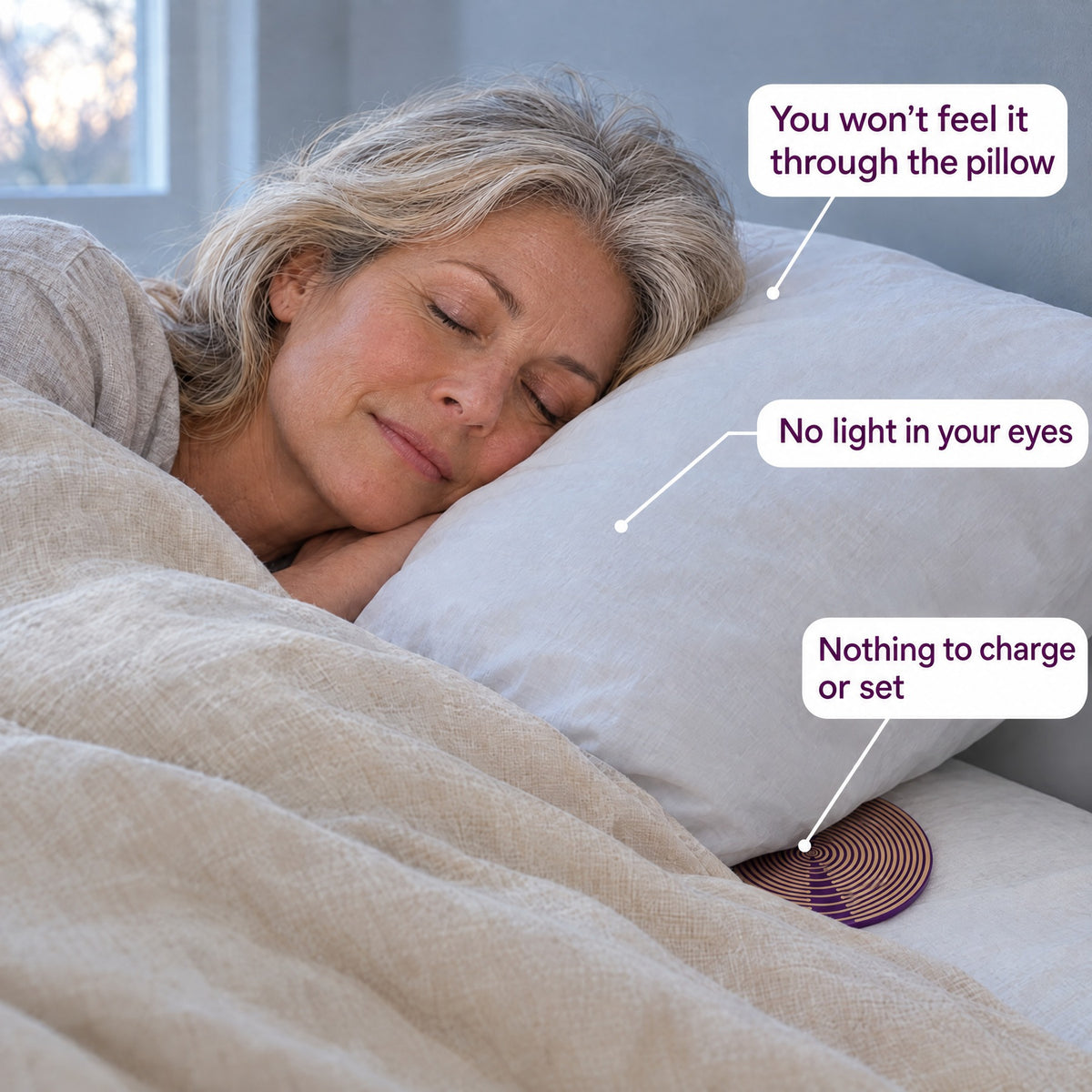
  • Can't Feel It Through a Pillow
  • Keep Your HRT

Launch gifts end Sunday, November 2.

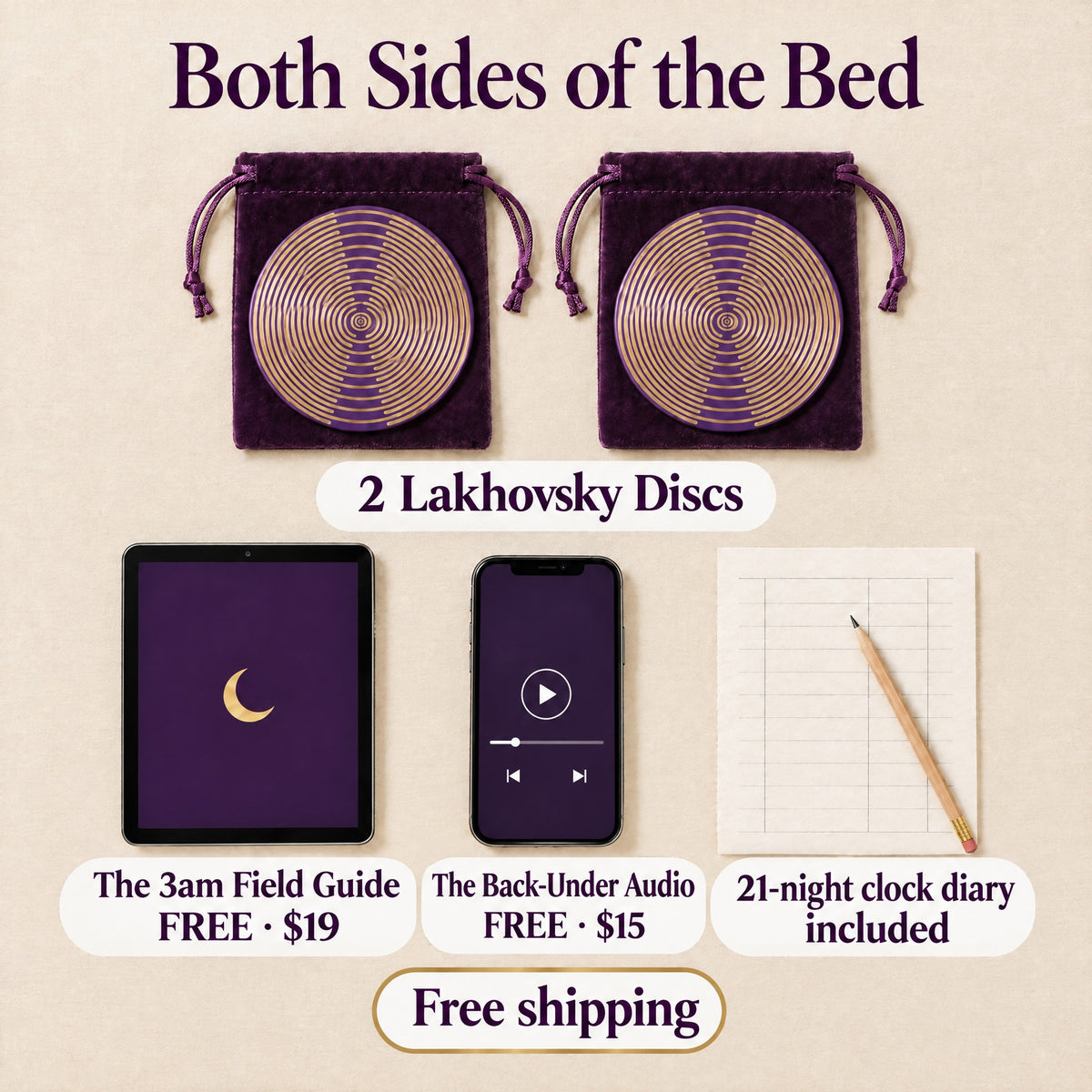
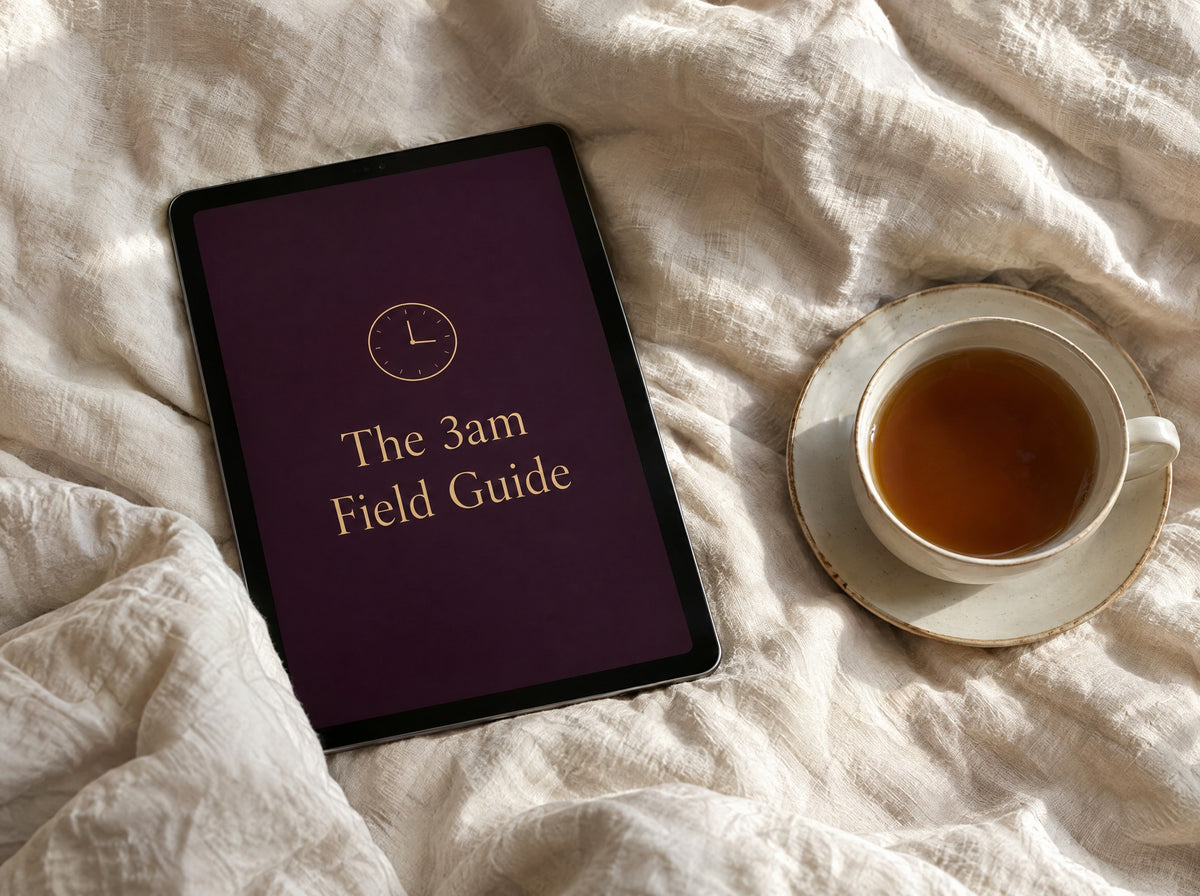
The 3am Field Guide (PDF, $19 value).All tiers.
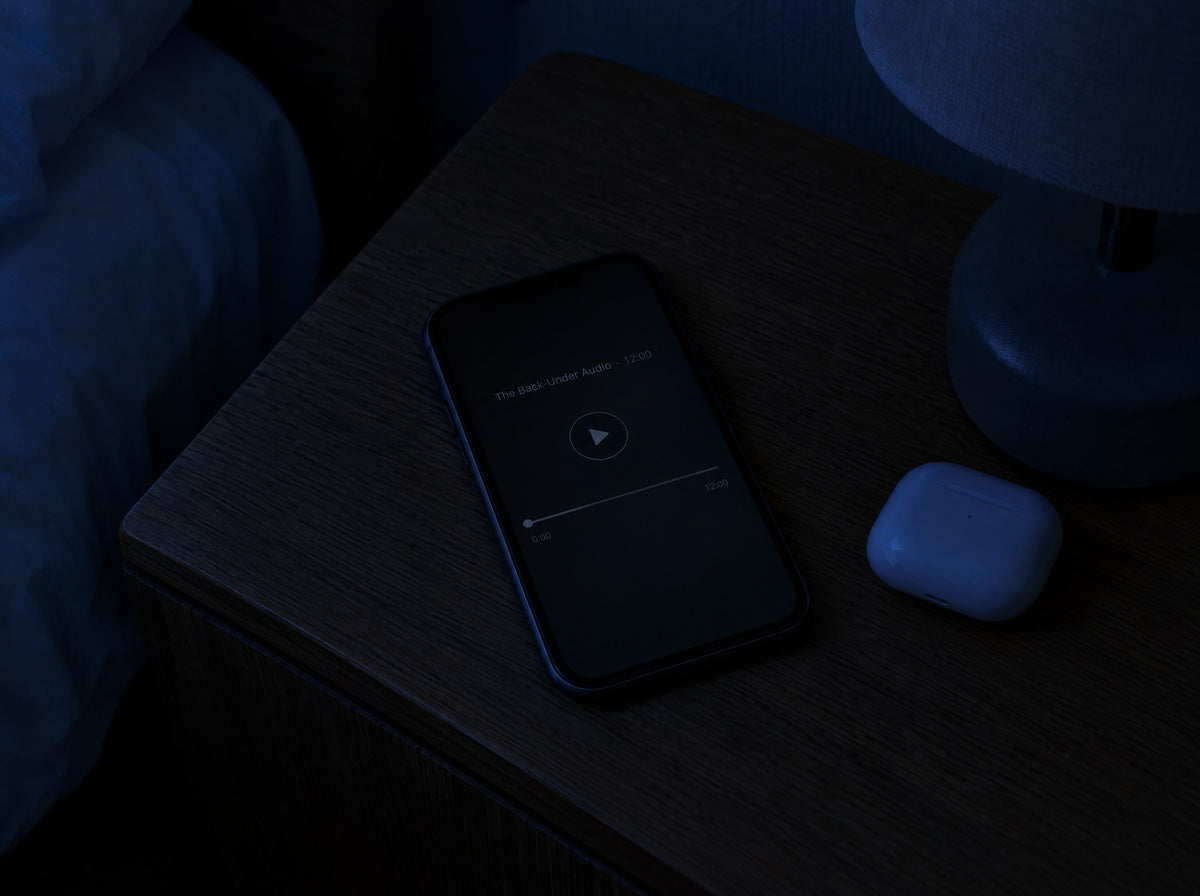
The Back-Under Audio (12 minutes, $15 value).2 discs and up.
$20 Spirad credit.3 discs.

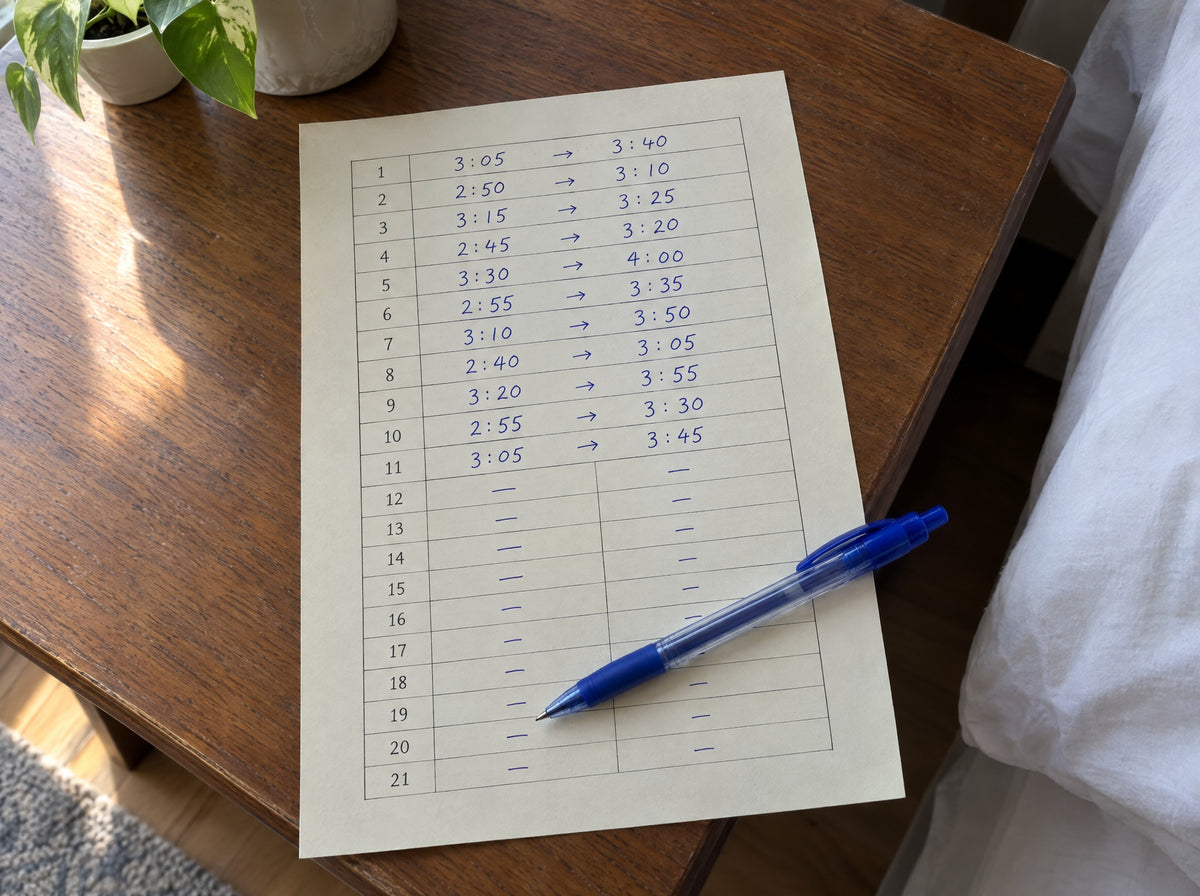
With every order: the "Where to put it" guide and the 21-night clock diary (printable).

Order today, at your door by Thursday, Oct 16. Free US shipping on 2 discs or more.

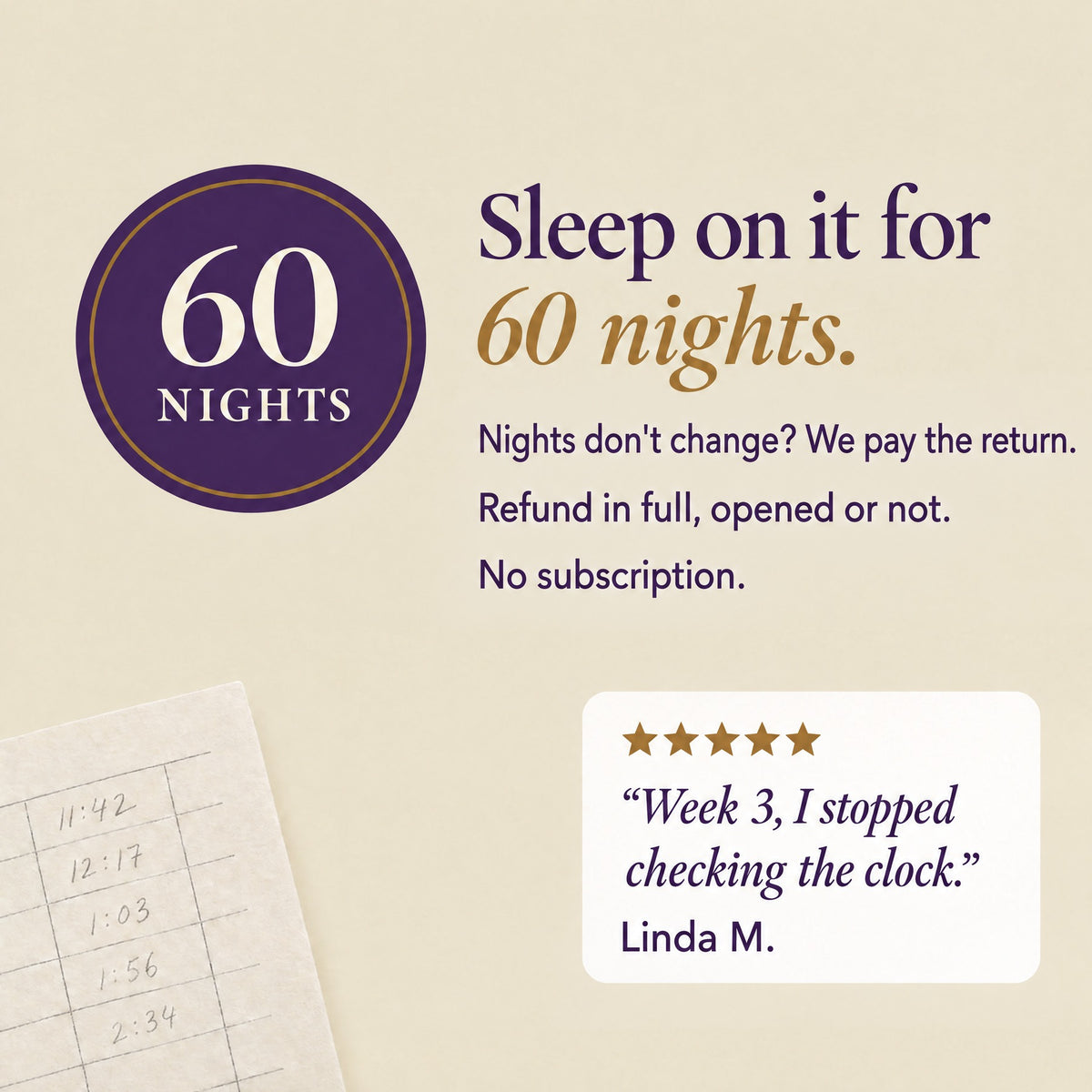
60 nights on your own pillow. If your nights don't change, we pay the return and refund every cent, opened or not.

Secure checkout ·Shop PayApple PayPayPalall major cards
  • Free shipping from 2 discs
  • At your door in 5-7 business days
  • Returns paid by us

What people say most:"I still wake up. I'm just back asleep before I can do the math."

"For my patients who are still awake at 3am on their HRT, I like anything that adds nothing to the medicine cabinet." Dr. Ruth Calder, DNP, certified menopause practitioner

From Spirad · 4.9★ on 1,422 store reviews

Fewer than 3 in 100 send it back.

What it is, and what it isn't

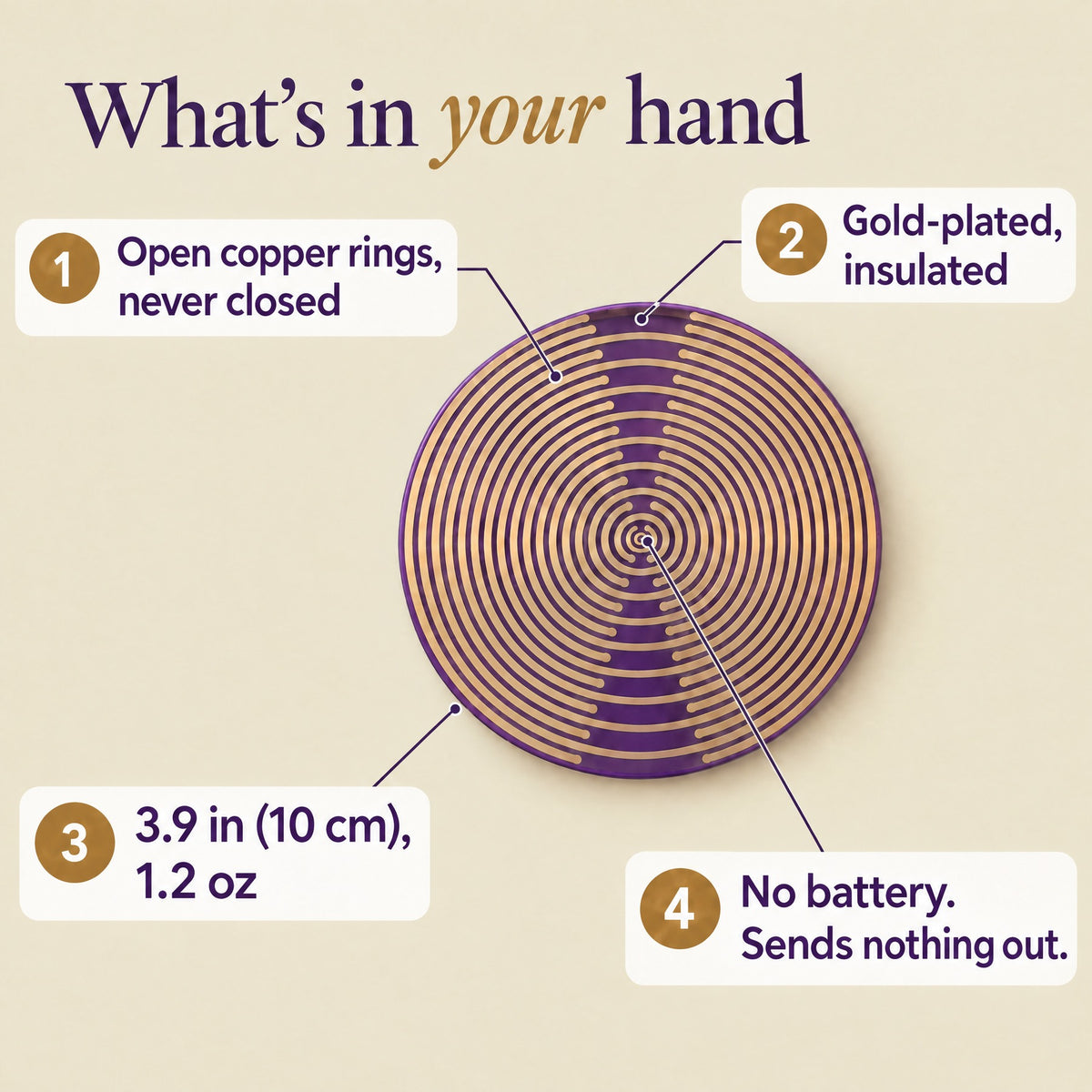
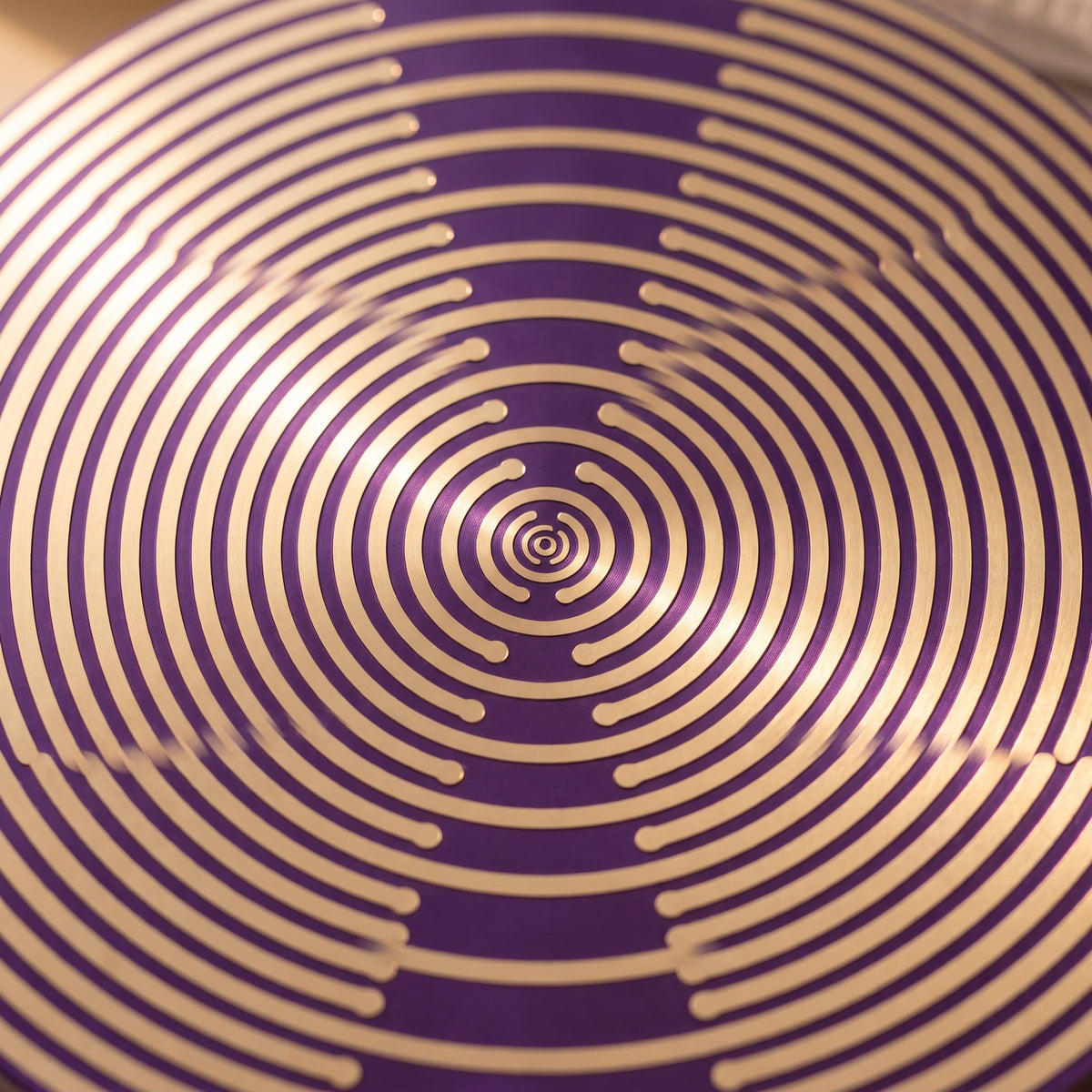
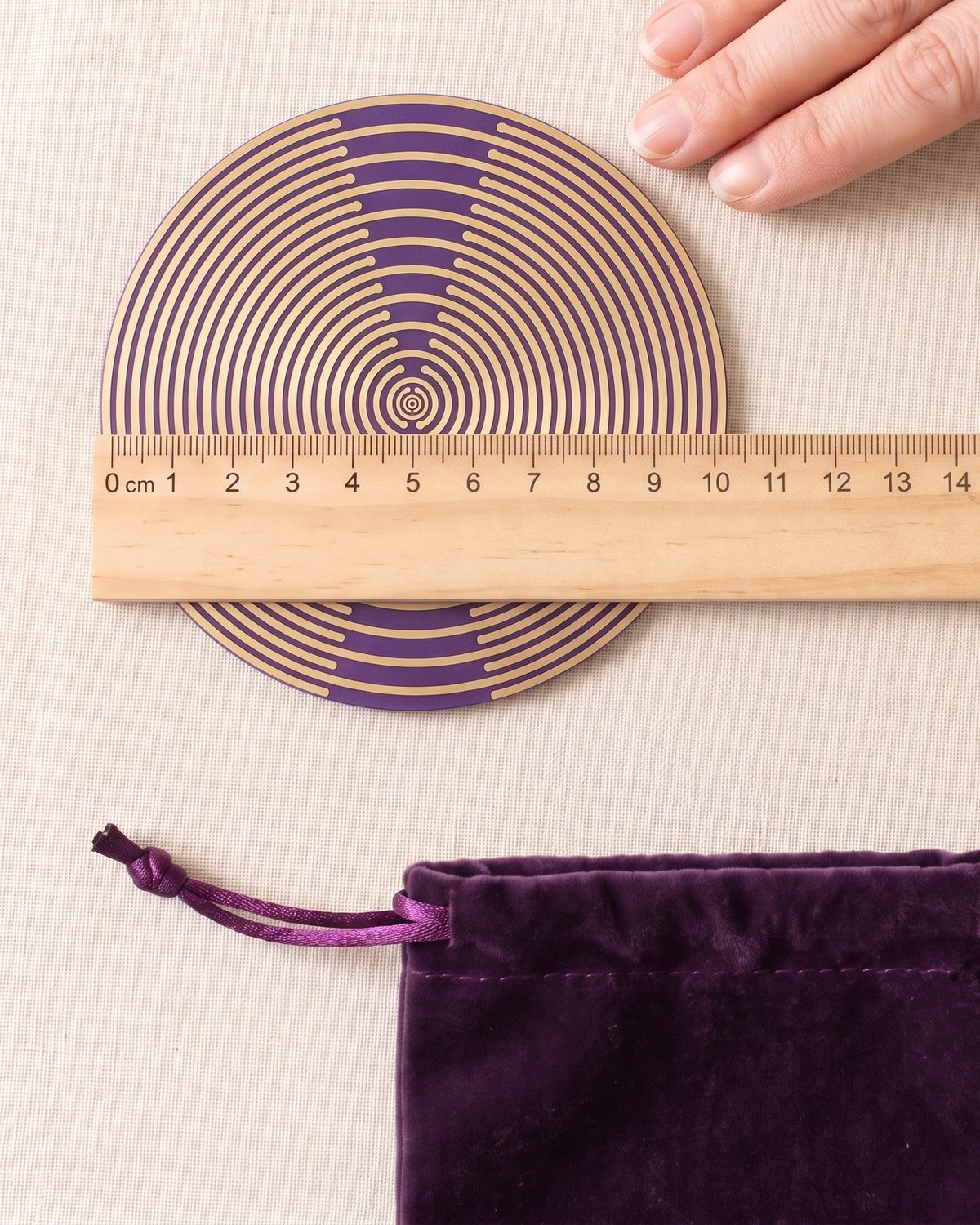
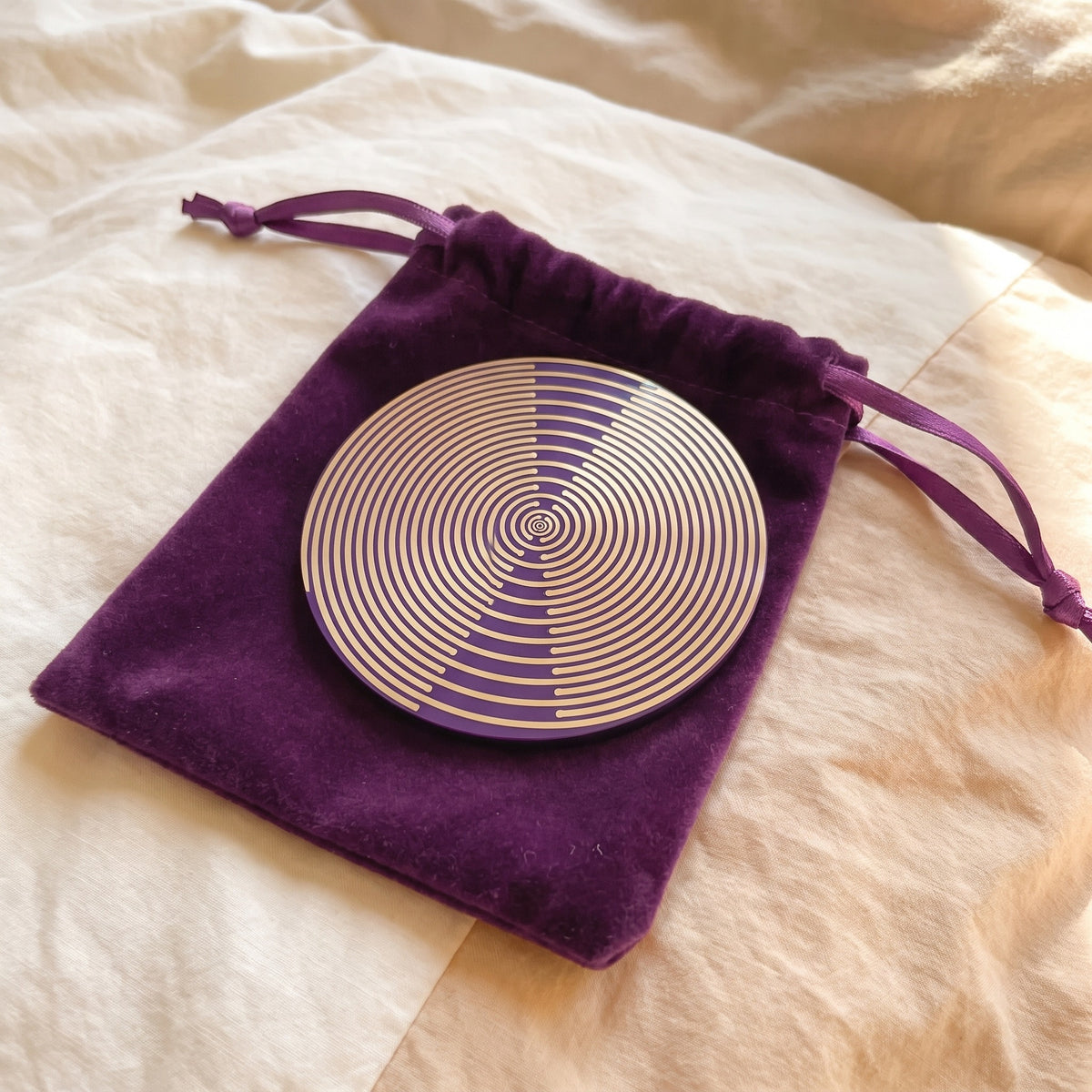
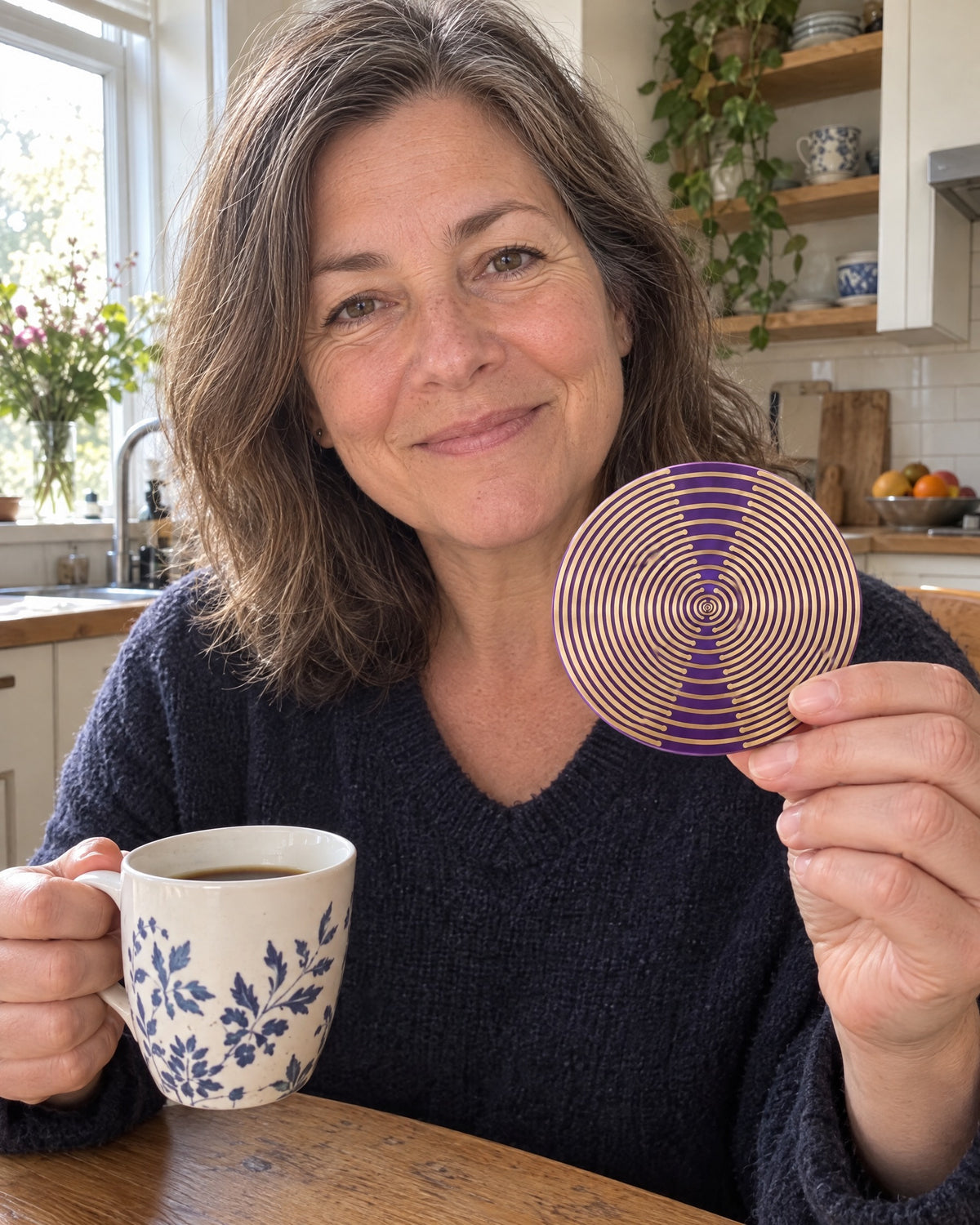
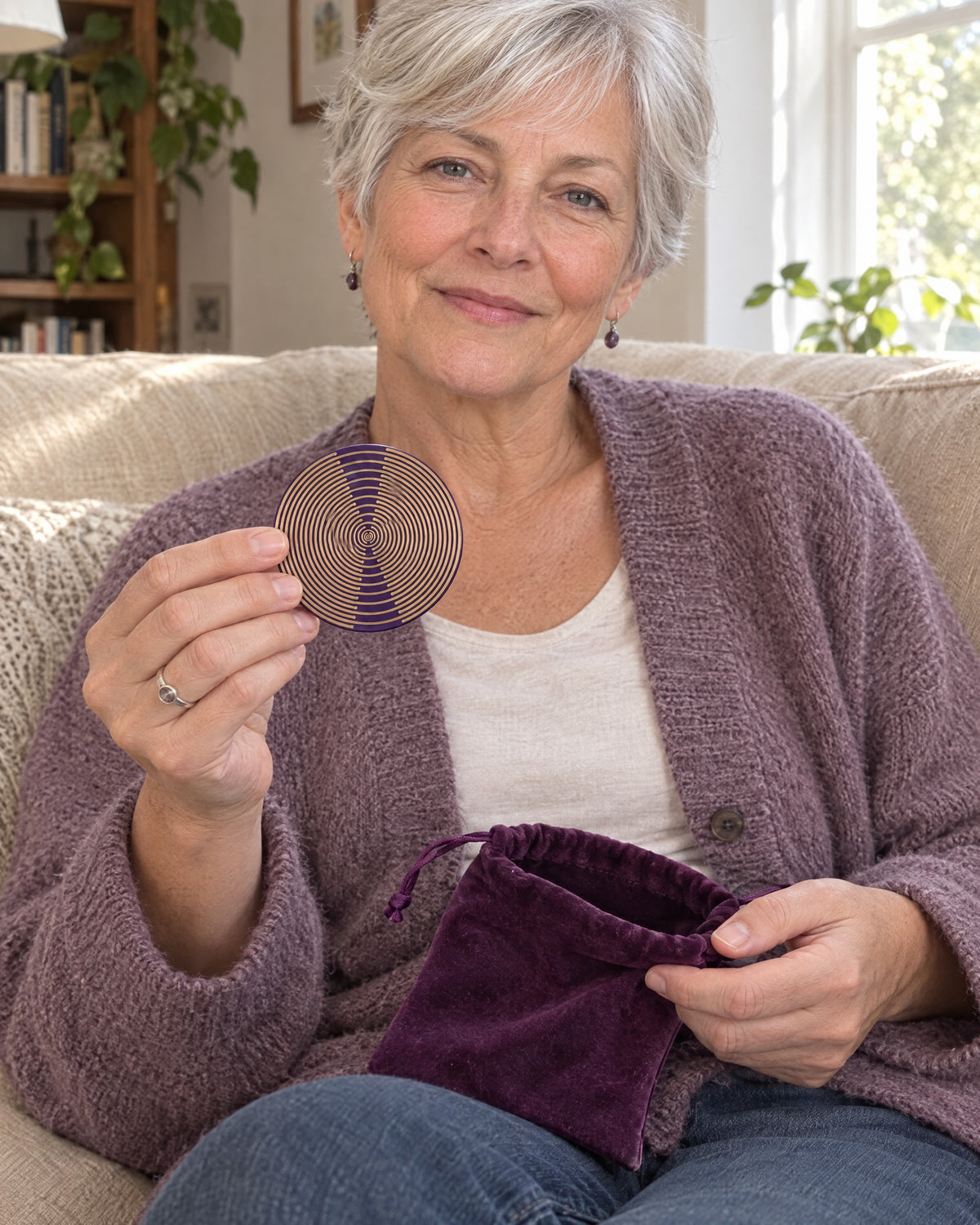
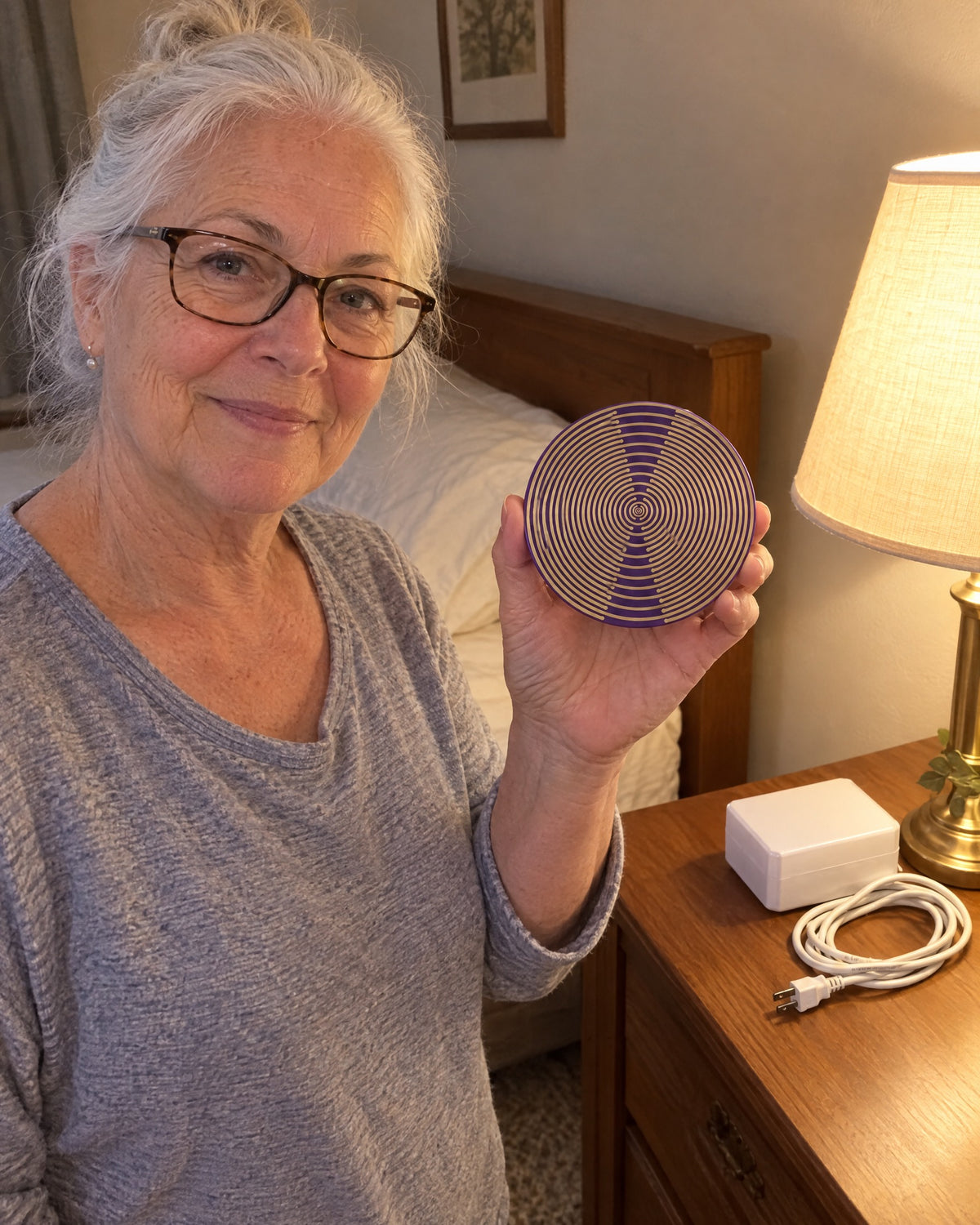
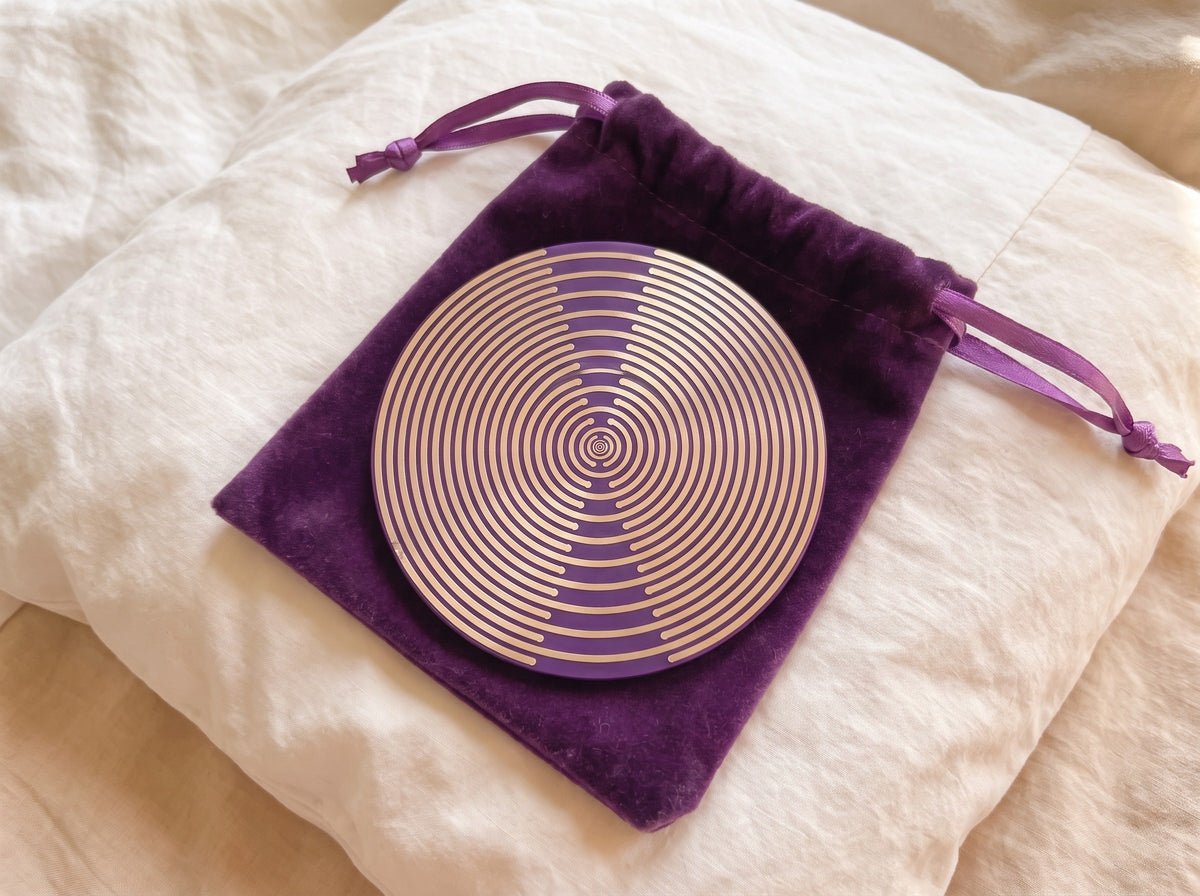
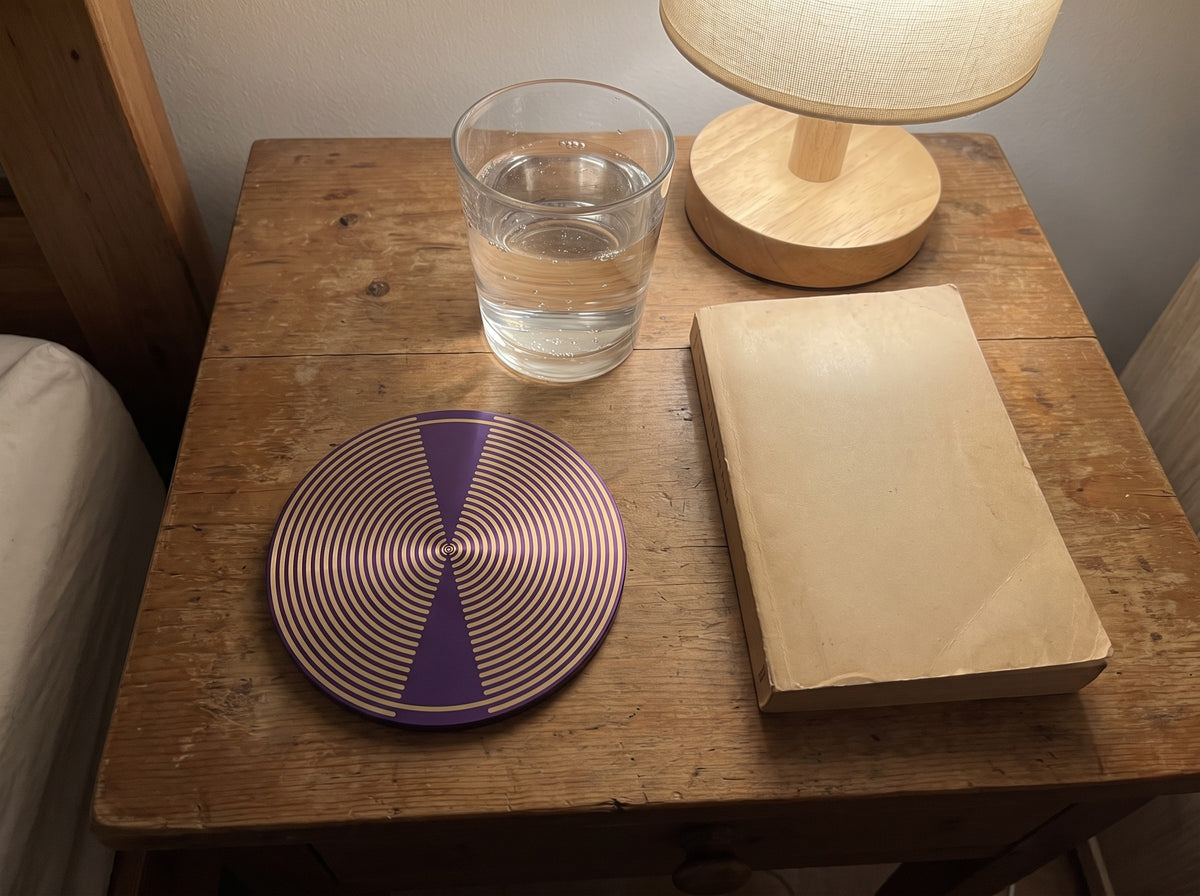
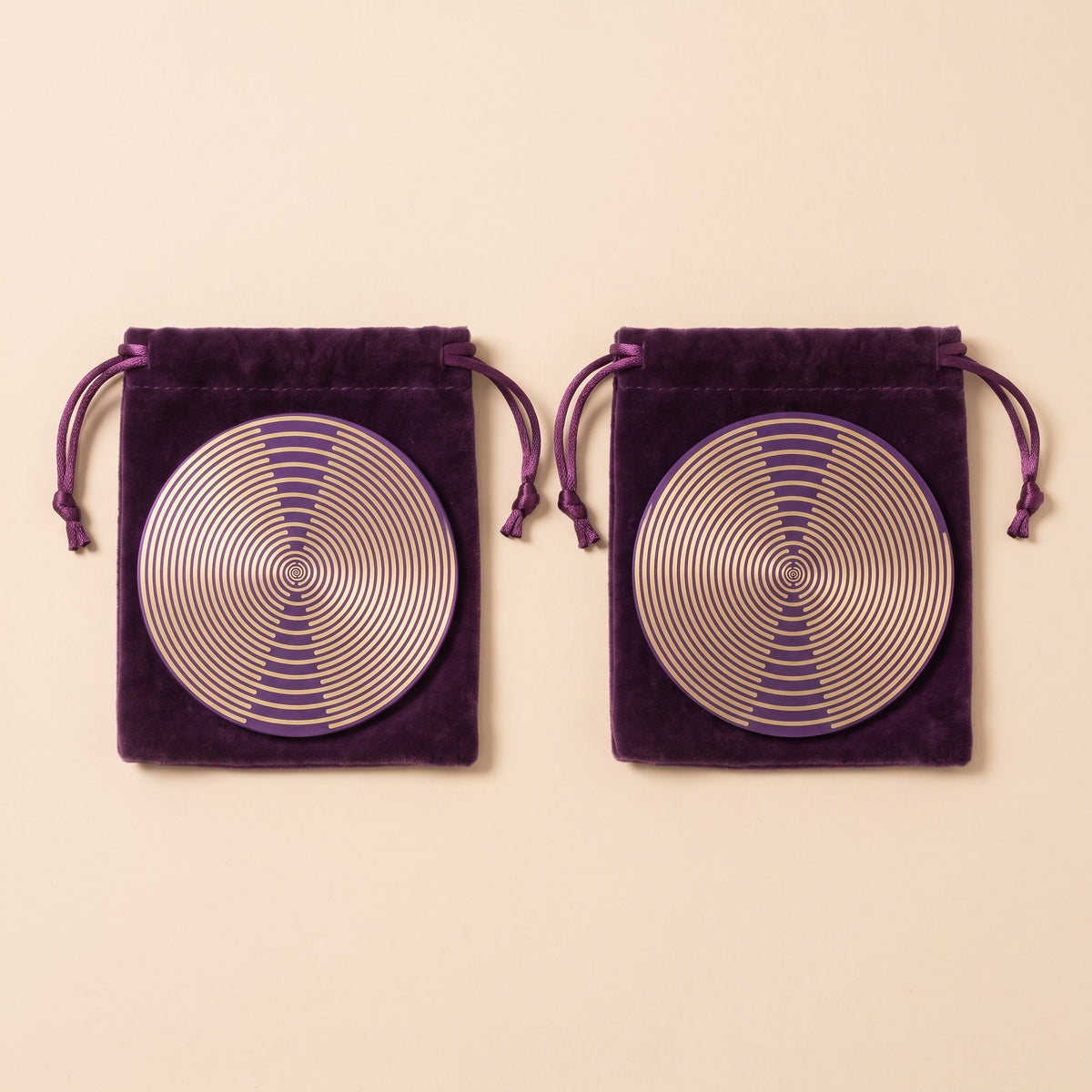
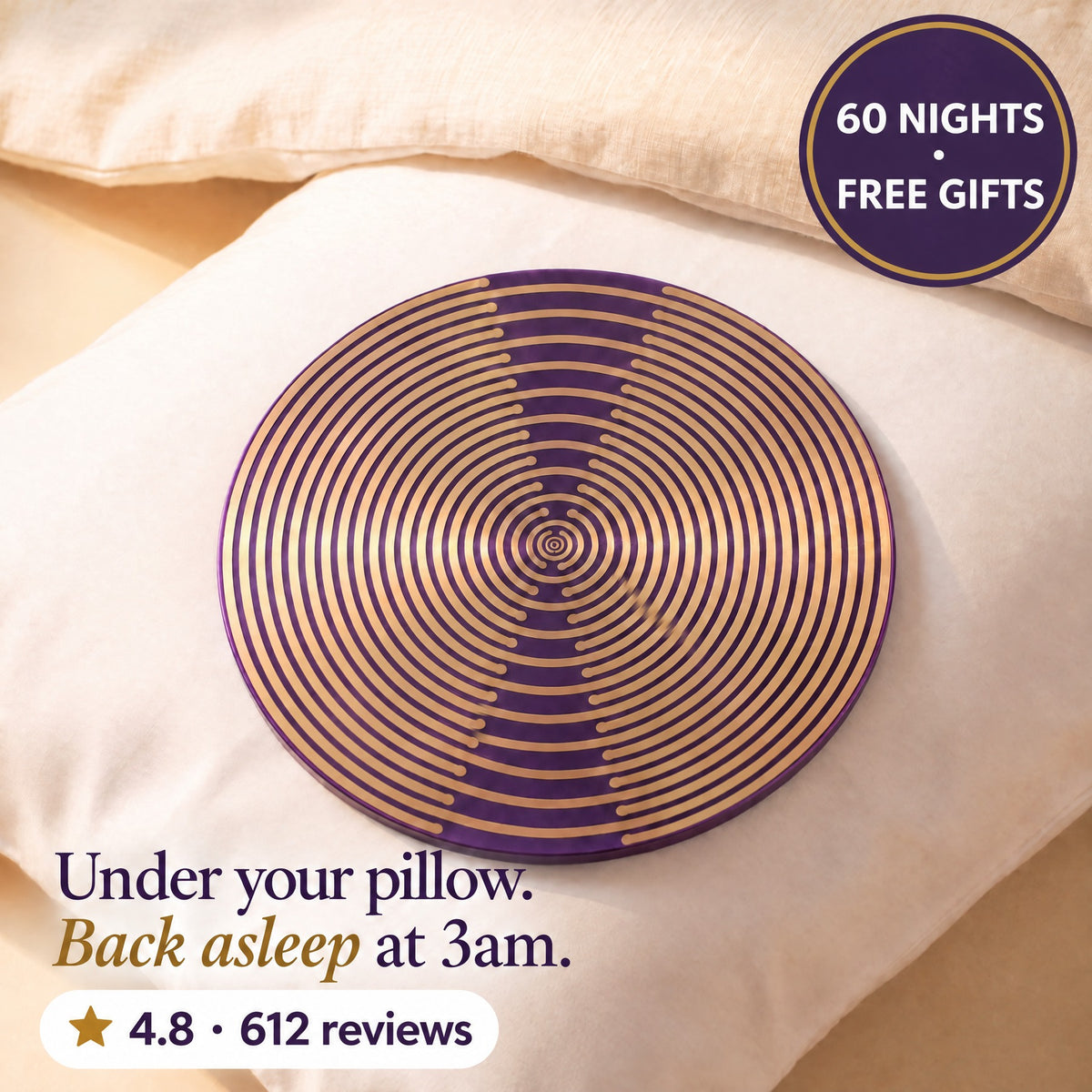
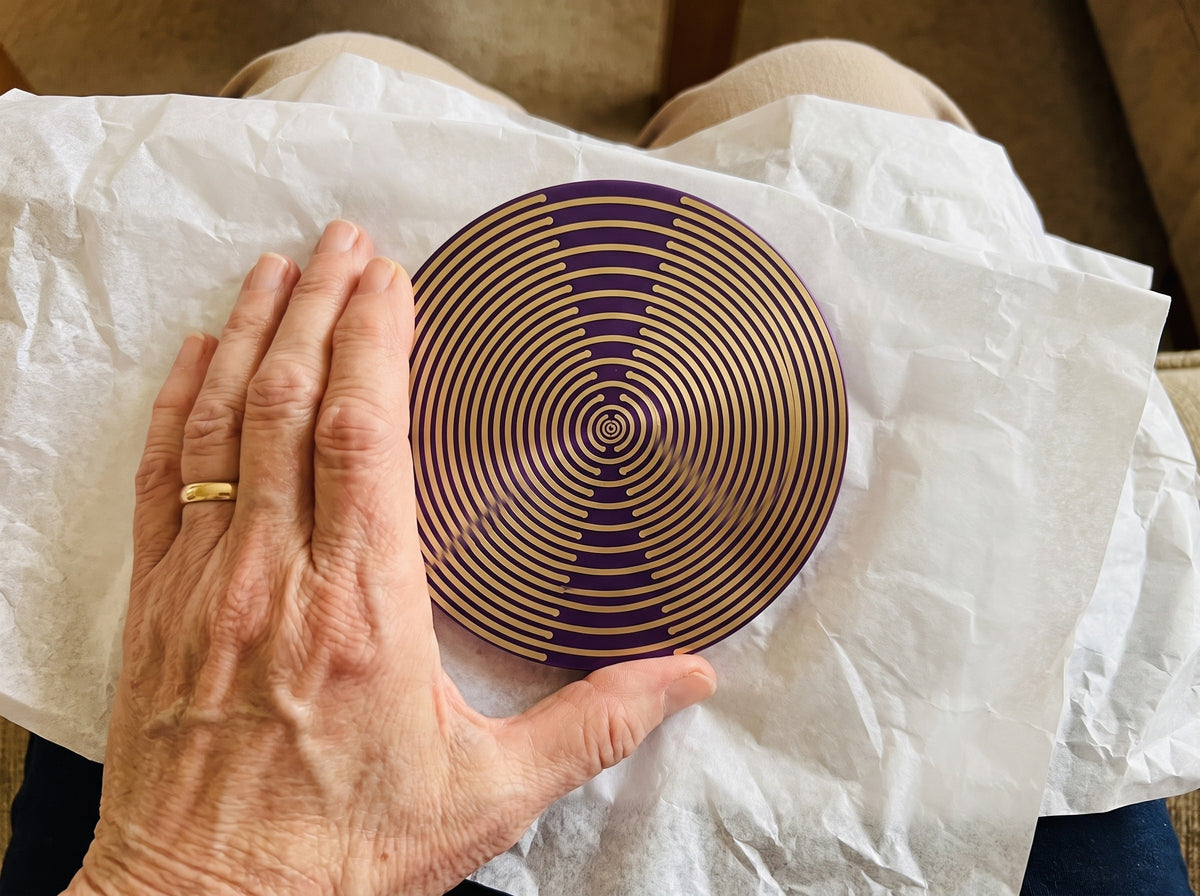
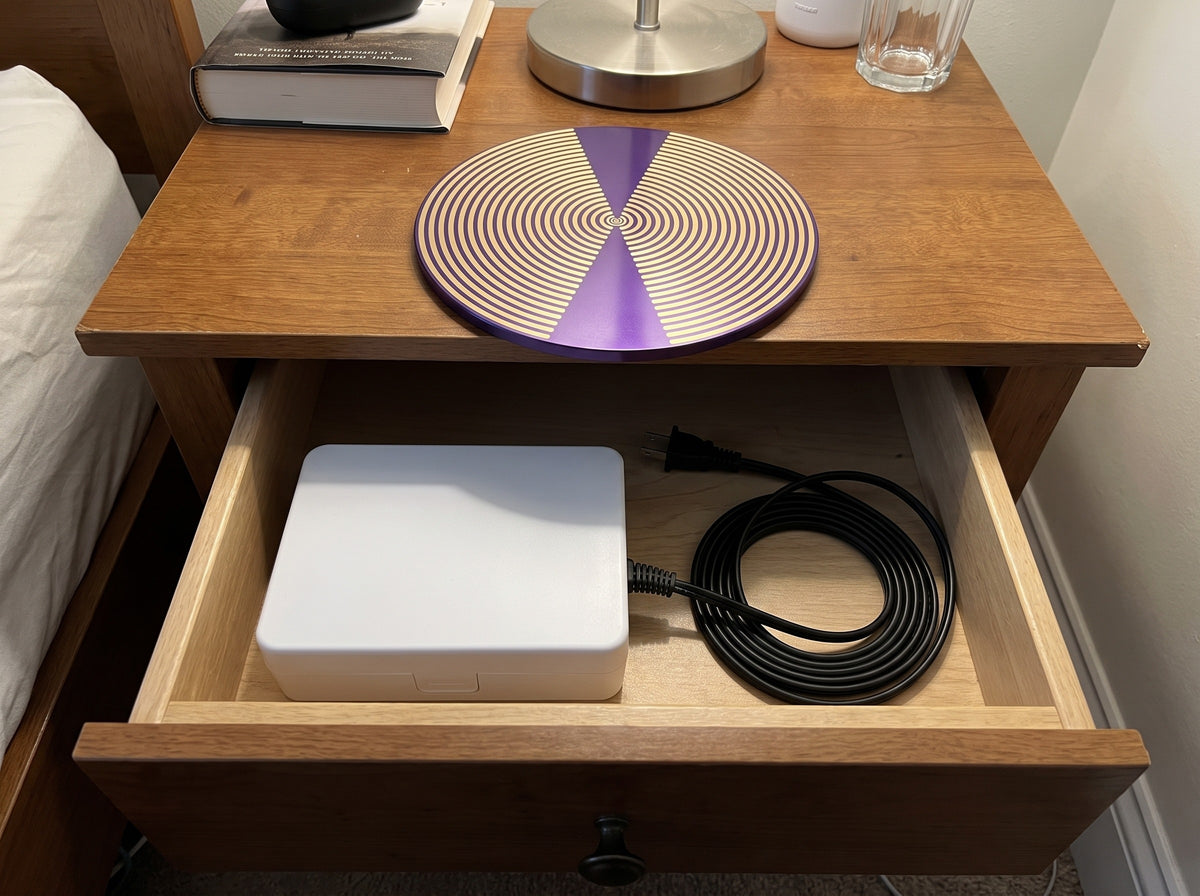
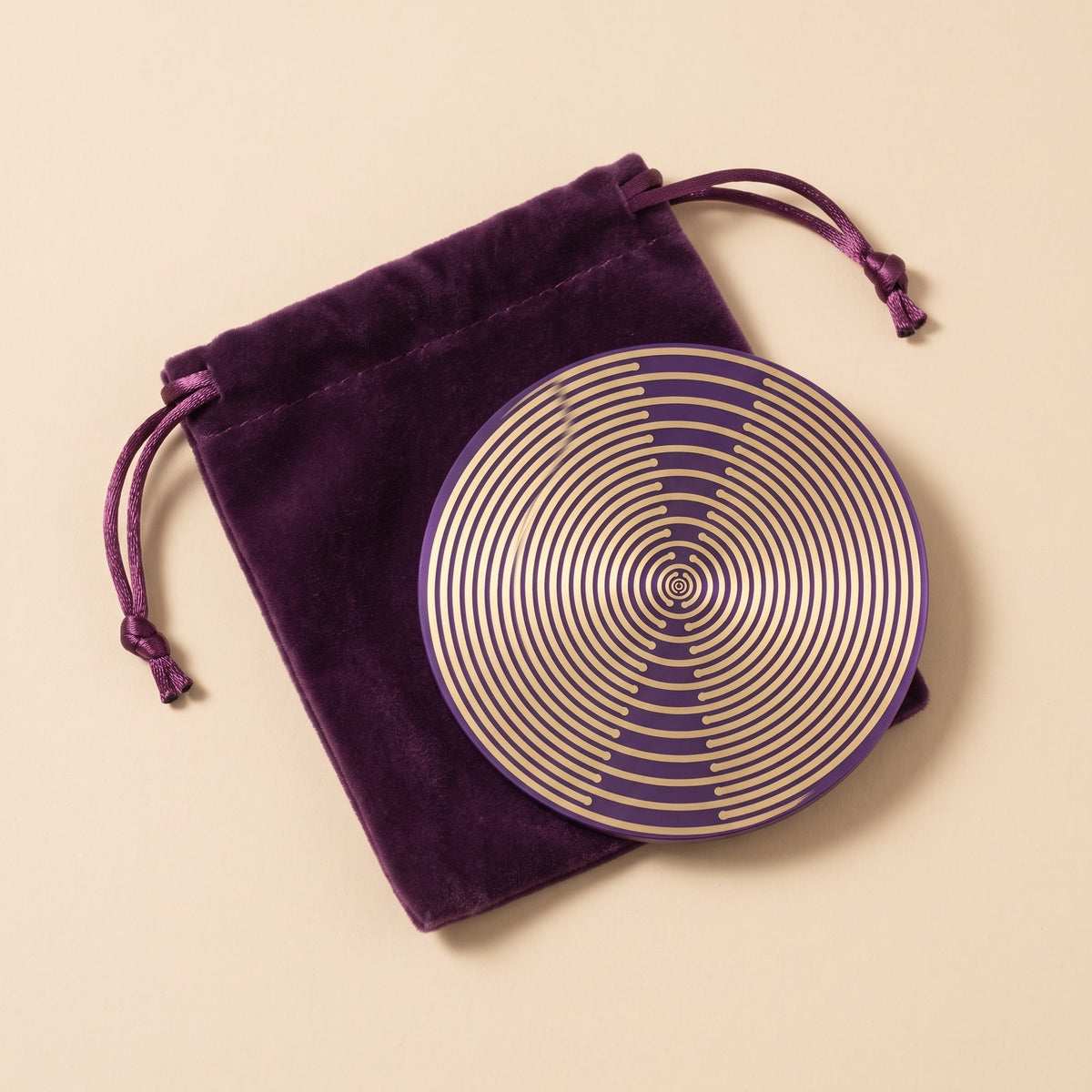
It is a 3.9-inch (10 cm) disc of open copper rings, gold-plated, on a thin fibreglass board, in the ring pattern of Georges Lakhovsky's 1934 patent. It weighs 1.2 oz (35 g). Each ring is open: the purple band cuts it top and bottom, so it never closes on itself and never touches the next one.

It isn't a gadget. No battery, no light, no sound, no app, no Hz menu. It sends nothing out. It is not a medicine and it doesn't replace yours. It goes under your pillow and stays there.

Where to put it

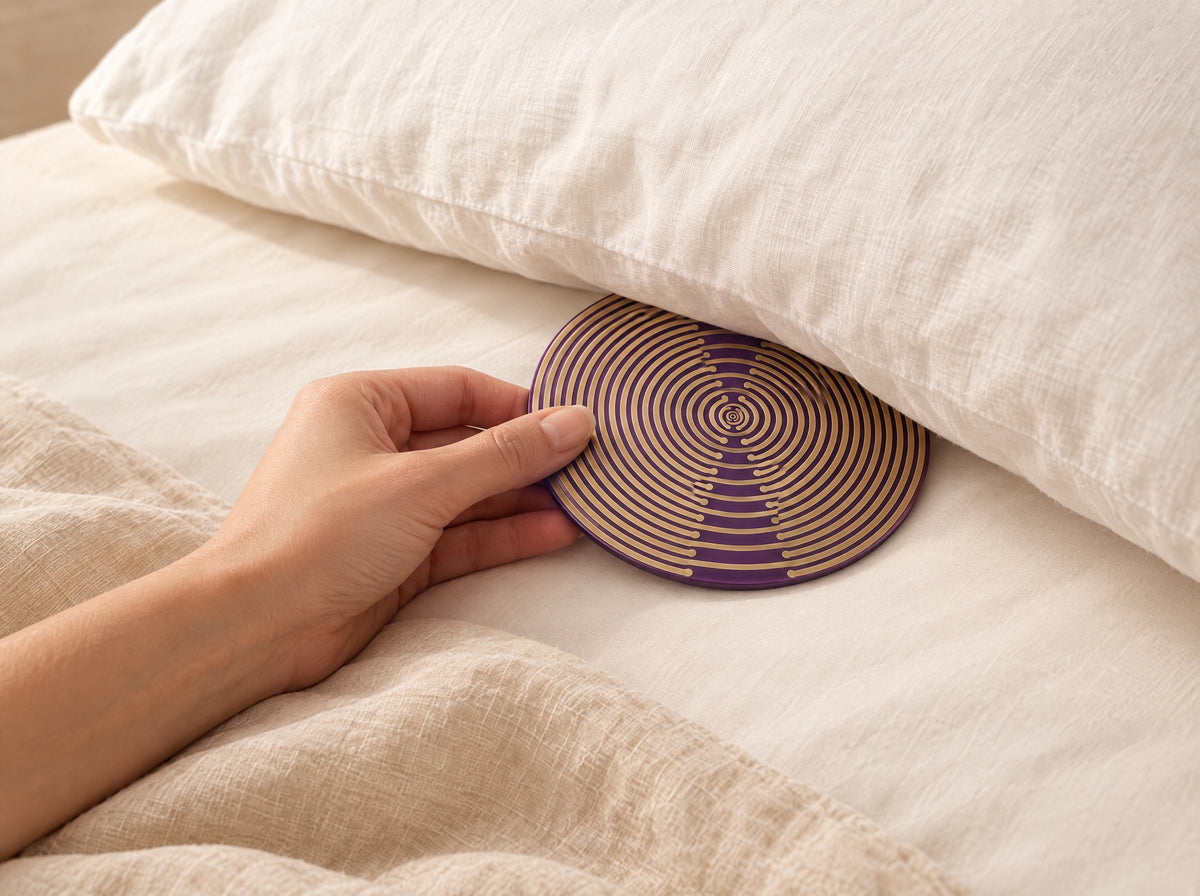
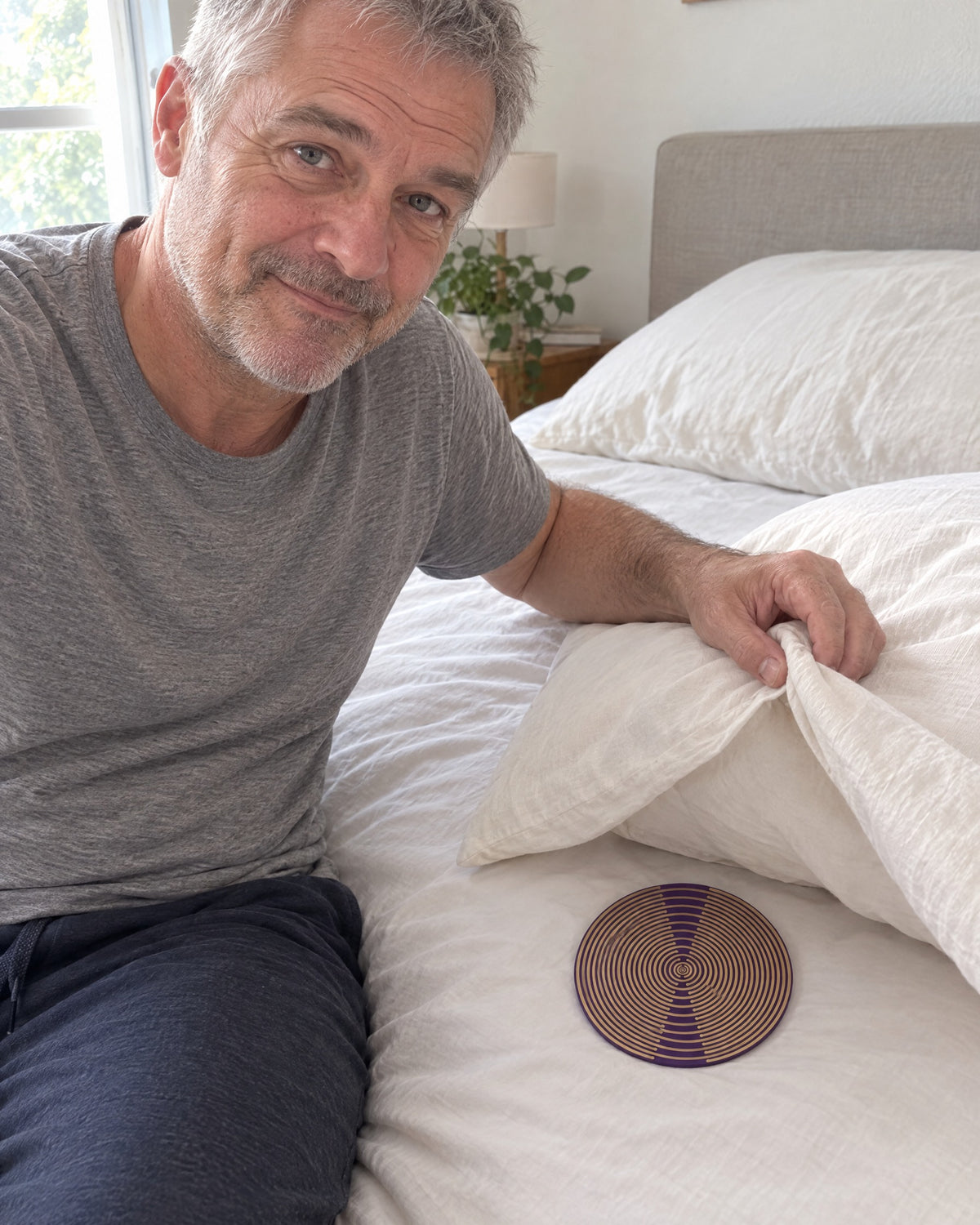
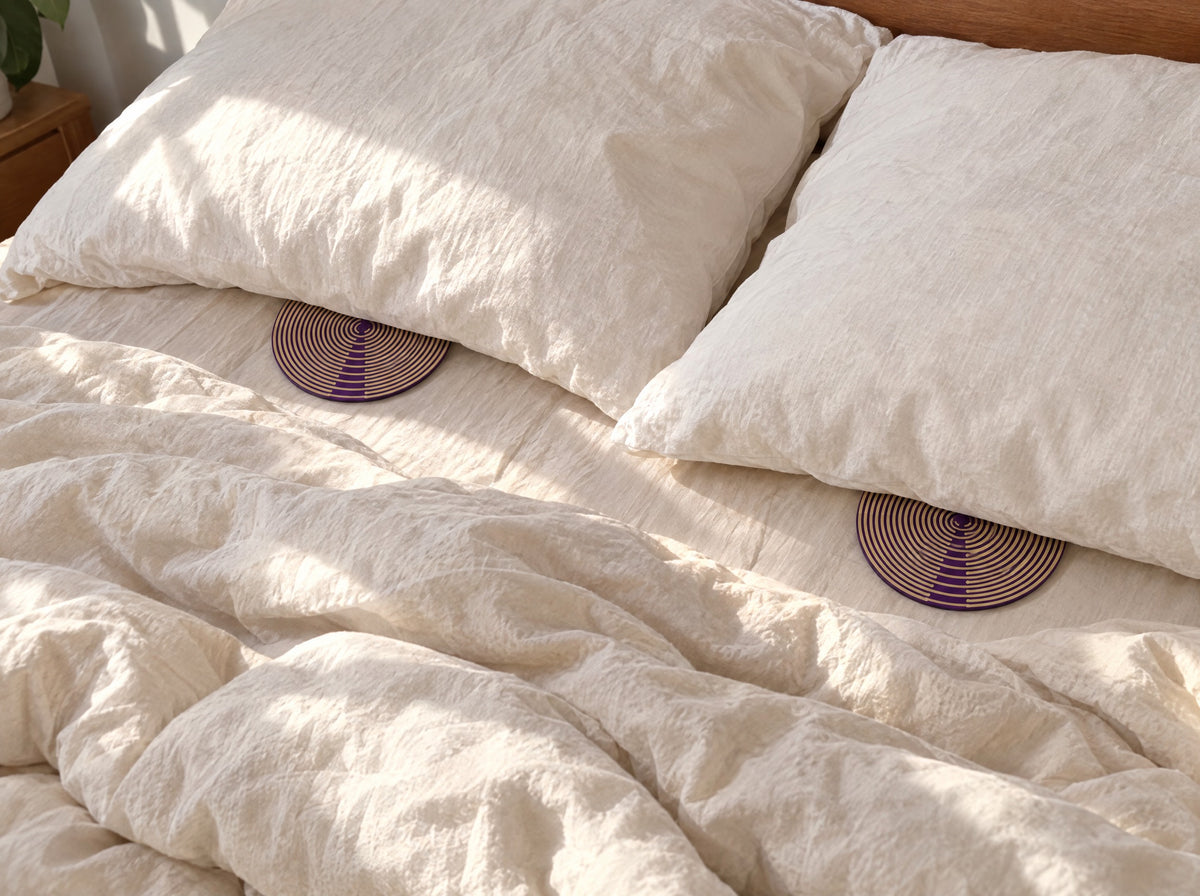
In its pouch, under your pillow, ring side up. Can't sleep with anything under the pillow? Under the mattress edge, level with your head, works the same way. One disc per sleeper. Then leave it alone: no clock check, no charging, nothing to set.

What to expect, night 1 to night 60

Most buyers notice nothing on night 1, and that's normal: there is nothing to feel. What they tell us they notice comes later, and it is usually small first: a wake that ends sooner, a night they didn't check the clock. Keep the 21-night clock diary from tonight. Nights vary (a bad week proves nothing either way), so judge on three weeks, not three nights. You have 60.

What's in the box

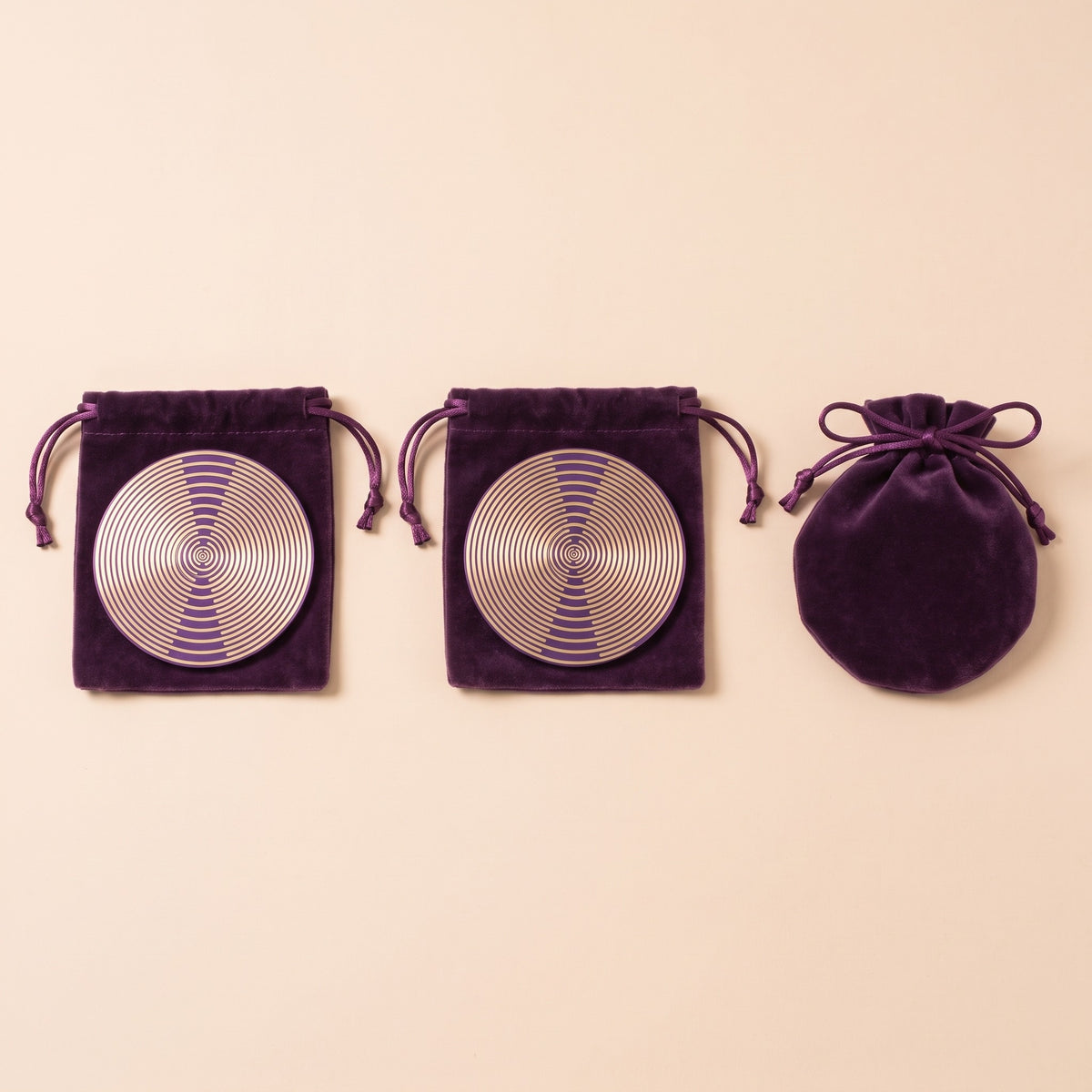
Your discs, each in a soft purple pouch. By email with your order: the "Where to put it" guide, the 21-night clock diary to print, and your gifts (the 3am Field Guide, the Back-Under Audio from 2 discs, the $20 credit with 3 discs).

Shipping, returns, no subscription

At your door in 5-7 business days, with tracking. Free US shipping on 2 discs or more ($5.69 for one). You pay once: no subscription, nothing to cancel. Not for you? Email us within 60 nights: we send a prepaid label and refund every cent, opened or not. The gifts are yours to keep.

Safety and care

Passive and non-magnetic: nothing in it reacts with a pacemaker, a metal bed frame or a mattress. The gold sits on a thin layer of nickel: if you are allergic to nickel, keep it in its pouch under the mattress edge or on the nightstand. Not for children's beds. Keep it away from pets that chew. Wipe with a dry soft cloth; no water, no polish, keep it in its pouch when you travel. It doesn't wear out: nothing to run down, nothing to replace.

WARNING: This product can expose you to chemicals including nickel and tetrabromobisphenol A (TBBPA), which are known to the State of California to cause cancer. For more information go to www.P65Warnings.ca.gov.

No pillNo lightNo cordNothing to chargeNothing to set60 nights to decide

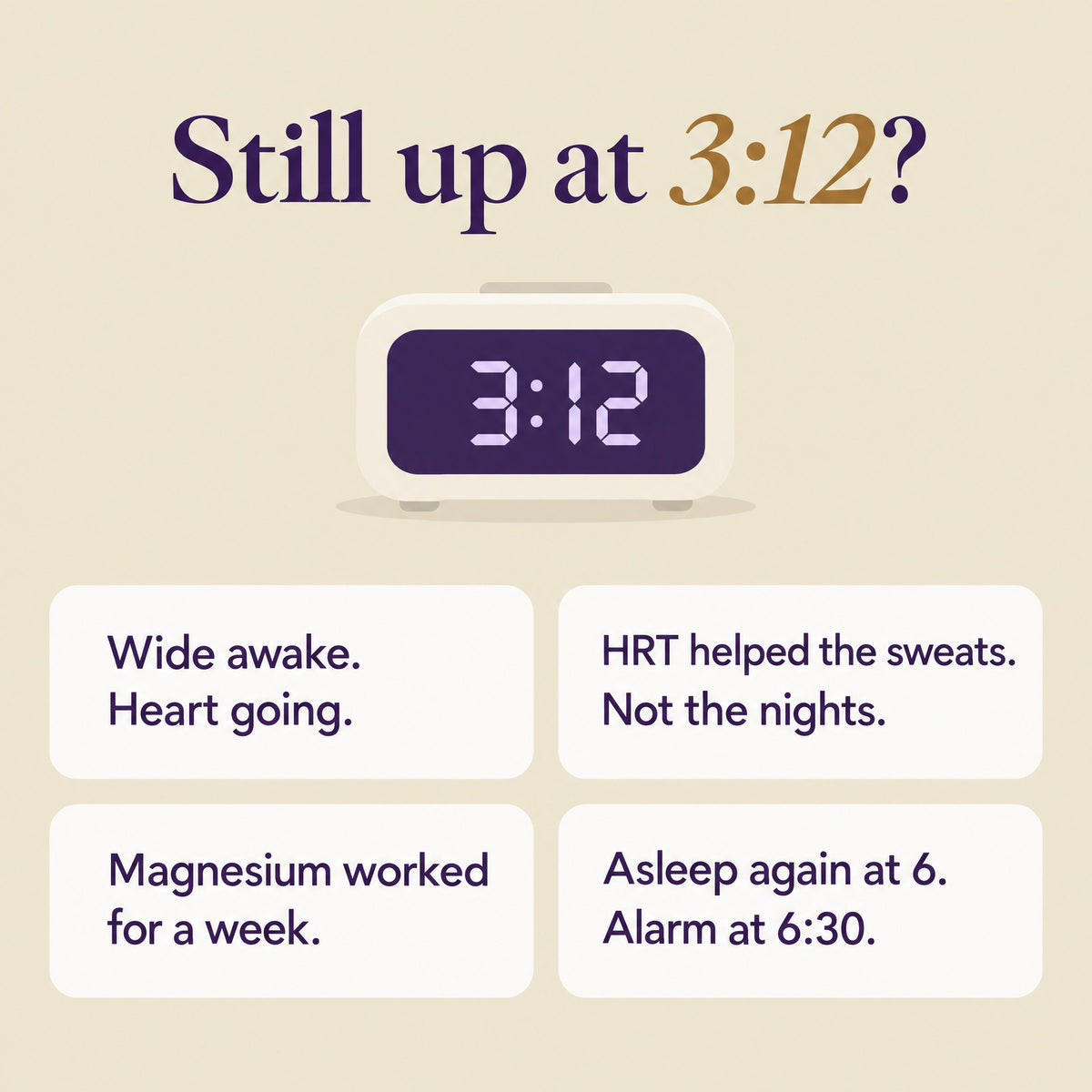
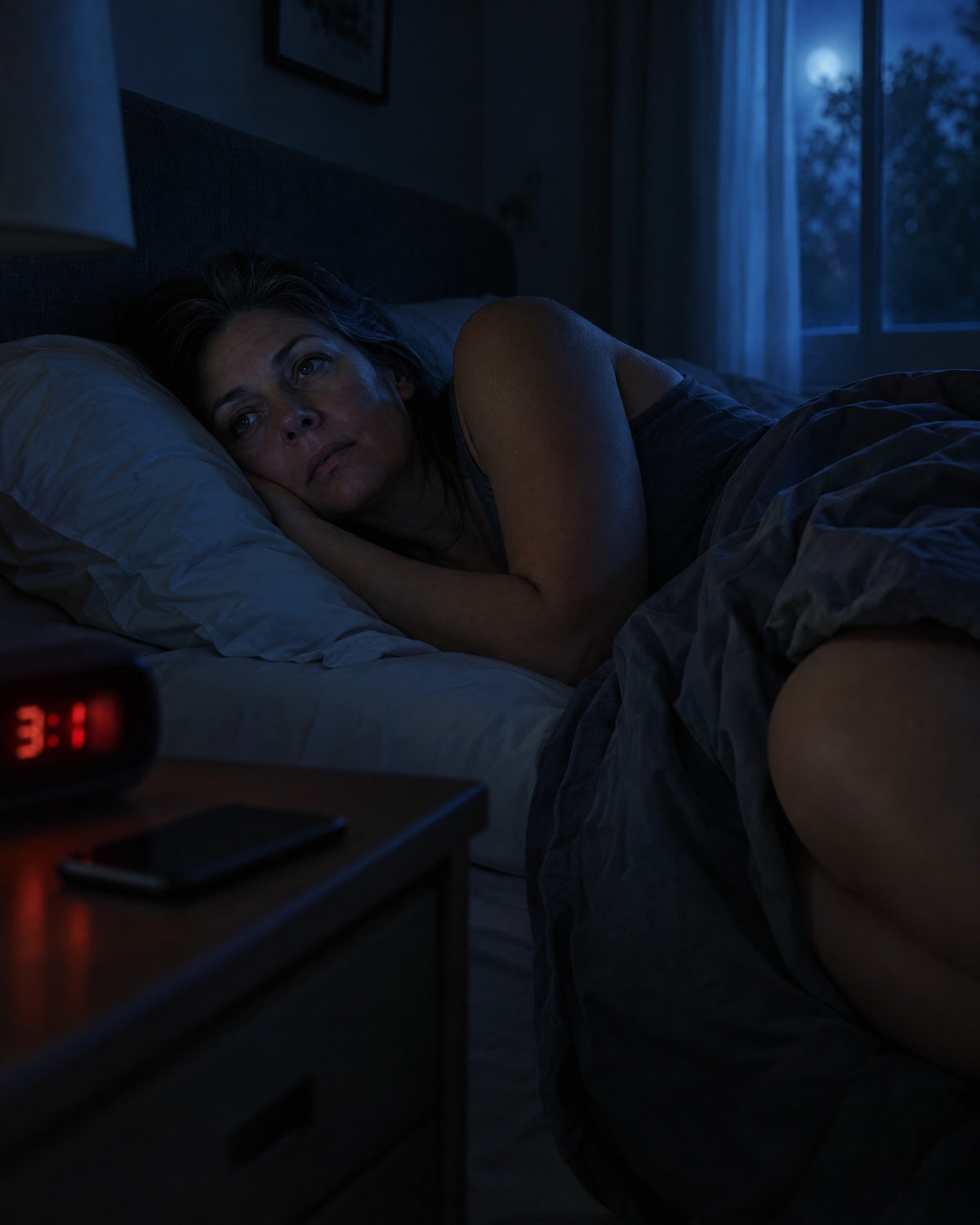
3:12. Again.

You know the moment. Your eyes open, and you're not drowsy. You're awake. Wide awake, the kind where your heart is already going.

You don't look at the clock. Then you look at the clock.

3:12. You do the math. If you fall back asleep right now, you still get three hours. You won't. You'll lie there until 5:40, drift off, and the alarm will go at 6:30.

And somewhere in the dark, a lot of other women are doing the exact same math.

  • "3:10 here. Every. Single. Night."
  • "Who else is up at 3 scrolling this?"
  • "How does menopause know what time it is?"
  • "I thought this was just me."

It isn't just you. And your hormones aren't the whole story.

Falling asleep was never the problem.

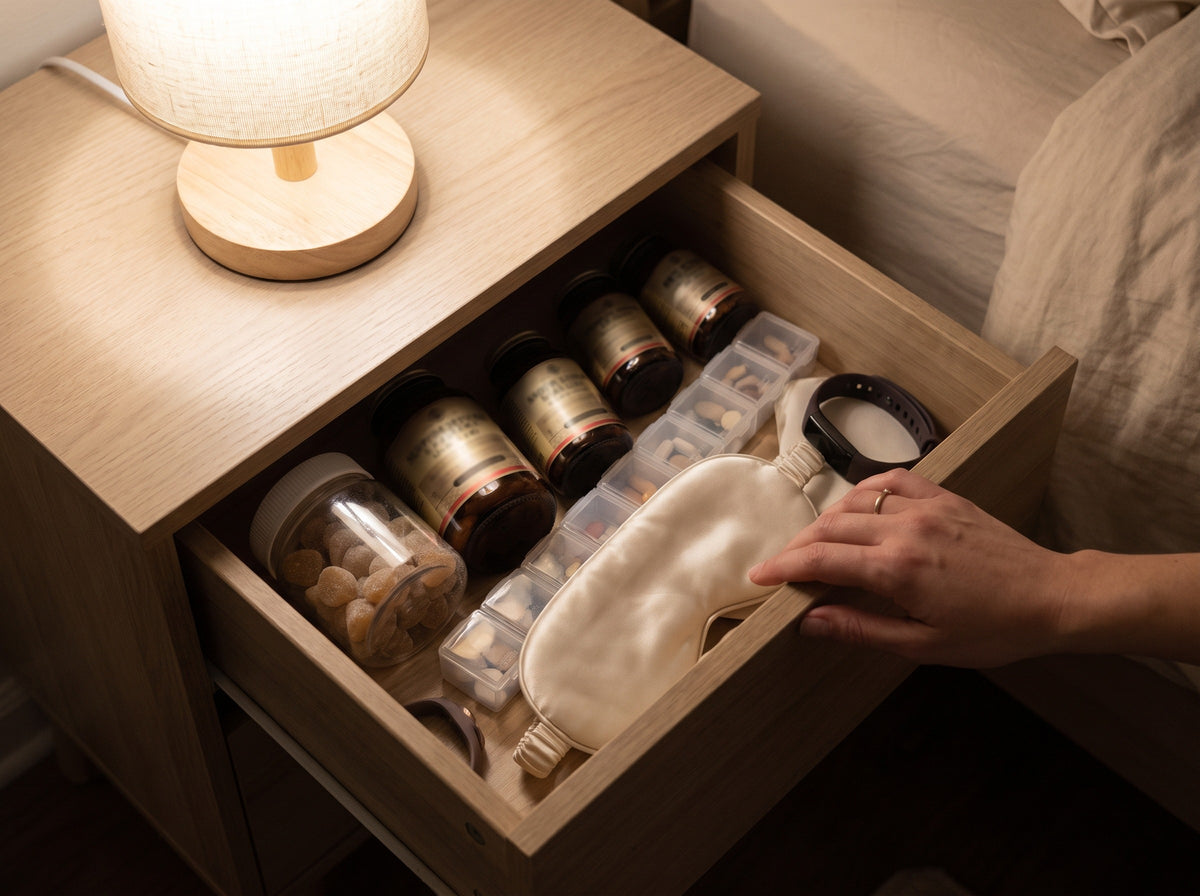
You've tried. You've tried more than most people know. Open the drawer:

  • Melatonin, $9. Gets you to sleep. "Works for like two hours." It was never made for 3am.
  • Magnesium glycinate, $24. Takes the edge off at bedtime. Then 3:10, like clockwork.
  • A cortisol blend, $90 a month. Built on the "3am cortisol spike". At 3am your cortisol is near its lowest and only starting its slow morning climb.
  • HRT or progesterone. It did its job on the sweats, and for a lot of women it helps sleep too. For you, the nights stayed. ("HRT has helped my other symptoms, but hasn't done a thing for my sleep.")
  • A frequency box, $79.95. Hums all night. A blue light you cover with a towel. A cord across the nightstand.
  • A grounding sheet, $99. Another cord, to the wall, and a sheet to wash.

That's more than $300 on the nightstand, and you're still up at 3.

And if you're one of the women who can't take hormones (after breast cancer, a clot, the wrong heart pills), you've heard "have you tried HRT?" more times than you can count. This page isn't going to ask you that.

Here's what no bottle in that drawer was built for: falling asleep is one problem. Staying asleep at 3am is a different one. Everything in the drawer works at bedtime, or by forcing sleep, or for a week. None of it is there at 3:12, when one ordinary wake decides to stay open.

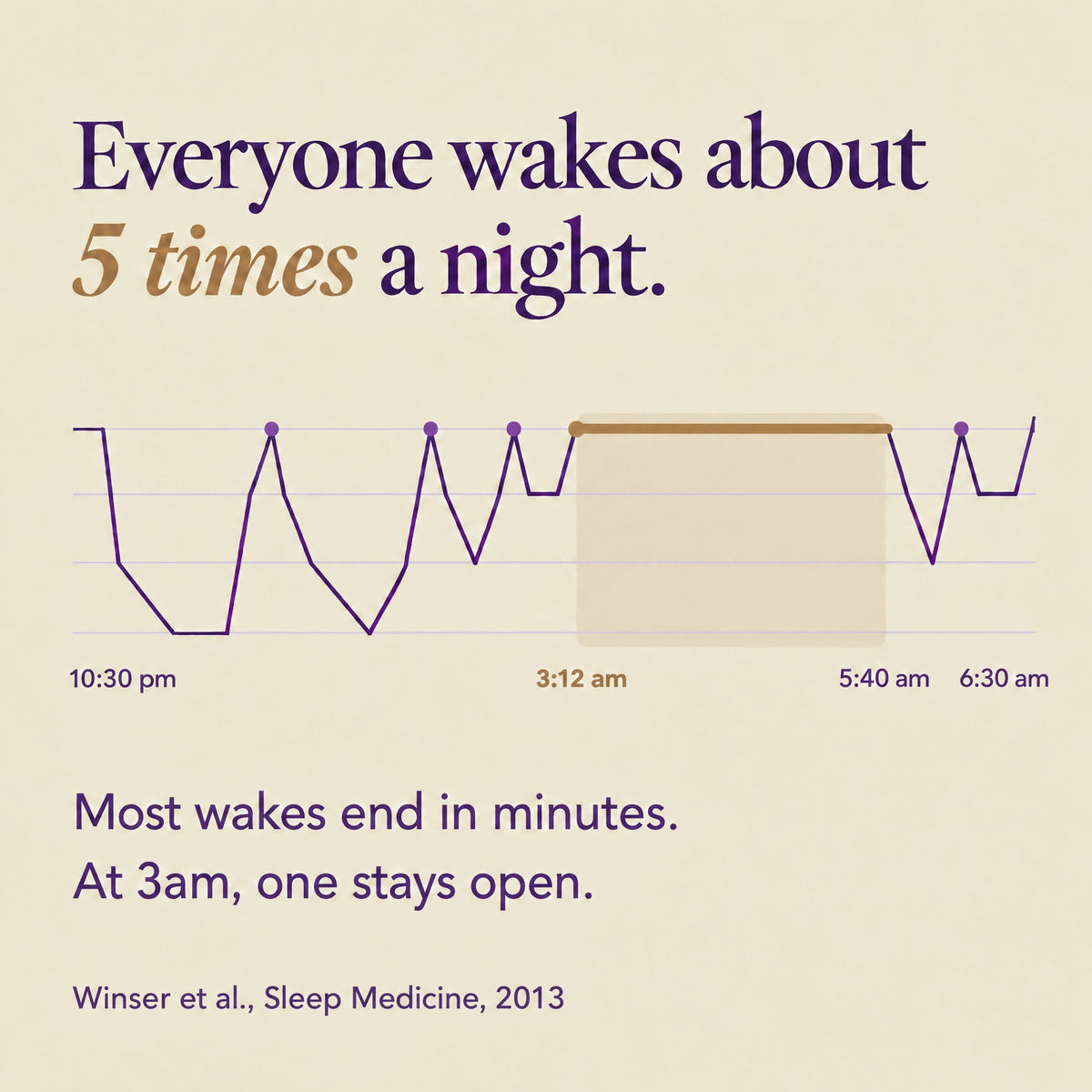
Everyone wakes. Your wake stays open.

  • 10:30 pm: asleep
  • Deep sleep, front-loaded: the first third of the night
  • Five short wakes: most last under 5 minutes and are forgotten
  • 3:12 am: the lighter half of the night. One wake stays open.
  • 5:40 am: back to sleep
  • 6:30 am: the alarm

Everyone wakes about five times a night, between sleep cycles, and forgets nearly all of it. A wake has to last about four minutes before you remember it. 1

After 2am, your sleep is lighter. Deep sleep is spent early; the second half of the night is lighter, and a wake is easier. 2

What you do in the first minutes decides the rest. Checking the clock makes people worry more and lie awake longer; 3 a screen's light at night cuts melatonin by more than half. 4

At 3am, the waking often comes first, and the heat after. In a sleep lab, flashes woke women in the first half of the night; in the second half it was the other way round: the wake came first. 5

And the "3am cortisol spike"? Your cortisol is near its lowest in the small hours and starts a slow climb toward morning. It doesn't jump when you wake. 6

So the 3am wake isn't a failure of your hormones, or of you. It's an ordinary wake, at the lightest hour of the night.

An ordinary wake ends on its own when nothing holds it open. The clock holds it open. The phone's light holds it open. Trying hard to sleep holds it open. Another pill can't reach any of that.

What you need at 3:12 isn't one more thing to take, check or switch on. It's something that's already there, under your pillow, and asks nothing of you at all.

That's the disc.

A small thing. Exactly what it is.

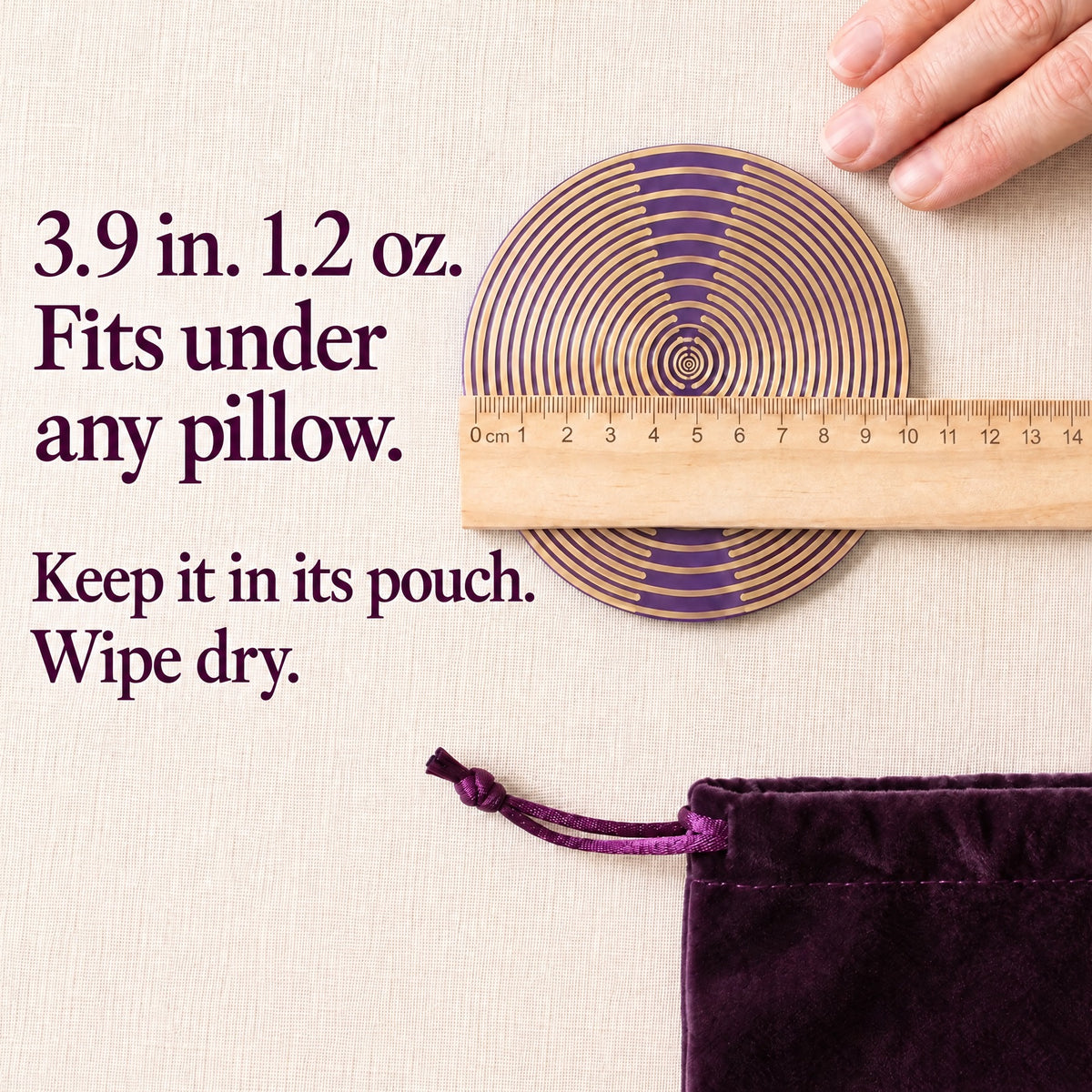
  • 3.9 inches (10 cm) across
  • 1.2 oz (35 g)
  • open copper rings, gold-plated, on a thin fibreglass board
  • no battery, no light, no cord, no app
  • About twenty open copper rings, one inside the other, each one cut by the purple band, top and bottom, so it never closes on itself.
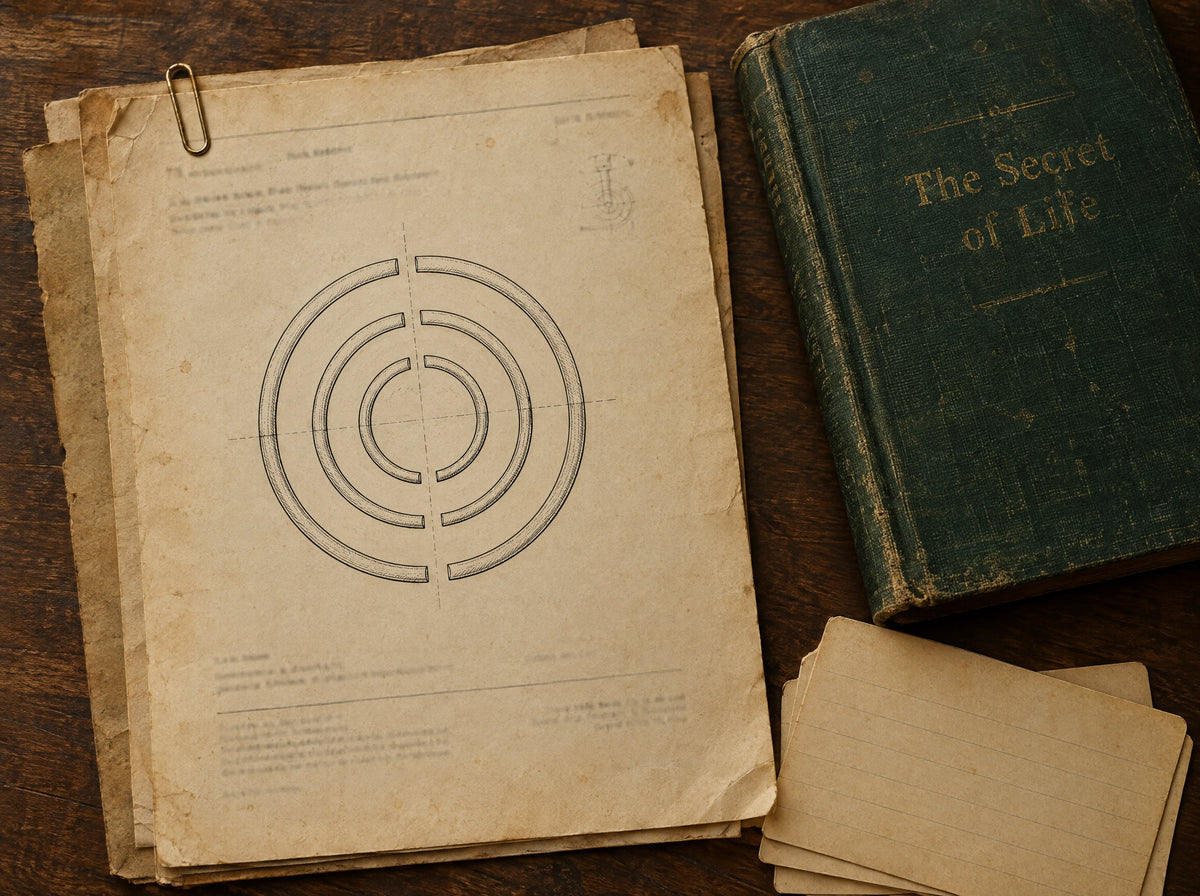
  • Every ring insulated from its neighbour, exactly as Lakhovsky's patent asked: "concentric open rings, maintained insulated".
  • Gold over the copper, so it doesn't tarnish under a pillow.
  • Thin and flat: under a pillow, you can't feel it.
  • Not a transmitter. It sends nothing out, makes no sound and has no setting.
  • Not a "frequency generator". There's no Hz menu, no Schumann, no 528.
  • Not a medicine, and never instead of yours. Keep your HRT, your progesterone, your prescriptions.
  • Not magic. It's a passive antenna, a design from 1934, placed where you sleep.

Yes, it's a circuit board. You may find a disc like it online for $9. Here's the honest version: a fibreglass board with copper rings is the most precise way to make what the 1934 patent describes, open rings held apart and insulated. The $9 disc is the same idea without the pouch, the guide, the diary, the 60 nights and anyone to answer your email. If that's all you want, buy that one. If you want to try it properly, with a trial and a way to tell if it's working, that's what you get here.

The engineer medicine forgot.

In January 1925, an engineer in Paris named Georges Lakhovsky placed a ring of copper around a sick geranium: a single open spiral, its two ends not joined, held on an insulating stand. He wrote down what happened next, and spent the rest of his life on open rings.

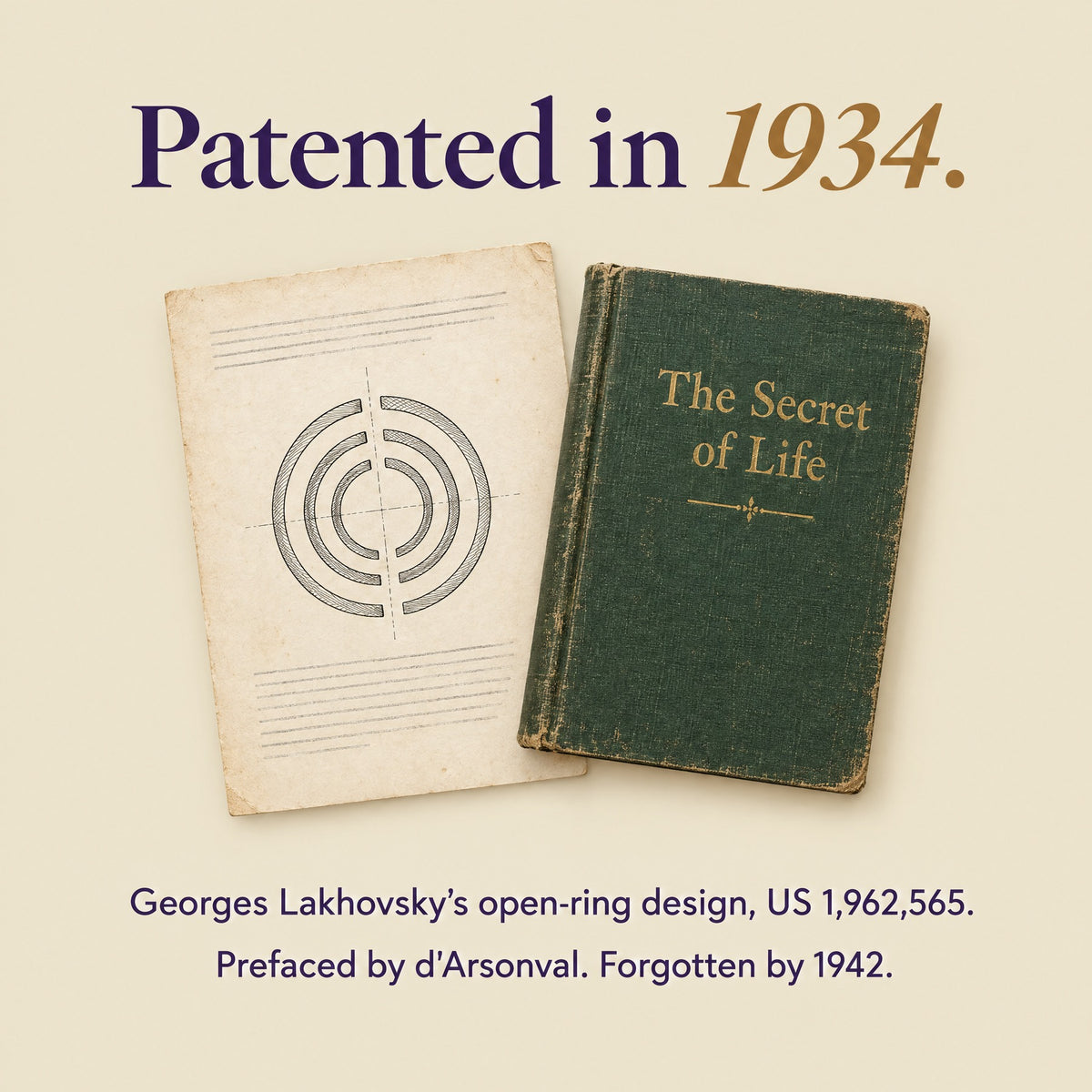
In 1929 he set out his theory in a book, The Secret of Life: that every living cell behaves like a tiny oscillating circuit. Arsène d'Arsonval, the father of medical electricity, wrote its preface. In 1934 the US Patent Office granted him patent 1,962,565 for his open-ring design. Nature reviewed the English edition in 1940.

That same year he fled France, through Lisbon, to New York. He died there in 1942, hit by a car, his work unfinished. Medicine moved on; his rings were left to hobbyists.

We don't ask you to believe his theory. We tell you what he wrote, what he built, and what you can check with your own clock.

"In scientific research it is advisable to encourage what appears to be the most daring ideas." Arsène d'Arsonval, preface to The Secret of Life

Medicine called his theory a hypothesis, and it still does. The disc is his ring design, made precisely, put where you sleep. The proof that matters is your own nights, and you get 60 of them.

Under the pillow. Then forget it.

  1. 1Slip it into its pouch.The pouch keeps the gold clean and the edges soft.
  2. 2Put it under your pillow, ring side up.Or under the mattress edge, level with your head, if you'd rather nothing under the pillow.
  3. 3Leave it.Nothing to charge, set or switch on. When you wake, don't check the clock: your hand already has nothing to do.

One disc per sleeper. When she's up at 3, he usually is too, and a disc under one pillow is a disc under one pillow. That's why most people take two.

Wipe it with a dry soft cloth. Keep it in its pouch when you travel. Nickel allergy: keep it in the pouch, under the mattress edge or on the nightstand. Not for children's beds.

Don't trust us. Trust your clock.
  1. Night 1.Nothing to feel, nothing to do. Most people sleep exactly as before."I kept waiting for something to happen. Then I fell asleep waiting." Pam R.
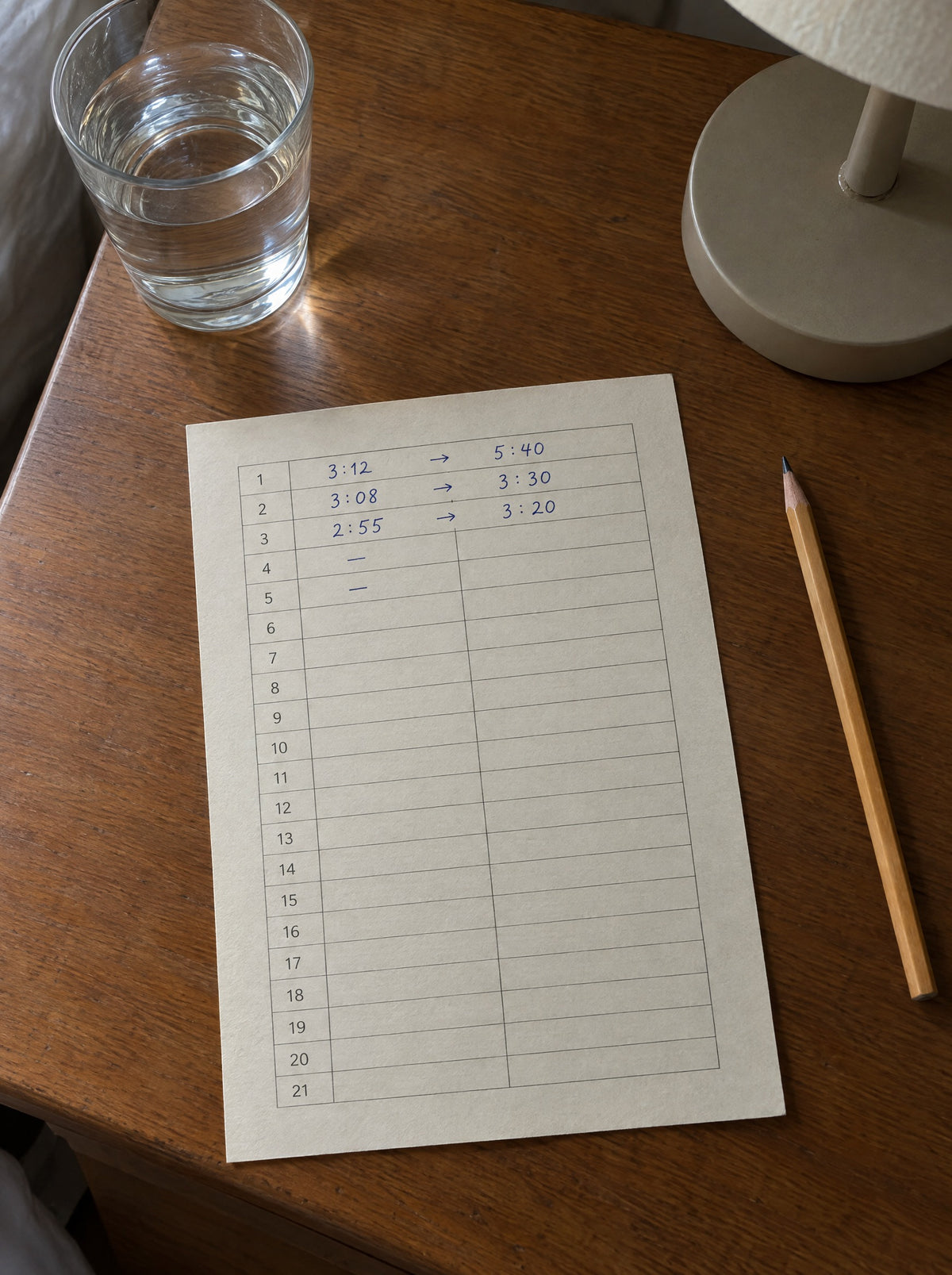
  2. Week 1.Still waking, often at the same time. Some notice the wake is shorter."Woke at 3:08 like always. Back under by 3:30, which never happens." Debbie K.
  3. Week 3.The diary starts to show it: fewer long wakes, a night or two with none."My diary went 3:12, 3:40, 2:55, then two blank nights. I cried a little." Sharon T.
  4. Night 60.You decide, with three weeks of your own handwriting in front of you. Keep it, or send it back on us.

Nights vary with stress, travel and cycles. Everyone's are different, and some people notice nothing. That's what the 60 nights are for.

Print the 21-night clock diary we email you. Every morning, write two times: when you woke, and when you were back asleep (a guess is fine). Keep the bad nights in. After three weeks, look at the column, not at last night.

Start my 60-night trial

60 nights on your own pillow, or we pay the return and refund every cent.

On HRT, off HRT, and him.

"I'm on HRT. The sweats stopped. 3am didn't. This is the first thing that changed that." Joanne, 54

"I can't take hormones after my cancer. I needed something that goes nowhere near my body." Maria, 61

"I put one under her pillow and one under mine. I'm the one sleeping through now too." Rick, 59

"I had a frequency box for a year. This does the same job without the light and the hum." Gail, 66

He didn't know it was there.

"I didn't tell my husband. I put one under his pillow because he's up when I'm up, and he thinks all of this is nonsense. Ten days later he said, 'I've been sleeping better, have you noticed?' I lifted his pillow and showed him. He went quiet, then asked if we could get one for his brother." Carol D., 58, Ohio

When she's up at 3, he's up at 3. That's why the pair is called Both Sides of the Bed.

  • 87 %still sleep with it under the pillow at night 60
  • 74 %say they get back to sleep sooner
  • 81 %have bought, or would buy, one for someone they love

Survey of 214 buyers at night 60, 2026. Self-reported.

Try it for 60 nights

60 nights on your own pillow, or we pay the return and refund every cent.

Why one more pill won't fix 3am.

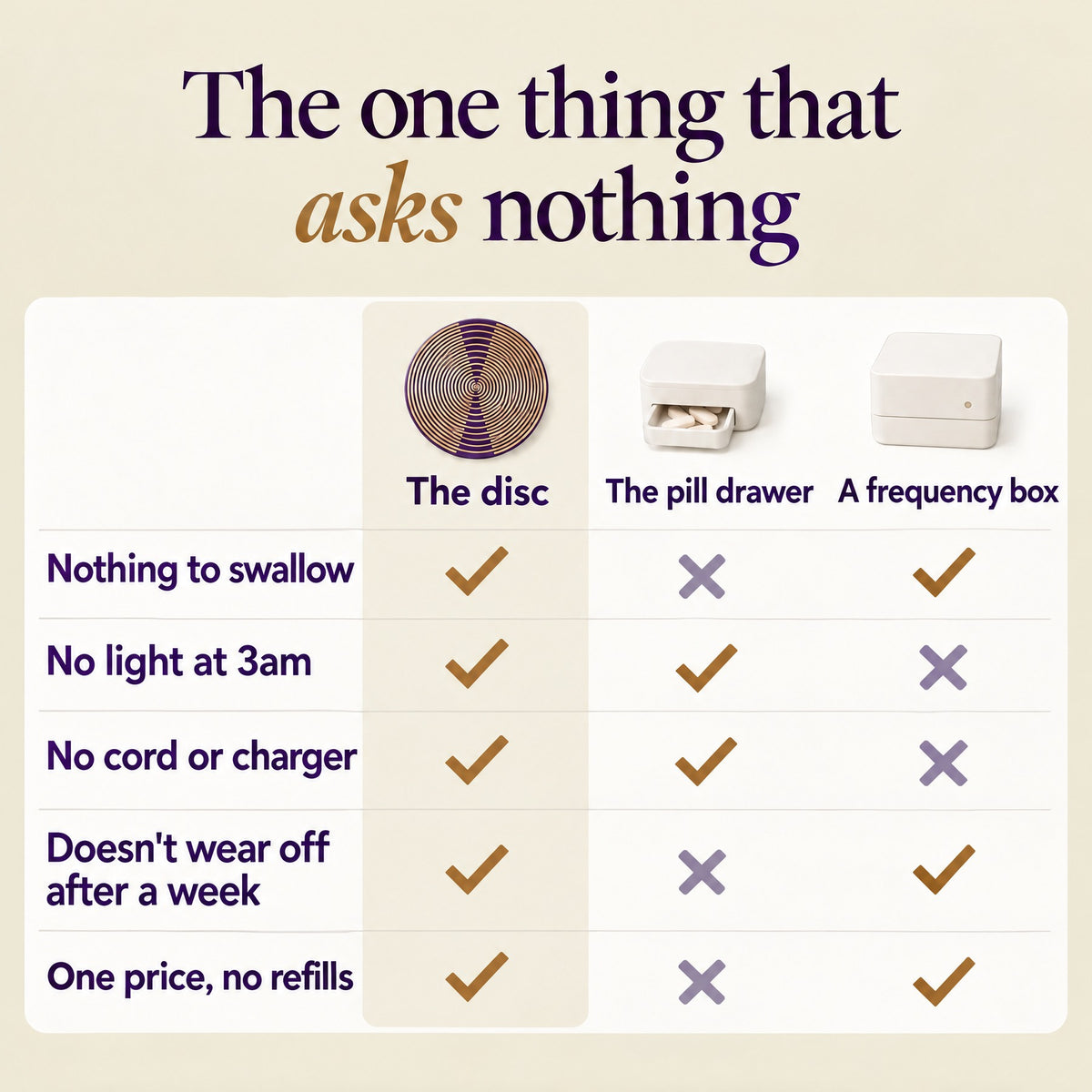
The Lakhovsky DiscThe pill drawerA frequency boxA grounding sheet
Nothing to swallow✓Something every night✓✓
Nothing lit up at 3am✓✓A light you cover with a towel✓
No cord, nothing to charge✓✓Plugged in all nightA cord to the wall
Still there at 3am, week after week✓Often wears off in a week✓✓
Beside your treatment, never instead✓Can interact with it✓✓
One price, nothing to refill$49 once$25-90 every month~$80~$99, plus washing

$49 once is 13 cents a night over a year. A month of a cortisol blend costs $90, and you buy it again in four weeks.

Start my 60-night trial

60 nights on your own pillow, or we pay the return and refund every cent.

Dr. Ruth Calder, DNP

Certified menopause practitioner · 22 years in women's health

"Half my patients on HRT tell me the hot flashes are better and the nights aren't. I never tell them to stop their treatment. I tell them the 3am wake is often a sleep problem as much as a hormone one, to stop checking the clock, and to keep anything at the bedside that adds nothing to their medicine cabinet. A disc under a pillow adds nothing. If it helps them stay asleep, good."

Spirad, rated by its customers:

  • 4.3Trustpilot
  • 4.6Google
  • 4.4Facebook
  • 4.9spirad.com

612 women, one 3am.

★★★★★

"On HRT for two years. First time 3am didn't win."

"The patch fixed my sweats and my mood. Not my nights. I put this under my pillow in July and I didn't tell anyone. Week three I realised I'd stopped knowing what time I woke up."

Joanne P., 54On HRT
★★★★★

"Nothing to swallow. That was the whole point."

"After my cancer every answer was 'HRT' and I can't. This goes under a pillow. I still wake some nights, but I'm back asleep before I start worrying."

Maria L., 61Can't take hormones
★★★★★

"Bought two. He's the convert."

"He laughed at me. Then he slept through four nights in a row and asked where his was."

Debbie K., 57For my husband
★★★★★

"Mum asked me to order two more."

"Bought it for my mother, who hasn't slept properly since she was 50. She called me on day 12."

Sarah H., 34Gift for mum
★★★★★

"No more towel over the box."

"I loved my frequency box but hated the light and the hum. This does its job silently. I keep both, the box is in the drawer now."

Gail W., 66Frequency box owner
★★★★☆

"I'm a sceptic. Four stars."

"I don't buy the theory. I bought the 60 nights. I wake less long, which is all I wanted. Four stars because I can't tell you why."

Ellen B., 52Sceptic

Three gifts for the hours that matter.

The 3am Field Guide

FREE with every order · $19 value

The problem: "Why does this keep happening, and am I doing something wrong?"

What it is: 16 calm, sourced pages: why everyone wakes five times a night, why the one near 3 stays open, what the "cortisol spike" really is, what to do in the first ten minutes awake, and how to keep the clock diary so it tells you the truth.

Why it helps: you stop fighting the wake and start ending it.

The Back-Under Audio

FREE from 2 discs · $15 value

The problem: you wake, and your head starts the to-do list.

What it is: a 12-minute spoken track for the moment you wake. Plain words, a slow voice, no music with lyrics. Screen off, volume low, earbud in.

Why it helps: it gives your mind something quieter to follow than the clock. (A month of a sleep-audio app costs $14.99.)
$20 Spirad credit

FREE with 3 discs

The problem: "What if I want one for my mother later?"

What it is: $20 off your next Spirad order, emailed with your shipping confirmation, valid 90 days.

With every order: the "Where to put it" guide and the 21-night clock diary, by email, ready to print.

Launch orders only. The guide and the audio are never sold on their own, and they end on Sunday, November 2.

The 60-Night Pillow Trial

Sleep on it for 60 nights. Keep the clock diary, or keep your watch on. If the column doesn't change, if your nights don't change, or if you simply don't love it, email us before night 60. We send you a prepaid return label and refund every cent, opened or not. No forms, no "unopened only", nothing to cancel. The gifts are yours to keep.

You've paid for a lot of things that worked for a week. This one has to work for two months, or it costs you nothing.

One for each pillow.

One Pillow

1 disc · The 3am Field Guide

$49$68Save $19
Most popular

Both Sides of the Bed

2 discs · The 3am Field Guide + The Back-Under Audio

$79$132Save 40 %

free shipping

Best value

Both Sides + One to Give

3 discs · Guide + Audio + $20 Spirad credit

$98$201Save $103

free shipping

Launch gifts end Sunday, November 2. The disc stays; the guide and the audio don't.

Start my 60-night trial

60 nights on your own pillow, or we pay the return and refund every cent.

Tonight, at 3:12, you'll be awake again.

Or it's your first night of sixty.

A disc under your pillow, a diary on your nightstand, nothing to swallow, nothing to switch on. Your treatment stays exactly as it is. Two discs and the gifts for $79, free shipping, at your door by Thursday, Oct 16. If your nights don't change, we pay the return and refund every cent.

The gifts end on Sunday, November 2. The 3am wake doesn't.

Start my 60-night trial

60 nights on your own pillow, or we pay the return and refund every cent.

Your questions, answered plainly.

How can something with no battery do anything?

Fair question. It isn't a device; it's a passive antenna: open copper rings, the design Georges Lakhovsky patented in 1934. It sends nothing out and has nothing to switch on. We don't ask you to believe his theory (medicine calls it a hypothesis). We ask you to put it under your pillow, keep the clock diary for three weeks, and judge by your own column of times. If the column doesn't move by night 60, we pay the return and refund you.

Is this the $9 disc I can find online? Is it a circuit board? Is it real copper?

Yes, it's a circuit board, and yes, the rings are copper, gold-plated. A fibreglass board is the most precise way to make what the patent describes: open rings, insulated from each other. Similar discs sell online for $9 without a pouch, a guide, a diary, a 60-night trial or anyone to answer an email. Try a fridge magnet: no pull is the right answer, because copper and gold aren't magnetic.

How do I know it's working if I can't feel anything?

You won't feel it; there's nothing to feel. You'll see it, on paper. Print the 21-night clock diary, write two times each morning (when you woke, when you were back asleep), and look at three weeks, not one night. A watch or a sleep tracker works too. "Week 3, I stopped checking the clock." Linda M. If the diary doesn't change, send it back on us.

How long before I notice anything?

Most buyers notice nothing on night 1. What they report usually shows up between week 1 and week 3, and it's usually small first: a wake that ends sooner, a night without one. Everyone is different and some people notice nothing, which is why you have 60 nights, not 7.

Where does it ship from, how long does it take, and who pays for returns?

Orders arrive in 5-7 business days, with tracking. US shipping is free on 2 discs or more ($5.69 for one). Returns are on us: email us within 60 nights and we send a prepaid label, then refund every cent, opened or not.

Is this a subscription?

No. You pay once. Nothing renews, nothing to cancel, no refills.

Is it safe with a pacemaker, a metal bed frame, a nickel allergy or pets?

It's passive and non-magnetic: nothing in it reacts with a pacemaker, a metal bed frame or a mattress. The gold sits on a thin layer of nickel, so if you're allergic to nickel, keep it in its pouch under the mattress edge or on the nightstand. Not for children's beds; keep it away from pets that chew. Questions about your own health? Ask your doctor, and keep the disc.

Can I keep my HRT, progesterone or sleep medication?

Yes, always. The disc goes beside your treatment, never instead of it. It adds nothing to your body and takes nothing away. Don't change a prescription because of anything you read here.

I can't take hormones (after cancer, a clot, heart medication). Is there anything in it?

Nothing you swallow, wear or absorb: copper rings under a gold layer, in a pouch, under your pillow. Nothing is released and nothing touches your skin. "After my cancer every answer was HRT. This goes under a pillow." Maria L.

Pillow, nightstand or under the mattress? Ring side up or down?

Under your pillow, in its pouch, ring side up. If you don't want anything under your pillow, under the mattress edge, level with your head. One disc per sleeper.

One per bed, or one each?

One each. A disc under one pillow is a disc under one pillow. If he wakes when you wake, that's the Both Sides of the Bed pair, with free shipping and the audio.

What frequency is it?

An honest answer: it isn't a speaker and plays no tone. It has no Hz setting, no Schumann, no 528. Like any antenna, its rings are tuned by their size, and they sit in the radio range. It receives; it doesn't broadcast.

Read the bad nights too.

4.8
★★★★★

out of 5 · 612 reviews

5★85 %
4★10 %
3★3 %
2★1 %
1★1 %
On HRTCan't take hormonesFor himGiftFrequency box ownerSceptic

Customer photos

612 reviewsSort by: Most recent ▾Write a review
K
Karen W., 57
Verified buyer
★★★★★2 weeks ago

Back under before I start counting.

I've been a 3:05 person for four years. I kept the diary like the email said. Nights 1 to 6, nothing. Then a run of wakes that were over before I'd looked at the clock. I still wake. I just don't lie there anymore.
Both Sides of the Bed

Helpful (41)

D
Denise R., 63
Verified buyer
★★★★★3 weeks ago

Nothing to take, which was the whole point.

I'm on blood thinners, so the supplement aisle is off limits for me. This sits under the pillow in its pouch and that's it. Third week, I slept to 5:50 twice.

One Pillow

Helpful (28)

M
Mark T., 61
Verified buyer
★★★★☆1 month ago

My wife bought it. I'm the one who noticed.

I didn't ask what it was. My nights are less broken than they were this summer, and hers too. One star off because the pouch is thinner than I expected.

Both Sides of the Bed

Helpful (19)

L
Lorraine B., 55
Verified buyer
★★★☆☆1 month ago

Some good weeks, some bad ones.

Week 2 was great. Week 4 was back to 3am most nights, but it was a stressful month at work. I'm keeping it to night 60 and keeping the diary honest.

One Pillow

Reply from Spirad: Thank you, Lorraine. That's exactly how the diary is meant to be read: the whole column, not one week. If it hasn't moved by night 60, email us and we'll send the prepaid label.

Helpful (12)

J
Jen P., 46
Verified buyer
★★★★★1 month ago

Bought three, gave one to my mum.

Mum is 74 and won't try anything new. I slipped it under her pillow on a visit. Two weeks later she asked me what the "little gold plate" was, and to please not take it back.
Both Sides + One to Give

Helpful (9)

Show more reviewsavis de démonstration, à remplacer par les vrais avis (app d'avis de spirad.com)
  1. Winser MA, McBean AL, Montgomery-Downs HE. Sleep Medicine, 2013.
  2. Normal sleep and sleep physiology, Medscape, 2024.
  3. Tang NKY, Schmidt DA, Harvey AG. Journal of Behavior Therapy and Experimental Psychiatry, 2007.
  4. Gooley JJ et al. Journal of Clinical Endocrinology and Metabolism, 2011.
  5. Freedman RR, Roehrs TA. Menopause, 2006.
  6. Klaas S et al. Proceedings of the Royal Society B, 2025.
  7. Lakhovsky G. The Secret of Life, 1929 (English edition 1939), preface by A. d'Arsonval. US Patent 1,962,565, granted June 12, 1934.

The Lakhovsky Disc is not a medical device. It is not intended to diagnose, treat, cure or prevent any disease. Keep taking your prescribed treatment. Reviews are from customers and reflect their own experience; results vary.

WARNING: This product can expose you to chemicals including nickel and tetrabromobisphenol A (TBBPA), which are known to the State of California to cause cancer. For more information go to www.P65Warnings.ca.gov.

The Lakhovsky Disc
Start my trial