

Labradorite Meaning: Lore, How to Wear It and How to Spot a Fake
Labradorite is a gray feldspar that flashes blue, green and gold when light hits it at the right angle, an effect called labradorescence. In crystal tradition, labradorite is the stone of transformation, intuition and magic, and modern crystal lore counts it among the best-known protection stones for sensitive people. Many wear it as a reminder that something bright can hide inside something quiet.

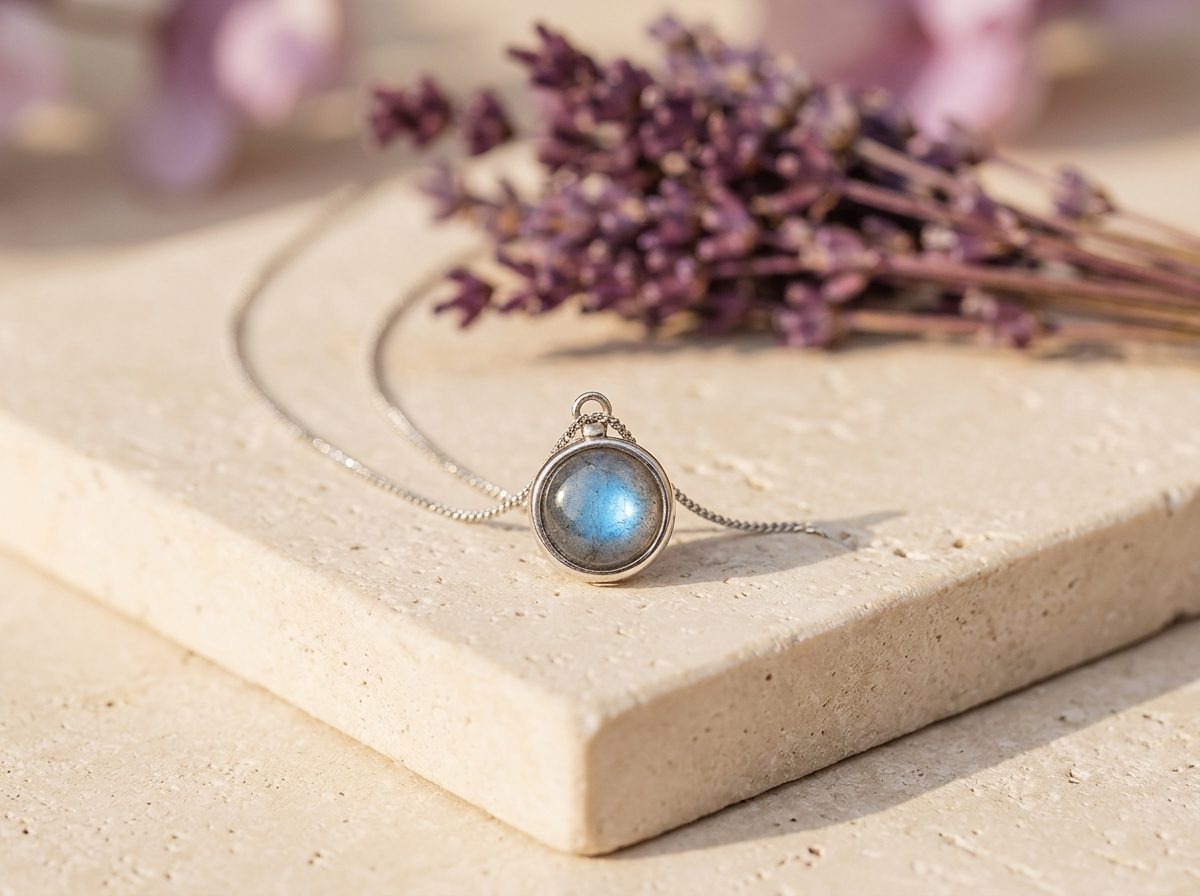
“Fine Pearl” Pendant in Labradorite
A small round labradorite with a soft blue flash, on a fine chain
See it · $39Below: what labradorite means, the legend of the northern lights, how to wear it and where to keep it, what people pair it with (and avoid), how to tell a real stone from glass, and how to choose one. You can browse all our labradorite pendants as you read.
Labradorite quick facts
| What | Details |
|---|---|
| Color | Gray to dark gray-green at rest, with flashes of blue, green and gold; rarer stones show orange, pink or purple |
| Mineral family | Plagioclase feldspar (a calcium-sodium aluminum silicate) |
| Mohs hardness | 6 to 6.5, softer than quartz |
| Main sources | Canada (Labrador, where it was named), Finland (the rainbow variety called spectrolite), Madagascar, Russia, Norway |
| Chakra (in tradition) | Third eye, also throat and crown |
| Zodiac (in tradition) | Leo, Scorpio and Sagittarius |
| Traditional associations | Transformation, intuition, magic, protection, the northern lights |
| Care | Wipe with a soft cloth; no soaking, salt or ultrasonic cleaners; store it apart and avoid hard knocks, as it can chip |
What labradorite means in crystal tradition
Pick up a piece of labradorite and it looks plain. Turn it a little and it lights up. That is the whole labradorite meaning in one gesture: hidden brilliance, and the change that reveals it.
- Transformation. Labradorite is often called the stone of transformation. People choose it at turning points: a move, a new chapter, a habit they are ready to leave behind.
- Intuition. In crystal lore it is linked to inner knowing. Many keep it nearby when journaling or making a choice that logic alone can't settle.
- Protection. Modern crystal practice calls labradorite a protection stone, especially for people who feel other people's moods strongly. It is a symbol to wear, not a promise. Our guide to crystals for empaths explores this side.
- Magic. Its flash has earned it the nickname "stone of magic" among crystal lovers, a reminder to stay curious.
Labradorite spiritual meaning
In modern crystal practice, labradorite belongs to the third eye, the center tradition links to intuition and inner vision. It is a favorite for meditation: some people hold it and slowly turn it in the light, letting the flash become a point of focus, then close their eyes and ask one question.
Because its colors appear only from certain angles, labradorite is also read as a stone of perspective. The lesson people take from it is simple: if something looks dull, try another angle before you decide.
History and lore
The legend of the northern lights
An Inuit legend, often retold in crystal books, says the northern lights were once trapped in the rocks along the coast of Labrador. A wandering warrior found them and struck the stones with his spear, setting most of the lights free into the sky. Some stayed behind in the rock, and that is the flash you see in labradorite today.
Named after Labrador
The stone takes its name from Labrador, in Canada. It became known in Europe around 1770, after Moravian missionaries in Labrador came across it; geologists still use Paul's Island, near the coastal village of Nain, as its reference locality. In Finland, workers digging defenses during World War II found an especially colorful variety at Ylämaa. It became known as spectrolite, and gem cutting of it began in the 1970s.
Where the flash comes from
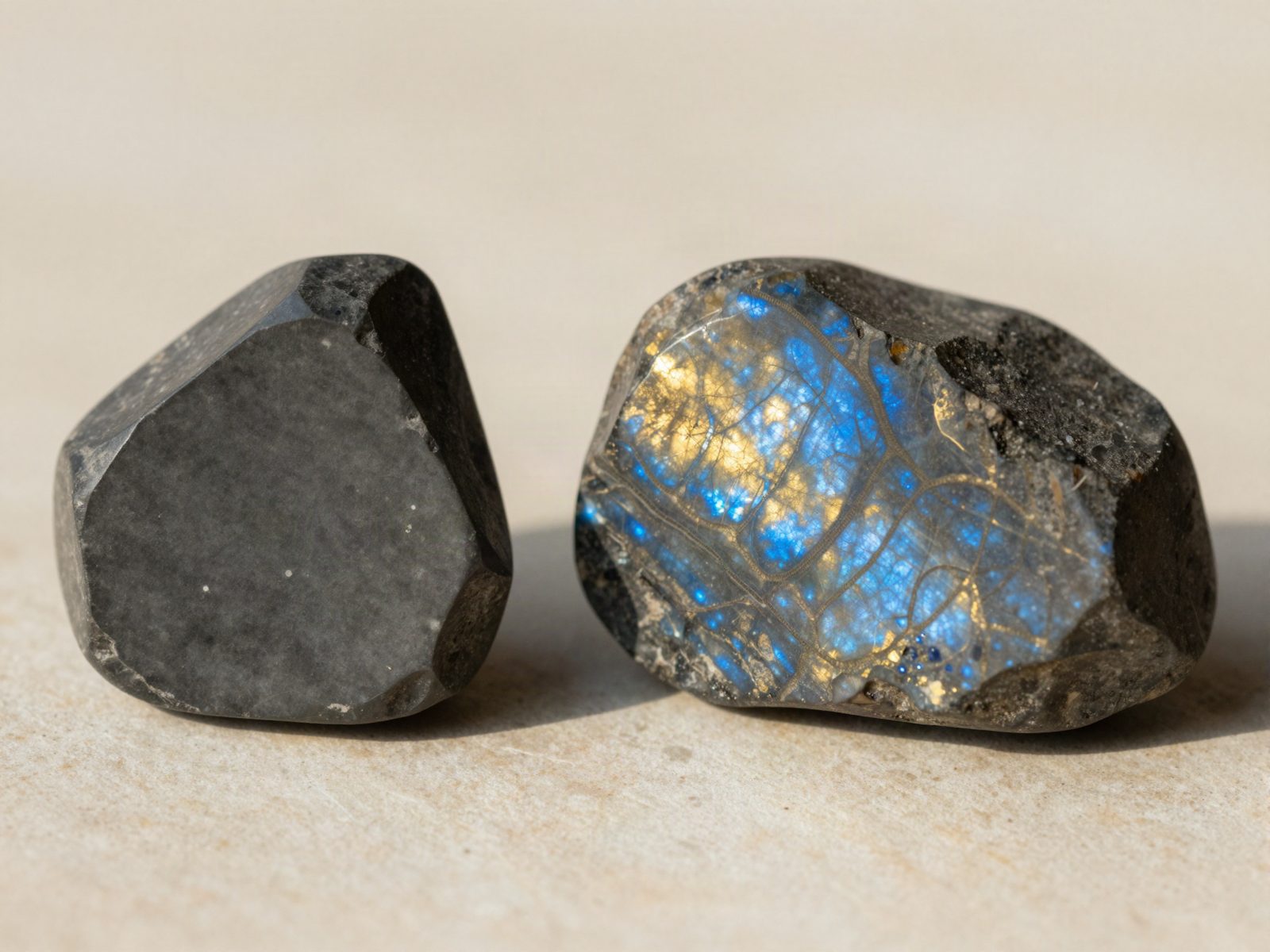
Labradorescence is not on the surface. Inside the crystal are extremely thin layers of slightly different feldspar, formed as the rock cooled very slowly. Light bounces between these layers and some colors cancel out while others shine. The spacing of the layers decides the color: one spacing gives blue, another gold. That is why a cutter has to orient the stone carefully, and why the same pendant looks gray from the side and electric from the front.
How to wear labradorite
- As a pendant. The best way to enjoy the flash: the stone faces outward and catches light as you move. It is also the safest choice for daily wear, because a pendant takes fewer knocks than a ring.
- As a ring. Lovely, but labradorite can chip if it hits a hard surface. Choose a setting with a metal rim around the stone.
- Which hand. In one common tradition the left hand receives and the right hand gives. People who wear labradorite as a protection symbol often choose the left.
Where to keep labradorite at home
| Place | Why people choose it (in tradition) |
|---|---|
| Near a window | Morning light brings out the flash; a small daily reminder of hidden brilliance |
| Meditation or reading corner | Linked to intuition and inner vision |
| Desk | A stone of perspective for choices and creative work |
| Entryway | Placed as a protection symbol where people come and go |
What to pair labradorite with (and what people avoid)
Common pairings in crystal practice:
- Amethyst: two stones of intuition, often kept together in a meditation space (see our amethyst pieces).
- Clear quartz: said to "amplify" labradorite's qualities.
- Black obsidian: a protection pair, labradorite for light and obsidian for grounding; see our black obsidian meaning guide or our black obsidian pieces.
What not to pair with labradorite is where guides disagree. Some say very grounding stones such as hematite or black tourmaline "weigh down" its airy, magical character; others pair them on purpose for balance. Some say moonstone, another stone with a shimmer, makes a confusing mix; others love them together. There is no fixed rule. Choose by intention, and if a combination feels like too much, wear one stone at a time.
How to cleanse labradorite
Keep water to a quick wipe. Labradorite has natural planes of weakness and is softer than quartz, so skip soaking, salt water and salt bowls. Gentle ways that suit it: smoke, sound, moonlight, or a night on a selenite plate. For each method step by step, read how to cleanse crystals.
How to tell real labradorite from fake
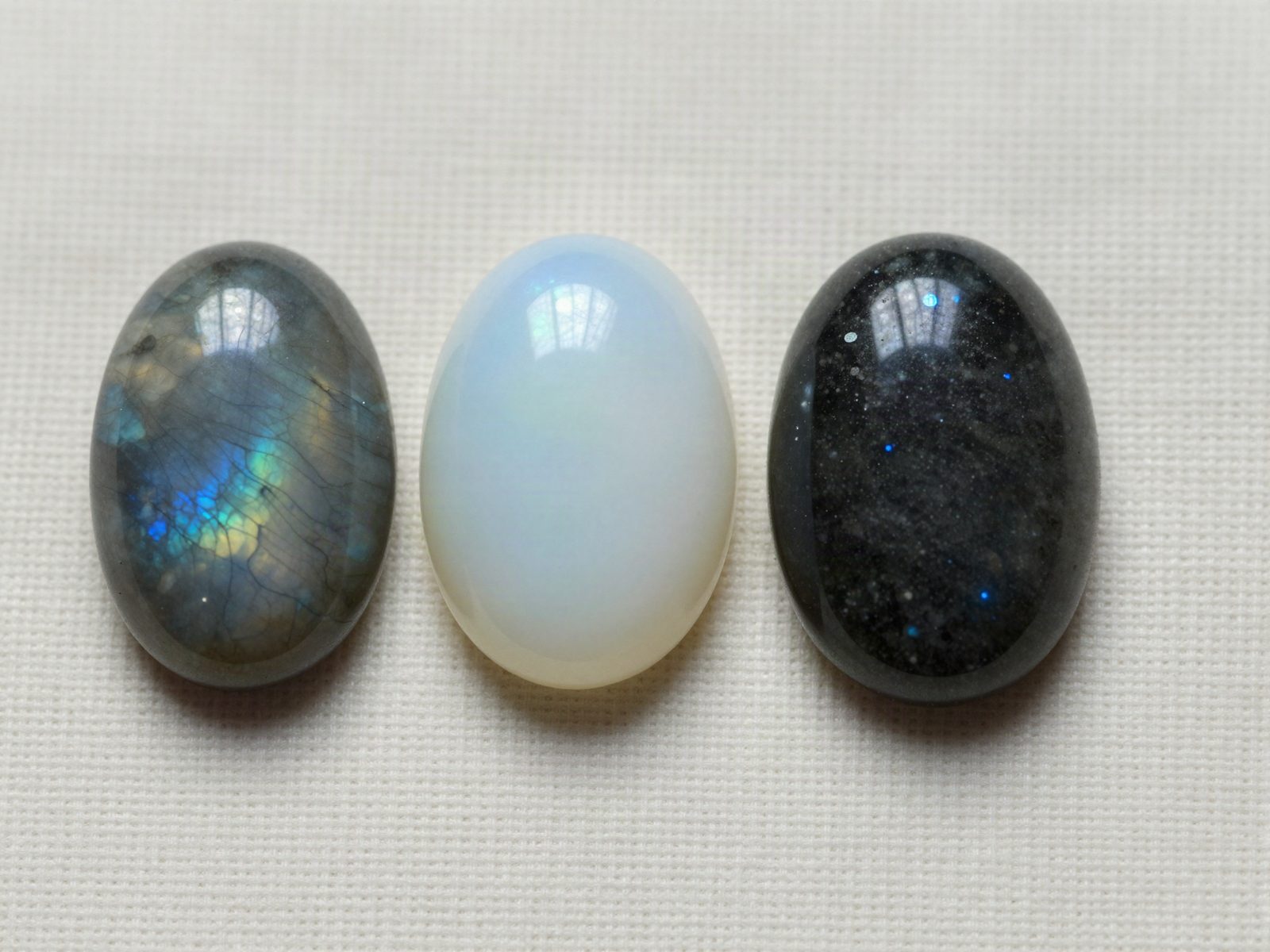
Real labradorite is common, but glass, plastic and coated stones are sold under its name. Five checks you can do at home:
| Check | Real labradorite | Likely fake |
|---|---|---|
| Tilt it under one lamp | The color flashes on at one angle and fades to gray or dark at others | Glows the same from every angle |
| Look inside | Fine lines, tiny fractures, patches and stripes of different color | Perfectly clean, uniform color with no inner structure |
| Check the base color | Gray to dark gray-green between flashes | Milky, bluish glass with a soft glow (often "opalite") |
| Hold it | Cool at first, solid for its size | Warms fast and feels light: resin or plastic |
| Read the label | "Spectrolite" is a real Finnish labradorite; "rainbow moonstone" is a pale form of labradorite | "Black labradorite" is usually larvikite, a different rock with a silvery shimmer |
How to choose a labradorite piece
- Look at the flash, not the photo. Strong stones show color across most of the face when you look at them straight on. Blue is the most common flash; gold, green and full-rainbow stones are rarer.
- Check the cut. A smooth, domed or flat-polished face shows labradorescence best.
- Protect the edges. A metal frame or bezel guards a stone that can chip; a wire wrap shows more of the stone and feels more handmade.
- Know the price range. Each stone's flash is unique. Our labradorite pendants run from $37 to $42.
Spirad pieces in labradorite

“Guardian Star” Pendant in Labradorite
A labradorite pendant with deep blue flashes, on a gold-tone chain (also in lapis lazuli)
See it · $42The Guardian Star pendant hangs a labradorite with deep blue flashes from a gold-tone chain; it is also made in lapis lazuli.

“Heart Serenity” Pendant in Labradorite
A hand-shaped labradorite heart, each one unique (also in four other stones)
See it · $37The Heart Serenity pendant is a hand-shaped labradorite heart, each one unique, and it also comes in amethyst, tiger's eye, rose quartz and amazonite.
For every stone tradition links to protection, browse our protection collection.
Frequently asked questions
What does labradorite mean spiritually?
Transformation, intuition and hidden brilliance. In crystal tradition it is linked to the third eye chakra and to seeing things from a new angle.
Is labradorite a protection stone?
In modern crystal lore, yes: it is one of the best-known protection stones, especially for sensitive people. Wear it as a symbol and a reminder, not as a promise. For more, see our guide to crystals for protection.
What should you not pair with labradorite?
Guides disagree. Some keep it apart from heavy grounding stones like hematite, or from moonstone; others pair them for balance. Choose by intention, and wear one stone at a time if a mix feels like too much.
Which finger should I wear a labradorite ring on?
There is no fixed rule. In palmistry-inspired tradition the index finger stands for confidence, the middle finger for balance and the ring finger for relationships, so people pick the finger that matches their intention. Whatever you choose, pick a protective setting.
Can labradorite get wet?
A splash or a quick wipe is fine. Don't soak it or leave it in salt water, and take it off before swimming or showering.
Which zodiac sign is labradorite for?
In astrology-inspired tradition, Leo, Scorpio and Sagittarius. Anyone can wear it.
Where to start
If you want a small everyday piece, start with the Fine Pearl, a round labradorite you can wear daily without thinking about it. If you want a bolder flash, choose the Guardian Star; and for a gift, the labradorite heart says it simply.
“Fine Pearl” Pendant in Labradorite
A small round labradorite with a soft blue flash, on a fine chain
See it · $39