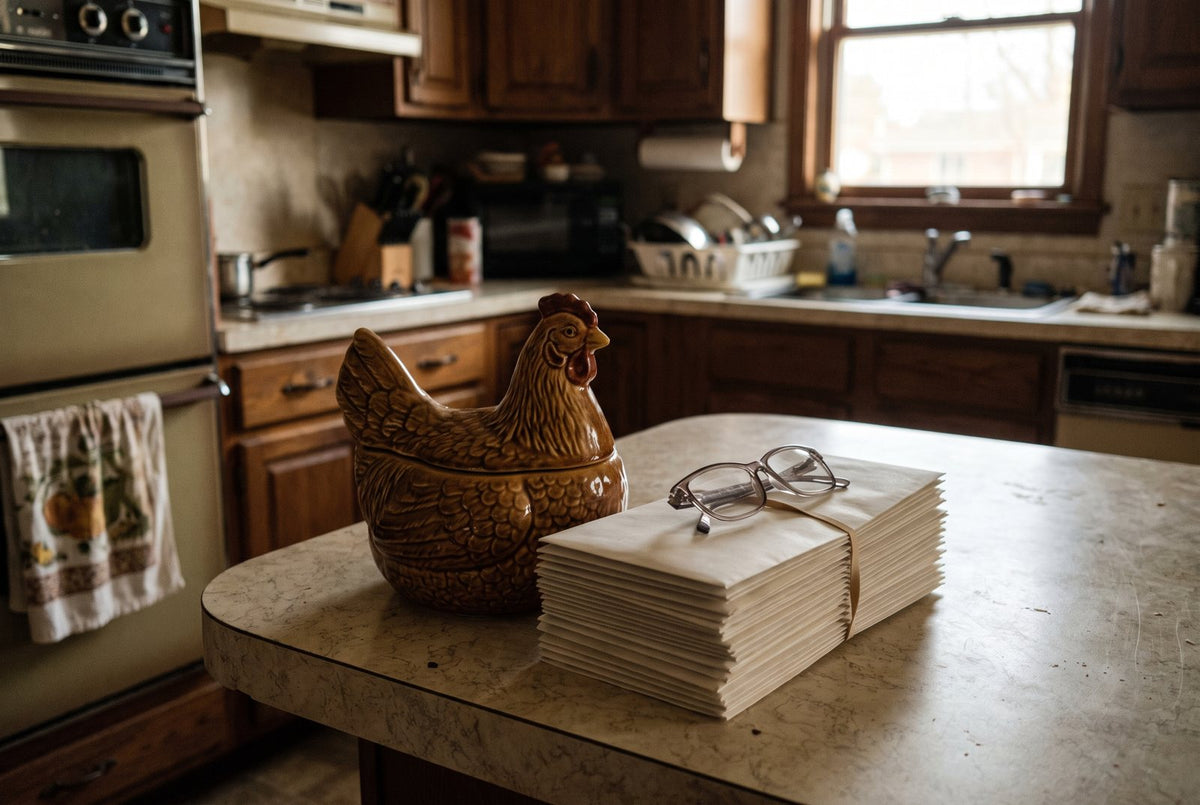
The end of my mother's counter, two years ago. The envelopes waited there for Sunday.
If your mom has a stack of unopened envelopes by her cookie jar too, read this.
She's on Social Security and does the math on everything, out loud. What changed wasn't her bank balance. It was the stack of envelopes by the cookie jar.
A note from Diane: Laurie wrote to me after my post about my own mother and the mail. I asked if I could share her letter. I've read it four times. If you have a mom, read it. — Diane Whitaker
The end of my mother's counter, two years ago. The envelopes waited there for Sunday.
My mother is 71.
She lives twenty minutes from me, in the house she and my dad bought in 1979. She keeps a rosary, a little ceramic angel and a lucky penny from 1961 on her windowsill. She calls me "honey" when she's about to win an argument.
She's not poor.
But she lives like she's one bad month away from it.
You probably know someone like this. Maybe you are someone like this. I think a lot of us are, after a certain age, after a certain kind of year.
This is the story of how my mother stopped opening her mail, how she started again, and the $212 check that made her laugh on the phone for the first time since my dad died.
It's also the story of a little pyramid of stone that sits next to her cookie jar. I rolled my eyes at it once. I don't anymore.
My mom's name is Ruth. She was a dental receptionist for thirty-one years. She knew every patient's kids by name and every insurance code by heart.
My dad passed in 2018. Since then it's been her, the house, Social Security, and a small savings account she guards like a bulldog.
She saves twist ties in a coffee mug. She washes and reuses the foil. She drives across town for gas that's six cents cheaper and comes home pleased about it.
And she does the math on everything. Out loud. In the store.
"That's four dollars, Laurie. Four dollars for lettuce."
I used to tease her about it. I'd put the lettuce in the cart anyway and she'd take it out when I wasn't looking.
Then, about two years ago, I noticed something that made me stop teasing.

"Four dollars for lettuce." Every single week.
It was a Sunday in October, a little after four. I'd come over to drop off soup.
The envelopes were on the end of the counter, by the cookie jar, held together with a rubber band. Ten or eleven of them. The electric company. The bank. Medicare. A couple that were probably nothing.
I asked if she wanted help going through them.
She said no, she does them on Sundays. Then she sat down at the kitchen table, slid the rubber band off, and opened them one at a time with a butter knife, with her shoulders up around her ears, like she was waiting to be hit.
She'd stopped opening her mail.
Not all of it. Birthday cards she opened at the mailbox. But anything that looked like a bill or a statement went on the stack, unopened, until Sunday.
When I asked her why, she didn't look up.
"I just don't like surprises."
My mother. Who used to throw surprise parties for the whole street.
Last fall, she called to ask if I could do Thanksgiving. She'd hosted it for nineteen people every year since I was in high school. She said she "didn't want the fuss."
I knew it wasn't the fuss. It was the grocery bill.
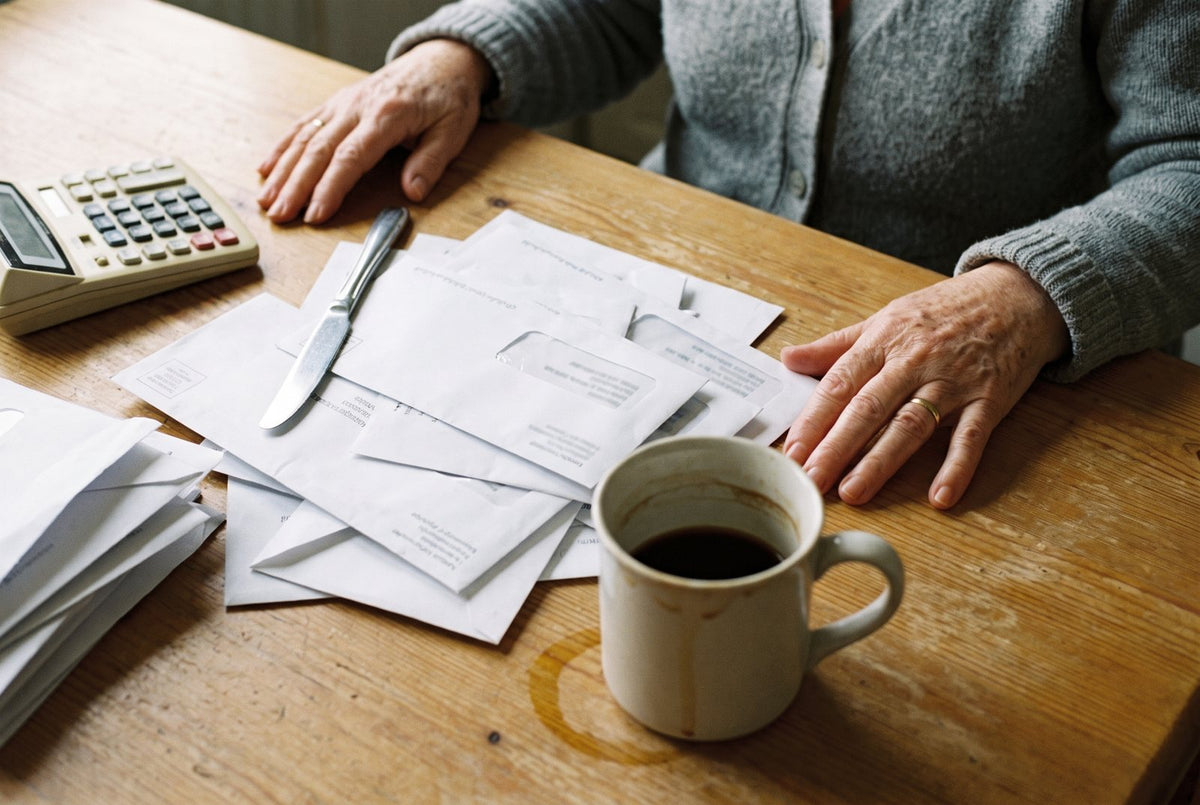
Sundays. One envelope at a time, with a butter knife.
I didn't know what to do, so I did what daughters do. I tried to fix it.
Then I found out Mom had been trying things on her own.
In the kitchen drawer, next to the batteries and the rubber bands, there were two bead bracelets from an ad she'd seen on Facebook. "Money bracelets." Two for $39.90. One had already snapped; the elastic was curled up like a dead spider. The beads on the other one were so light I thought they were plastic. I bit one. They were.
She'd also been falling asleep to "money music" on YouTube. Every night, for about a year. She woke up to the same bills.
She was embarrassed I'd found the bracelets. I was embarrassed for whoever sold them to her.
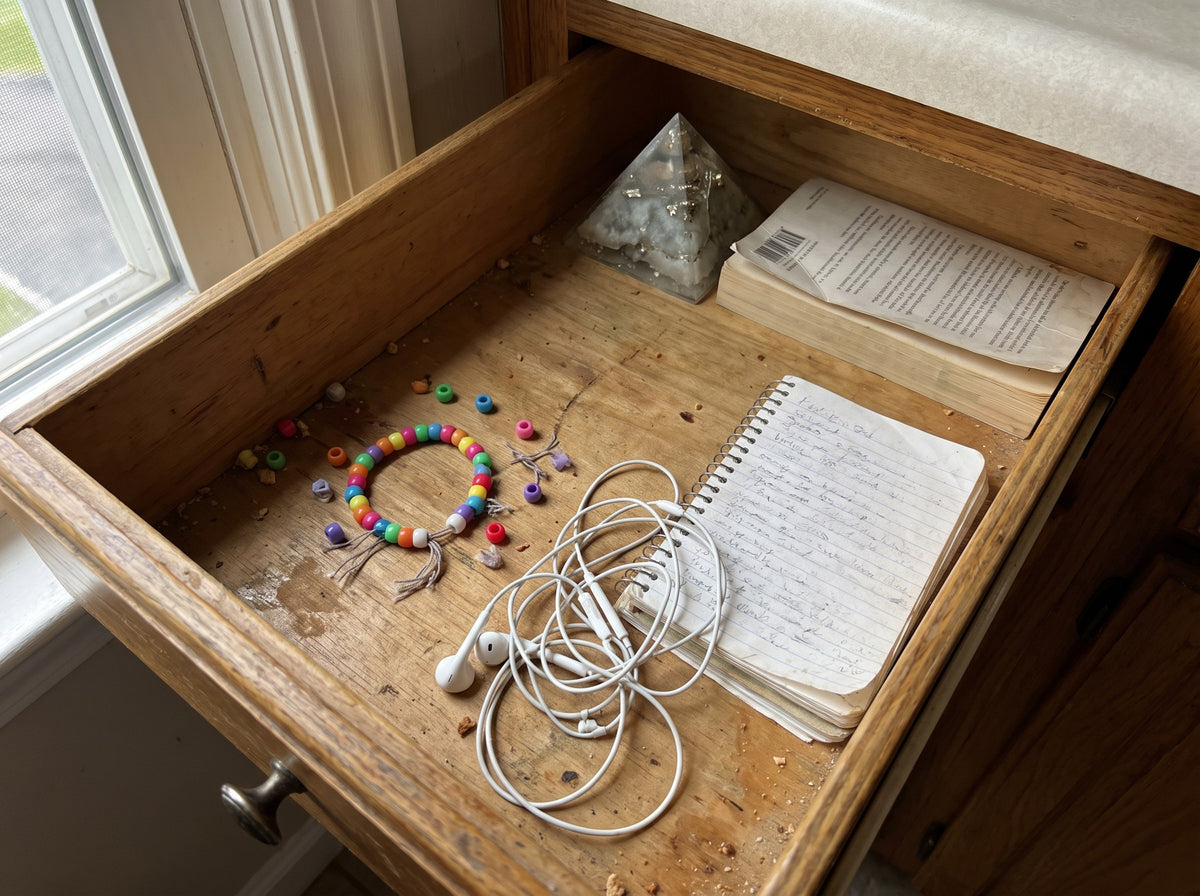
Mom's drawer. Two "money bracelets," $39.90. One snapped within the week.
Every single thing we tried asked her to do something. Talk about it. Trust a stranger. Wear it, listen to it, believe in it.
She was already tired. That was the whole problem, and none of us saw it.
I figured it out in the car on the way home one Sunday, which is where I figure most things out.
My mother is not bad with money. She's spent forty years being good with it. She can tell you what a gallon of milk cost in 1985.
She wasn't bad with money. She was tired of bracing.
When every envelope might be bad news, you stop opening the envelopes. When you stop opening them, you stop seeing the good ones too: the refund, the rebate, the letter that says you're owed something. Everything goes on the same stack, and the stack gets heavier, and you open it on Sunday with your shoulders up.
She'd been carrying it all by herself since Dad died. And she'd stopped looking.
She wasn't unlucky. She wasn't careless. She'd just stopped looking, because looking hurt.
I didn't know what to do with that. Then a coworker's desk gave me an idea.
This spring, a woman in my office had a little pyramid on her desk. Deep blue at the top, gold flecks, something green and purple lower down. It sat by her monitor and caught the light from the window in the afternoon.
I asked about it, mostly to be polite.
She said her husband had given it to her. It was supposed to be for abundance, money coming your way, that kind of thing. She laughed when she said it, which I liked.
I'm a practical person. I rolled my eyes a little.
But I picked it up.
And it was so much heavier than I expected. About four ounces, in something that fit in my palm. And cold, the way a stone from a creek is cold.
That stopped me. Mom's bracelets weighed nothing. This had weight.
You could see everything inside it, like looking into clear water. A blue ball of lapis lazuli at the top with real gold in it. Green malachite. Purple amethyst. Copper wire and little bits of metal all through it.
It was beautiful. Honestly, that's what got me first.
And I thought: Mom would keep this.
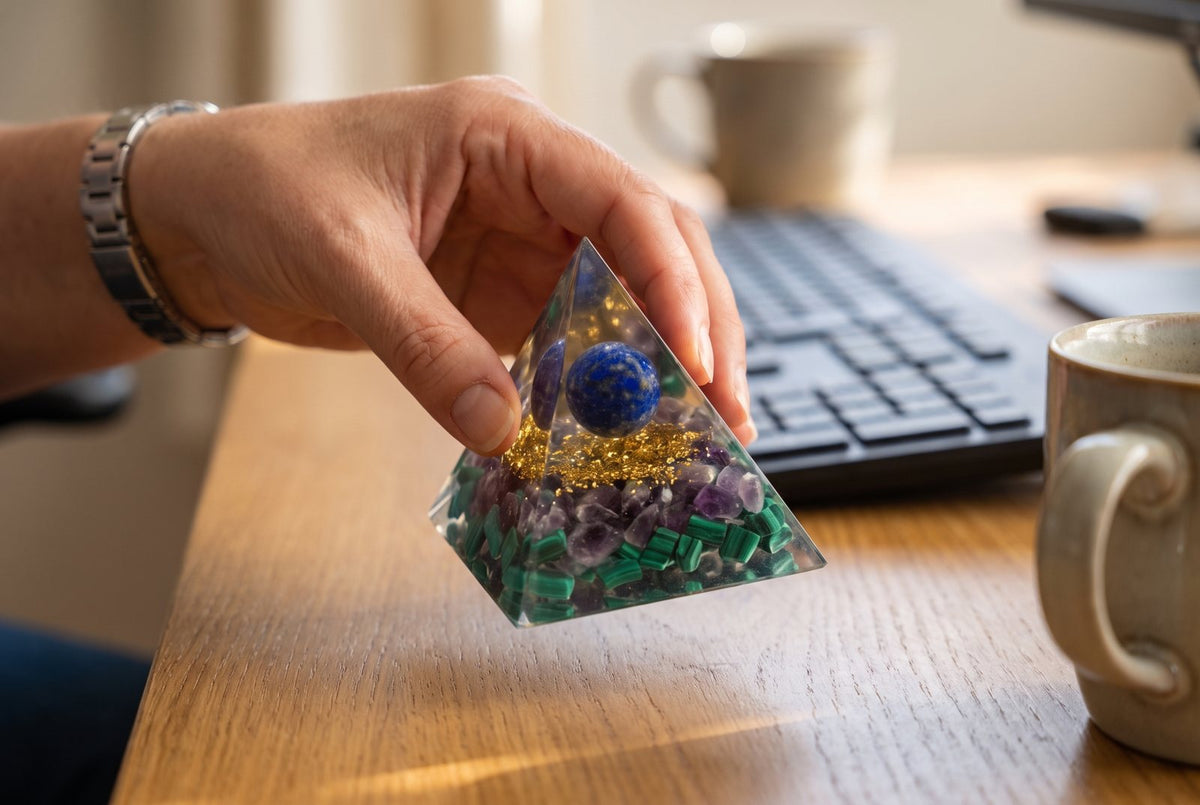
My first time holding one. I expected it to weigh nothing.
I know my mother. Before I spent a dollar, I made a list in my head of what it would have to be. If you're buying for your own mom, or for yourself, you might use the same list.
Try this with any "lucky" stone or bracelet you own. Close your hand around it. Real stone feels cool and has weight for its size. Plastic warms up in a few seconds and feels like nothing. Then ask: would it snap if you dropped it, or pulled it on over your hand? Mom's bracelets failed all three.
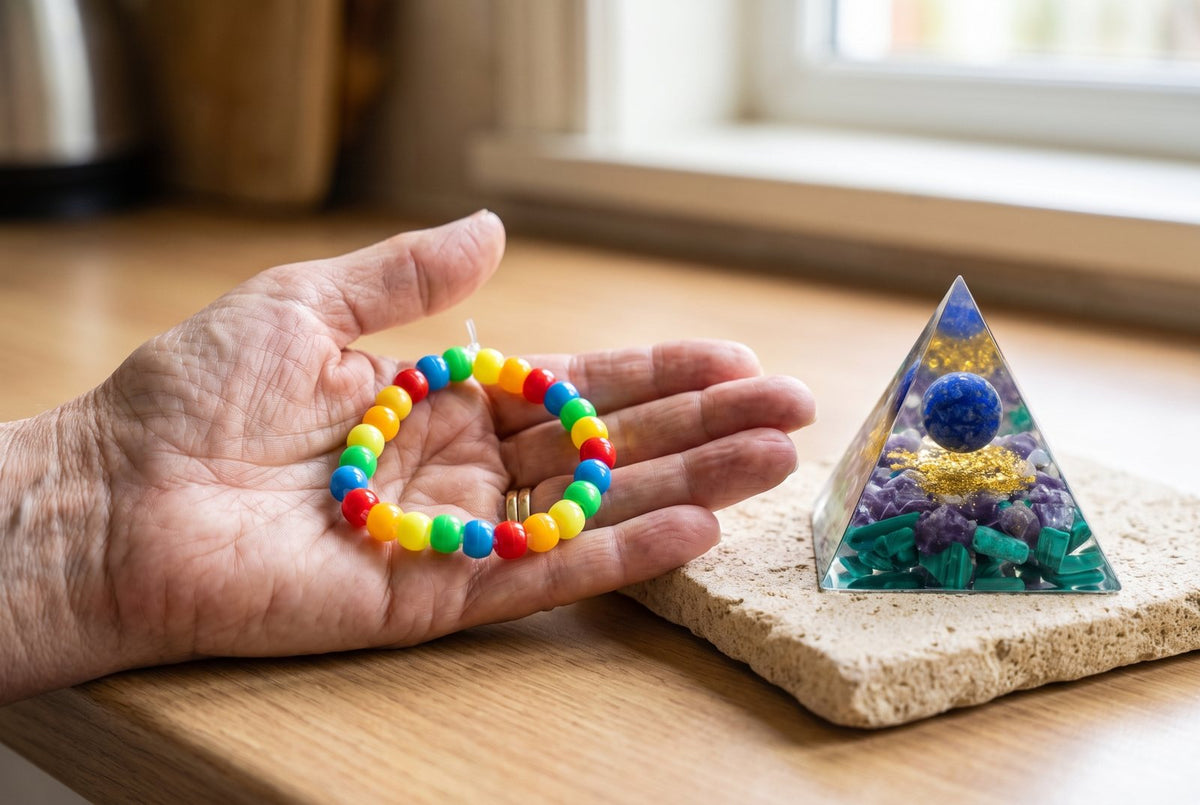
Left: the bracelet. Right: the stone. You can feel the difference before you can see it.
The one on Karen's desk came from a small company called Spirad. They call it the Sovereign Abundance Pyramid. I looked it up that night, mostly to find out if it was real, and then to find out what I'd actually be giving her.
It's about 2.4 inches across at the base and a little over 2 inches tall. Bigger than a golf ball, smaller than a can of soup, and heavier than it looks: about 4 ounces.
Here's what's inside, all of it visible through the clear setting:
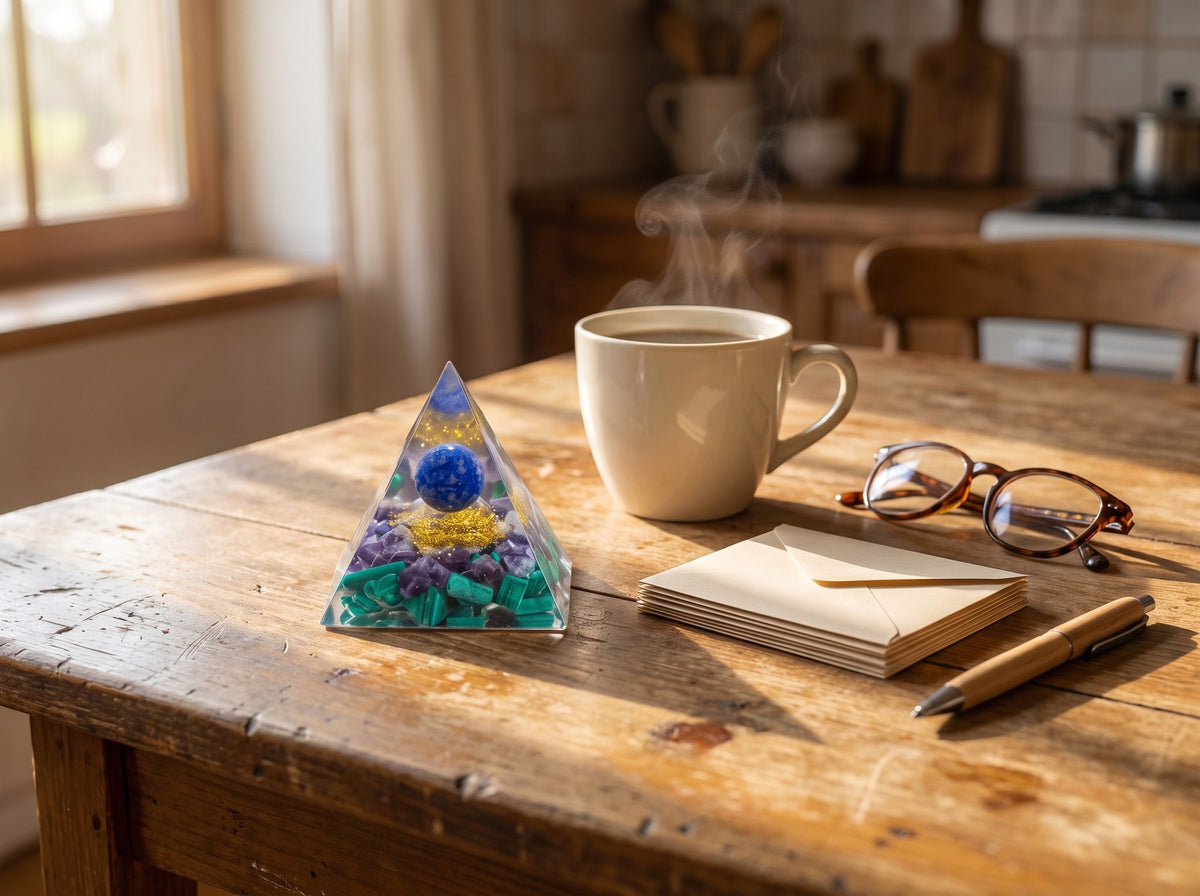
The Sovereign Abundance Pyramid. About 4 ounces, 2.4 inches at the base.
"Isn't the clear part just plastic?" That was my first question too. The clear resin is the setting, like the glass on a watch. It holds the stones and seals them in for good. Resin alone that size would weigh about 2.7 ounces. The rest of the weight in your hand is the stone.
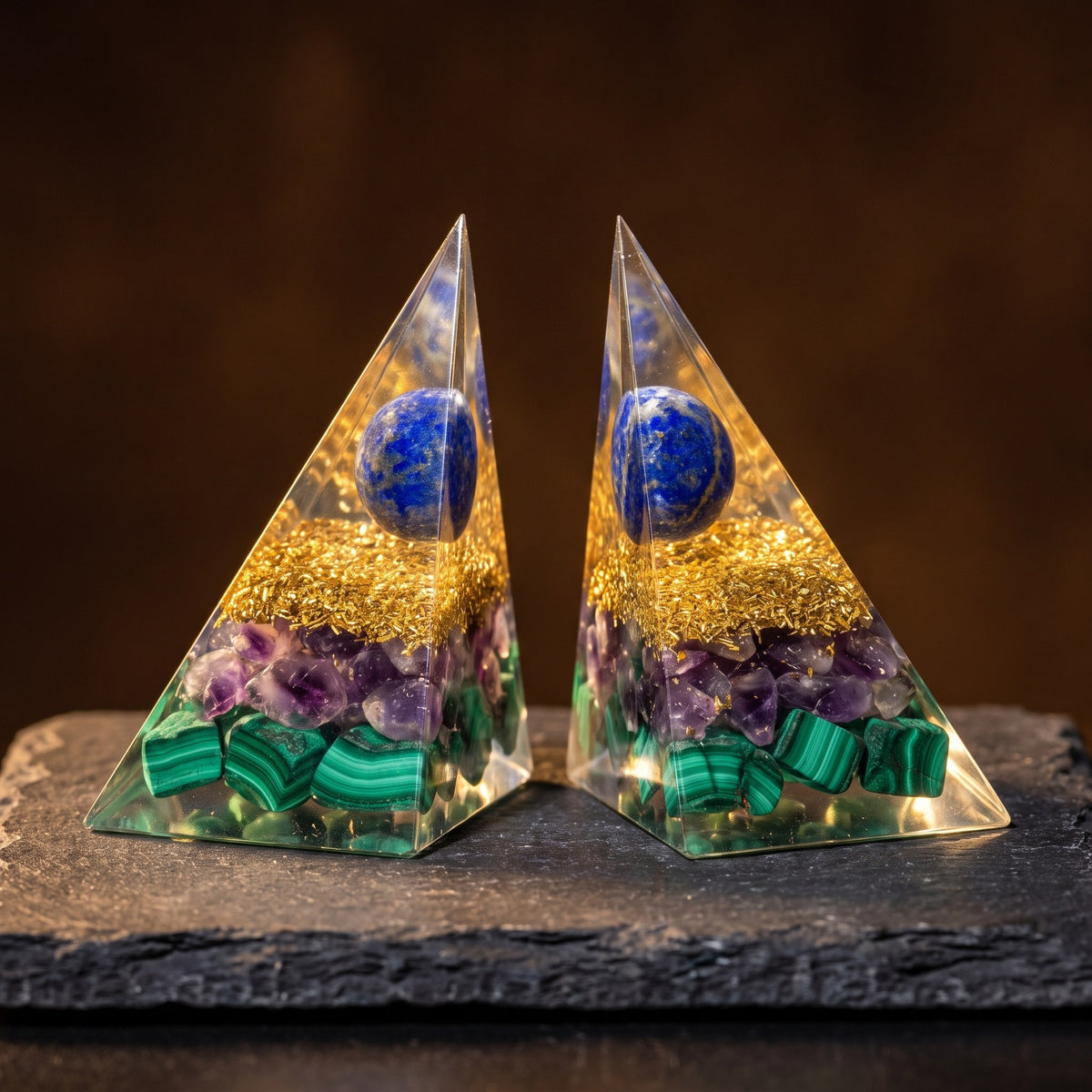
Illustration: one cut in half. Stone all the way through.
Nothing to wear, so nothing to snap. Nothing to charge or cleanse. You take it out of its pouch, you set it down where you look every day, and you leave it there. That was test number two, passed before I'd even ordered.
I want to be careful here, because I'm not a crystal person and I don't want to sound like one.
People have kept stones like these for a very long time. Lapis was the blue of the pharaohs' jewellery. This kind of piece, stone and metal set in resin, is a craft people started making in the 1990s, inspired by a scientist named Wilhelm Reich who believed that layering natural and metal materials could gather good energy in a room. You can believe that or not. I'm honestly not sure what I believe.
Here's what I am sure of.
A bracelet asks you to wear it, every day, and to wonder if you're wearing it right.
This asks nothing. It sits where the mail lands. It's the one thing on that end of the counter that isn't a bill. It's real, it's heavy, and it's pretty enough that you look at it.
And when you look at that corner of the counter every day, you look at what's next to it.
| The bracelet | The stone | |
|---|---|---|
| Made of | beads on elastic | lapis, malachite, amethyst, gold flakes, copper |
| What you do | wear it every day, the right way | set it down once |
| How long it lasts | the elastic went in a week | can't snap |
| If you don't like it | good luck | 60 days, they pay the return |
I was worried about one more thing. My mother goes to Mass every Sunday. I didn't want to give her something she'd feel was against her faith.
So I read about lapis. In Exodus 24:10, the elders see God, and under His feet is "a paved work of a sapphire stone." Bible commentators say the stone the ancients called sapphire was most likely lapis lazuli: that same deep blue, with flecks of gold.
When I told Mom, she thought about it for a minute and then said the thing she still says:
"It doesn't replace my prayers, honey. It sits by them."
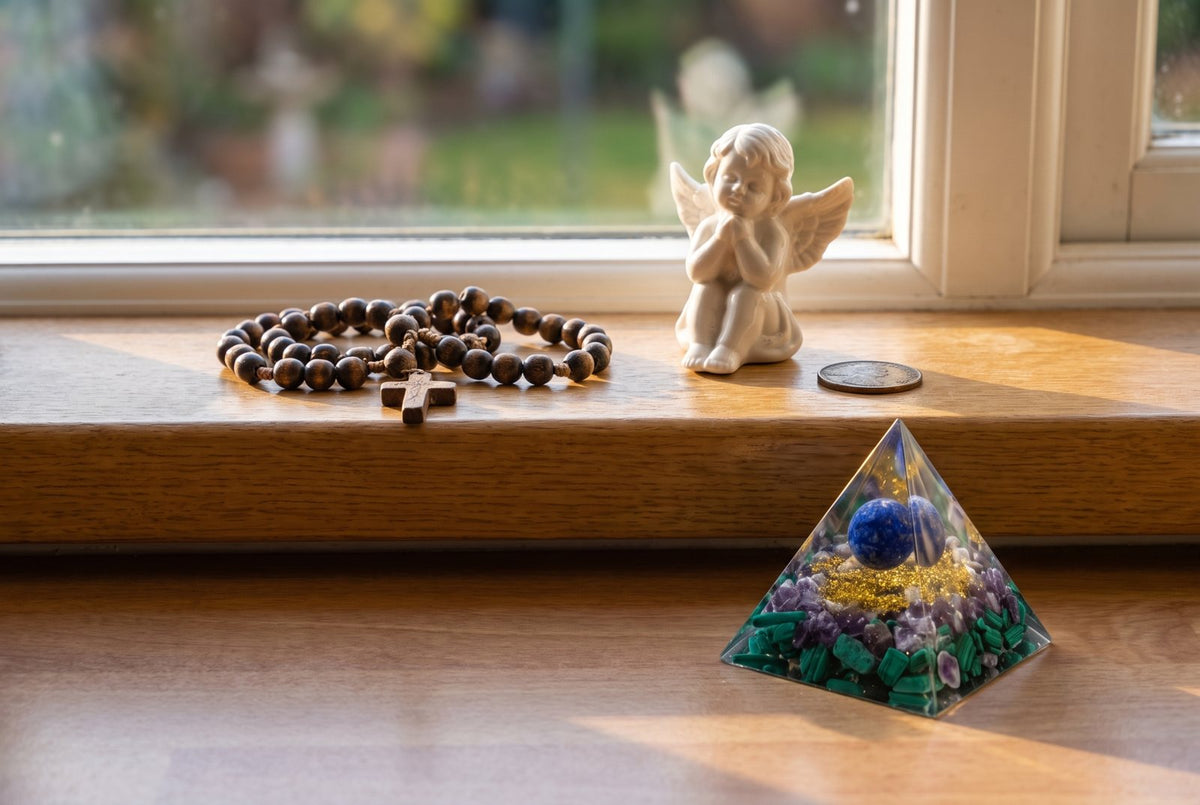
Her windowsill: the rosary, the angel, the 1961 penny. The stone lives just below.
I ordered one for her 71st birthday, in the spring.
They had a deal where you buy two and get the third free, so I got one for me and one for my sister in Cincinnati. The free one was added on its own; I didn't have to tick anything. They came in about a week, each in its own little velvet pouch, in a gift box, which made it feel like a real present and not something from an ad.
Mom opened it at her kitchen table, after cake.
"What on earth."
I told her what Karen had told me, the abundance part, and braced for the eye roll.
She didn't roll her eyes. She turned it over in her hands for a long time. She weighed it in her palm, the way she weighs cantaloupes.
Then she got up, walked it over to the counter, and set it down right next to the cookie jar. Right by the stack of envelopes.
"There," she said. "Now it can watch the mail."
I laughed. I thought that was the end of it.
It wasn't.
About a month later I came by on a Wednesday, and I noticed the stack was gone.
She was opening her mail again. Every day, standing at the counter, by the stone. Bills, statements, all of it.
I asked her about it, carefully, because she hates being asked about things.
She shrugged.
"It's easier with something nice to look at."
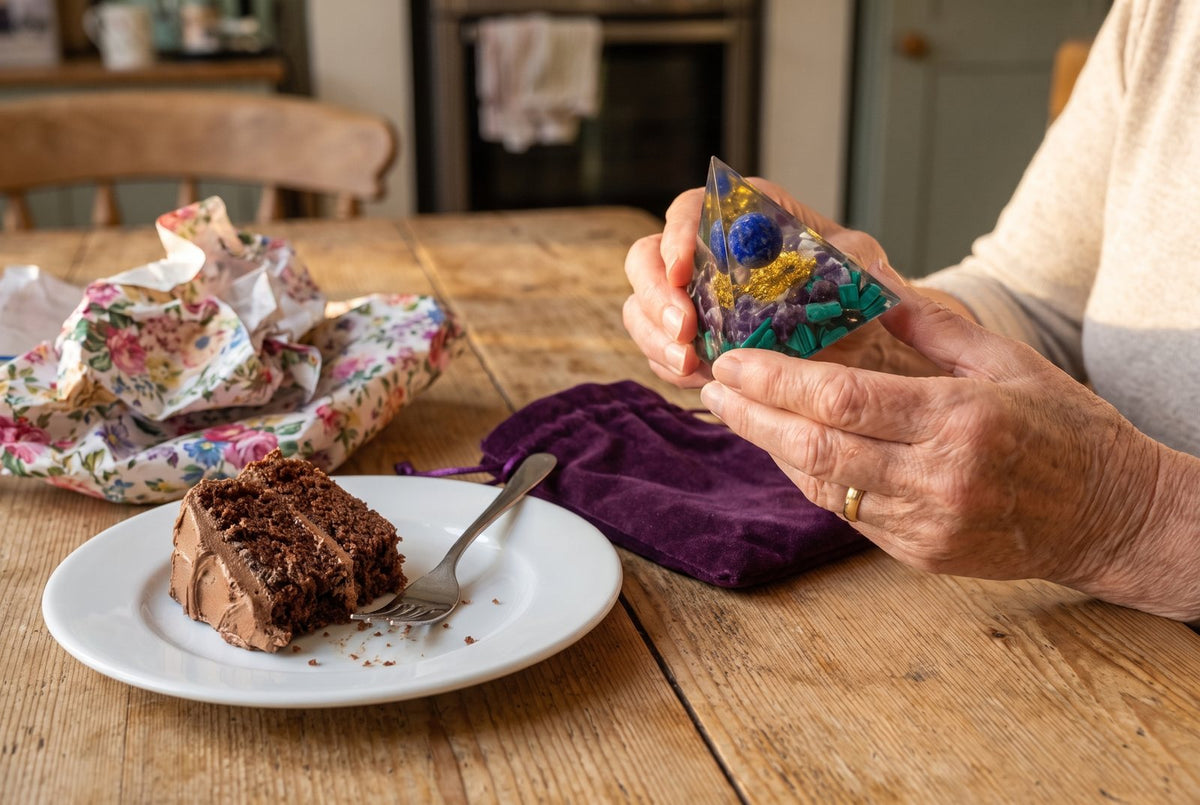
Her 71st birthday. She weighed it like a cantaloupe.
My mother does not call me at work. Ever. When I saw her name, my stomach dropped.
She was laughing.
A check had come. $212.
Two years before, a neighbour had told her to sign up for a class-action settlement over a billing error at the gas company. She'd filled out the form, mailed it, and completely forgotten it existed.
She opened that envelope the day it came, standing at the counter. Then she put the check next to the pyramid, took a picture of it with her phone, which she also never does, and sent it to me.
Under the picture she wrote: "told you. it's the stone 💙"
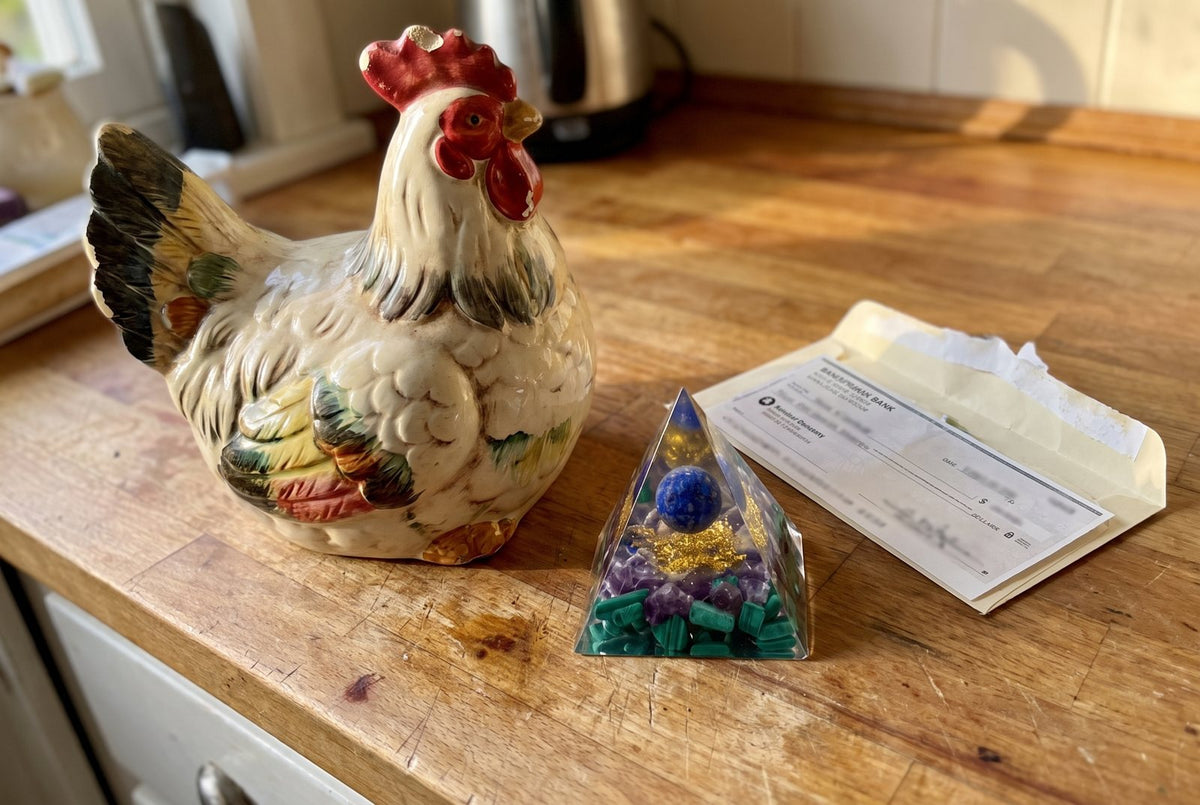
The picture she sent me. My mother has never sent me a picture of anything.
Now, I'm not telling you a rock sends checks.
I know what you're thinking, because I thought it too. That check was coming either way. She'd filled out the form two years before.
But here's the thing. A year earlier, that envelope would have gone on the stack. She'd have opened it on a Sunday, with a butter knife, with her shoulders up around her ears. And she would not have laughed.
Mom says it's the stone. I don't argue anymore. She's happier.
She's opening her mail. She called me laughing. A few weeks ago she bought herself a forty-dollar sweater without driving to three stores first, and told me about it like she'd robbed a bank.
And on the phone that day in August, she said one thing I wrote on a sticky note as soon as we hung up. It's the most hopeful thing I'd heard her say since Dad died.
"I'm not lucky, honey. I'm just paying attention now."
— Ruth, 71Bev noticed before I said a word. She called me, which she has never done in her life, and said, "What did you do to your mother? She's herself again."
I told her about the stone. There was a long pause on the line. Then Bev asked where to get one.
And this year, Mom is hosting Thanksgiving again. Nineteen people. She's already told me what I'm bringing.
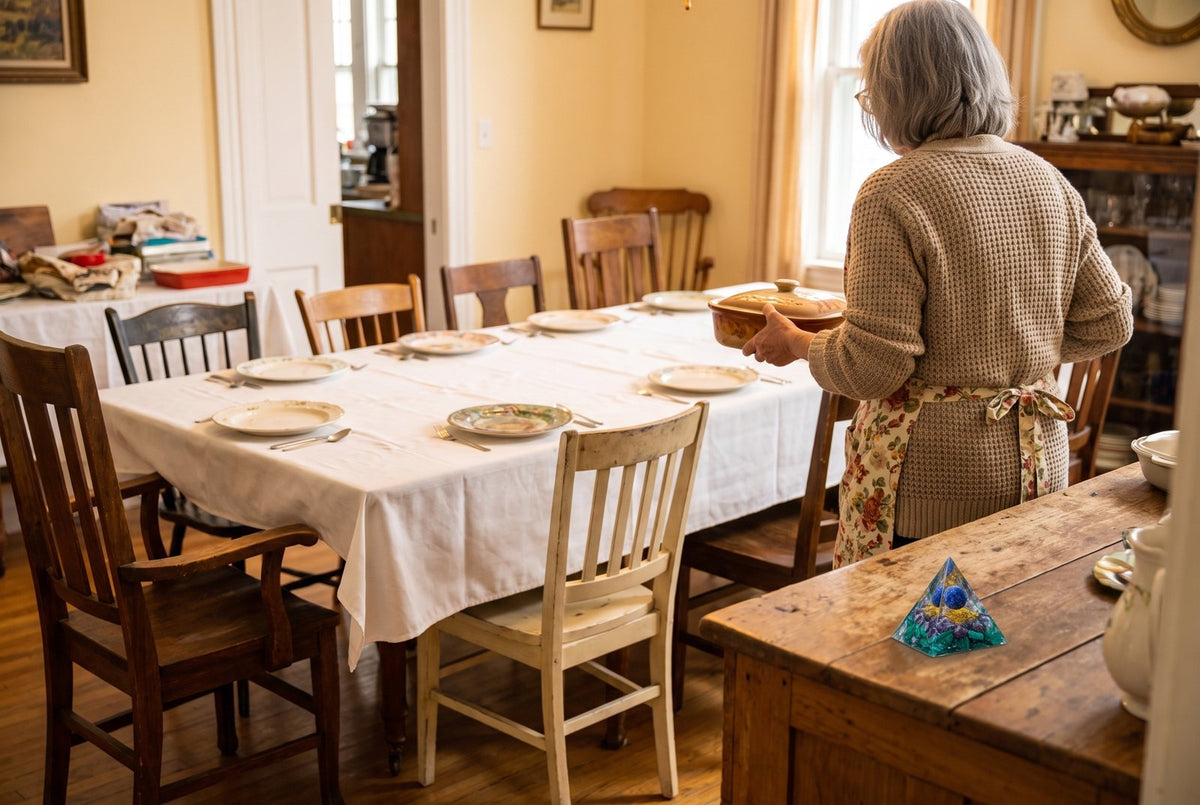
Nineteen chairs. She found the extra two in the garage.
When I first shared this in Diane's group, women started writing to me about their own mothers, and themselves. These are a few of them, in their words.
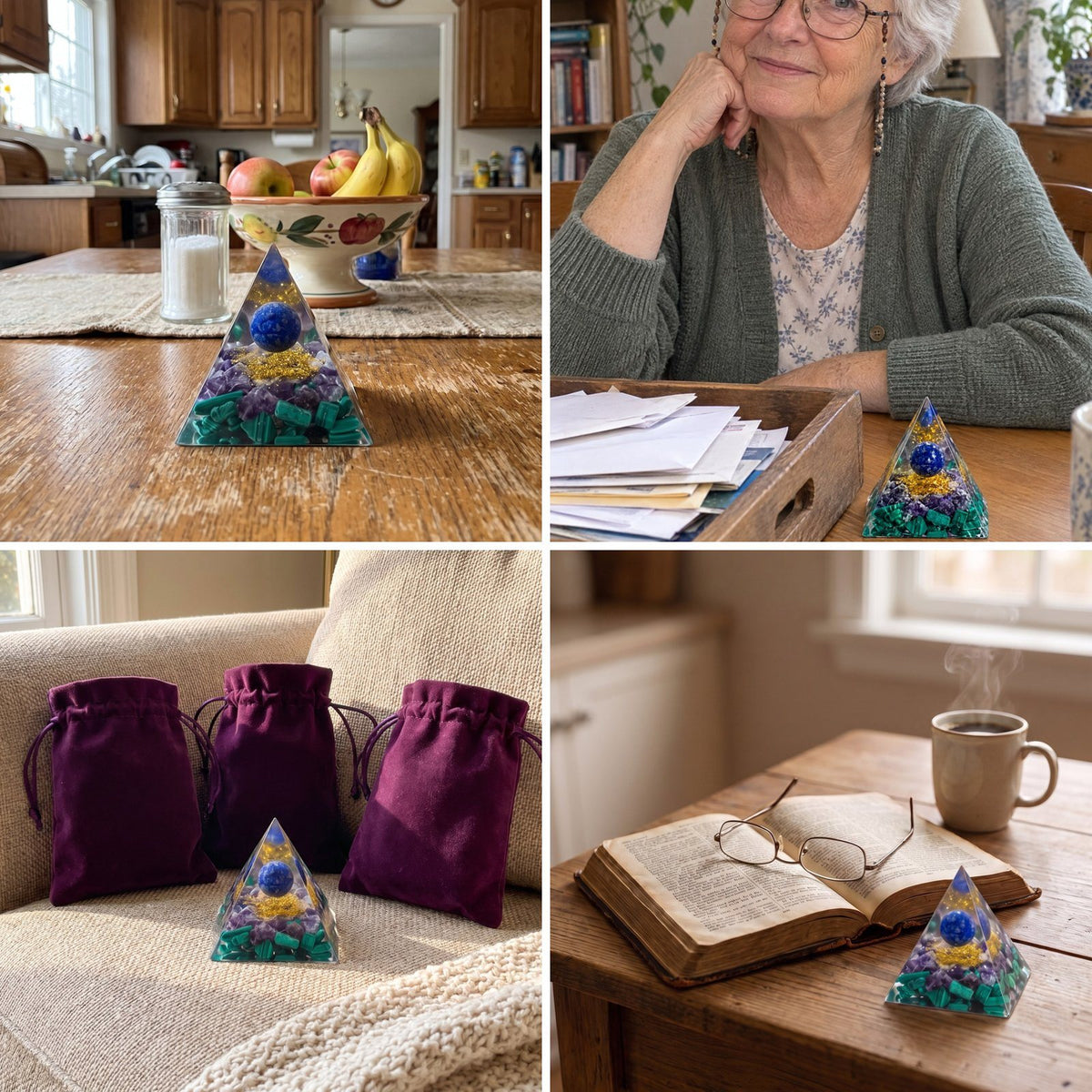
"Mine sits by my phone bill basket. Two months in, the bank called about an old savings account I'd forgotten, $200 and some change. My husband says coincidence. I say I was finally picking up the phone."
Sharon T., 68, Dayton, OH · Customer story"There was a mix-up with my late husband's pension and I'd given up on it. A letter came saying they'd fixed it and back paid me. I opened it the day it came. That's the part that still surprises me."
Doris K., 74, Lansing, MI · Customer story"Bought the two plus one after reading Laurie. Kept one, gave Mom one, gave one to my sister. Each in its own pouch. Mom calls it 'the blue one' and moved it three times before she was happy."
Kelly A., 44, Louisville, KY · Customer story"No checks here, I'll be honest. But I stopped checking my bank app five times a day, and I sleep better. It's on my nightstand. I'm keeping it."
Linda R., 66, Tulsa, OK · Customer story2,700+ people keep one on their table. Results described are personal experiences. This is a decorative intention object and does not guarantee financial outcomes.
If you're reading this because of your own mother, here's what I'd tell you.
Get two. They do a deal where you buy two and they add the third free, automatically. You'll see it in your cart at $0.00. So that's one for her, one for you, and one for a sister, a friend, or Bev.
Every piece comes in its own pouch, in a gift box, so the ones you give are ready to give. They email you a little card to print, "Set it down once," that tells her where to put it in four lines, a verse card if she'd like one, and on the 2 + 1 a short printable guide, the Kitchen-Table Guide, with a gift note for the pieces you give.
Right now they're also giving an extra 25 % off with the code FALL25. It ends Sunday, November 15.
And here's the part that made me stop worrying about getting it wrong: they call it the 60-Day Table Trial. Keep it on her table for 60 days. If she's not glad, you write to them, they send the return label, they pay for it, and they refund every cent, opened or not. You're charged once. Nothing every month.
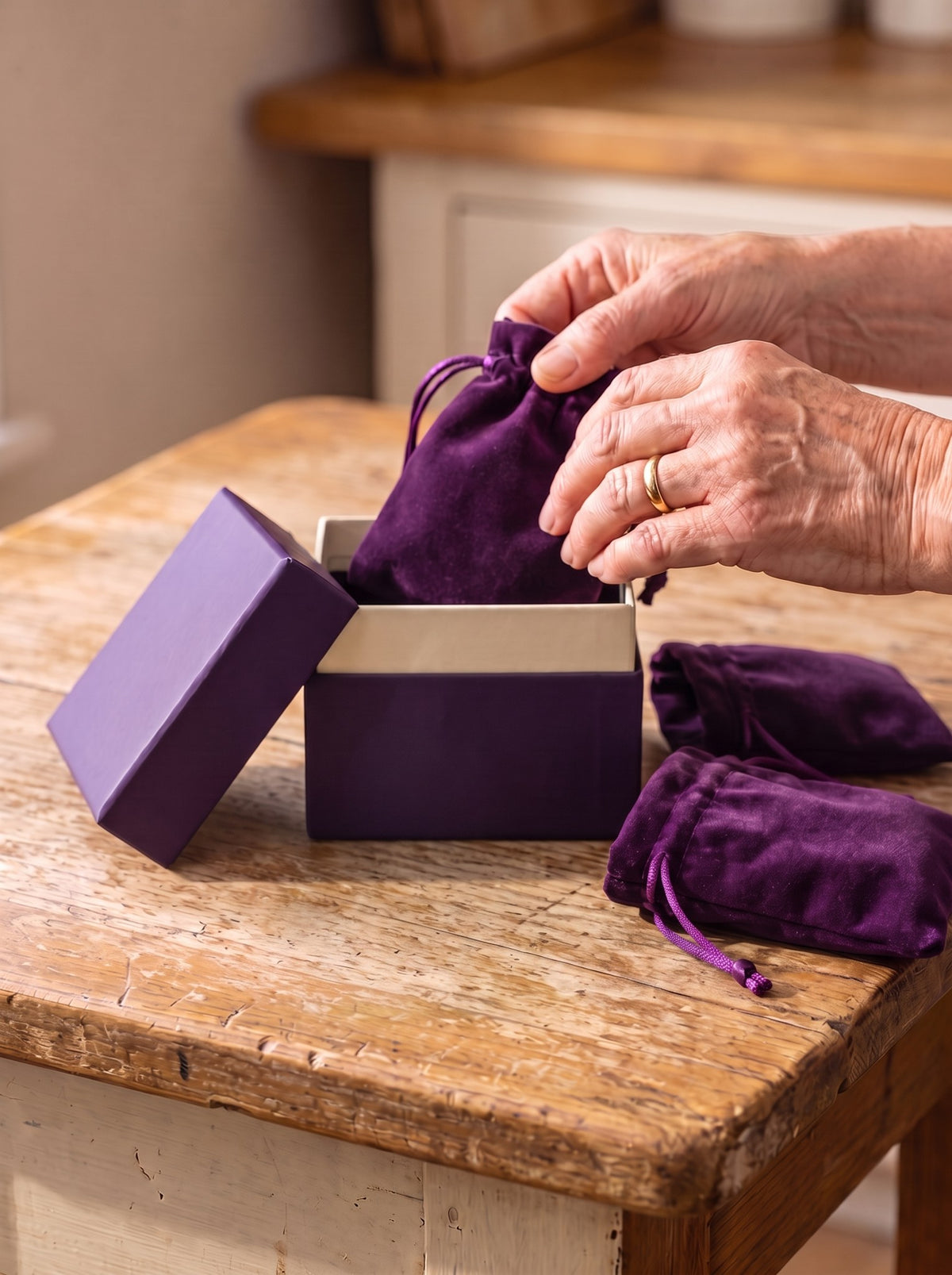
Three pieces, three pouches, one gift box. The third one was free.
What happens when you order:
60 days on her table. Not glad? They pay the return and refund every cent.
I think about it like this.
Two Sundays from now, your mom (or you) can sit down to the same stack, with the same butter knife and the same shoulders.
Or she can open the mail on the day it comes, standing at the counter, next to something real and heavy and pretty that asks nothing of her.
I can't promise you a check. Nobody honest can. I can tell you my mother laughs on the phone again, and that I don't argue anymore.
Get two. Keep one. You'll understand when you hold it.
60 days on her table. Not glad? They pay the return and refund every cent.
— Laurie
P.S. Mom wanted me to add one thing. When I read her this before sending it, she said: "Tell them to put it by the mail. Now it can watch the mail."
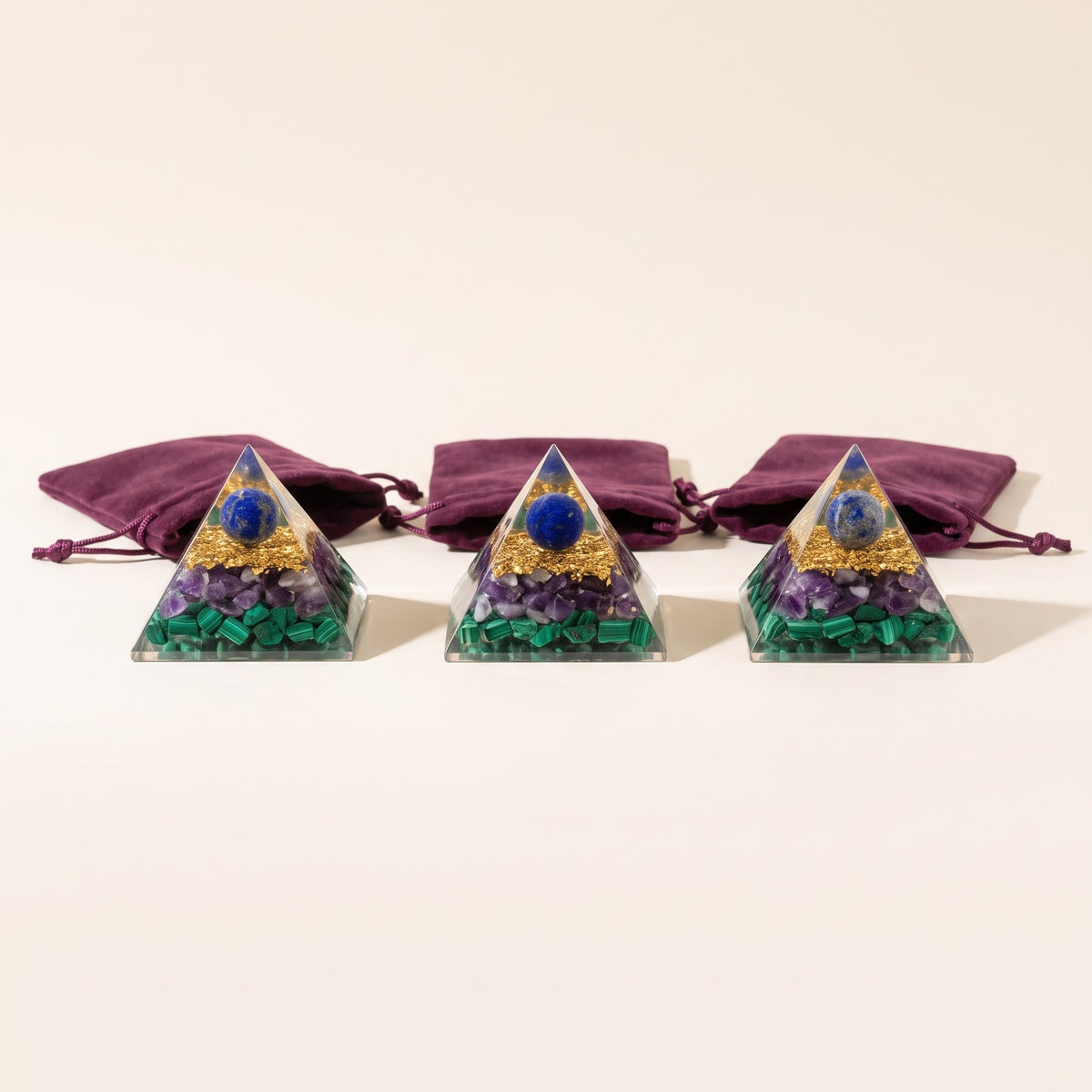
The clear resin is the setting, like the glass on a watch: it holds the stones and seals them in for good. The weight you feel is the stone: about 4.2 ounces in a piece that fits your palm, where clear resin alone would weigh about 2.7. And you have 60 days to judge it in your own hand.
Yes: lapis lazuli, amethyst and malachite, with genuine gold flakes. Real stone feels cool and heavy; you'll feel it the moment you pick it up. The lapis is from Badakhshan, Afghanistan. If anything looks wrong to you, send it back within 60 days. They pay the return.
Nobody honest can promise that, and they don't. It's real stone, sealed, made to last, and it sits where you look every day. What people do with that is their own story. Results described are personal experiences. This is a decorative intention object and does not guarantee financial outcomes.
Many of their customers pray with it on the table. Lapis is the blue the Bible calls "sapphire" under God's feet (Exodus 24:10). It's a stone, not an idol. As my mother says, "It doesn't replace my prayers. It sits by them." If it doesn't sit right with you, you have 60 days.
Really free, and nothing to tick. Choose 2 + 1 and the third is added for you: you'll see it at $0.00 in your cart. Every piece ships together, in one parcel, each in its own pouch. If anything is missing, they send it, no return needed.
Write to them within 60 days. They email a return label, they pay for it, and they refund every cent, opened or not. You're charged once; there is no subscription.