You did the HRT. The sweats are gone. You're still up at 3:15.
On HRT for Two Years and Still Up at 3:15 Every Night: The Question a Sleep-Lab Tech Asked Me That Nobody Else Had
My doctor was happy with my levels. My hot flashes were gone. And at 3:15 every morning I was wide awake, doing the math. This is what I finally understood, with the sources.
A note from Diane: I wrote about my own 3 a.m. last spring, and Joanne was one of the hundreds of women who wrote back. Hers was the letter I couldn't stop thinking about. I asked if I could share it. Here it is, nearly word for word. — Diane
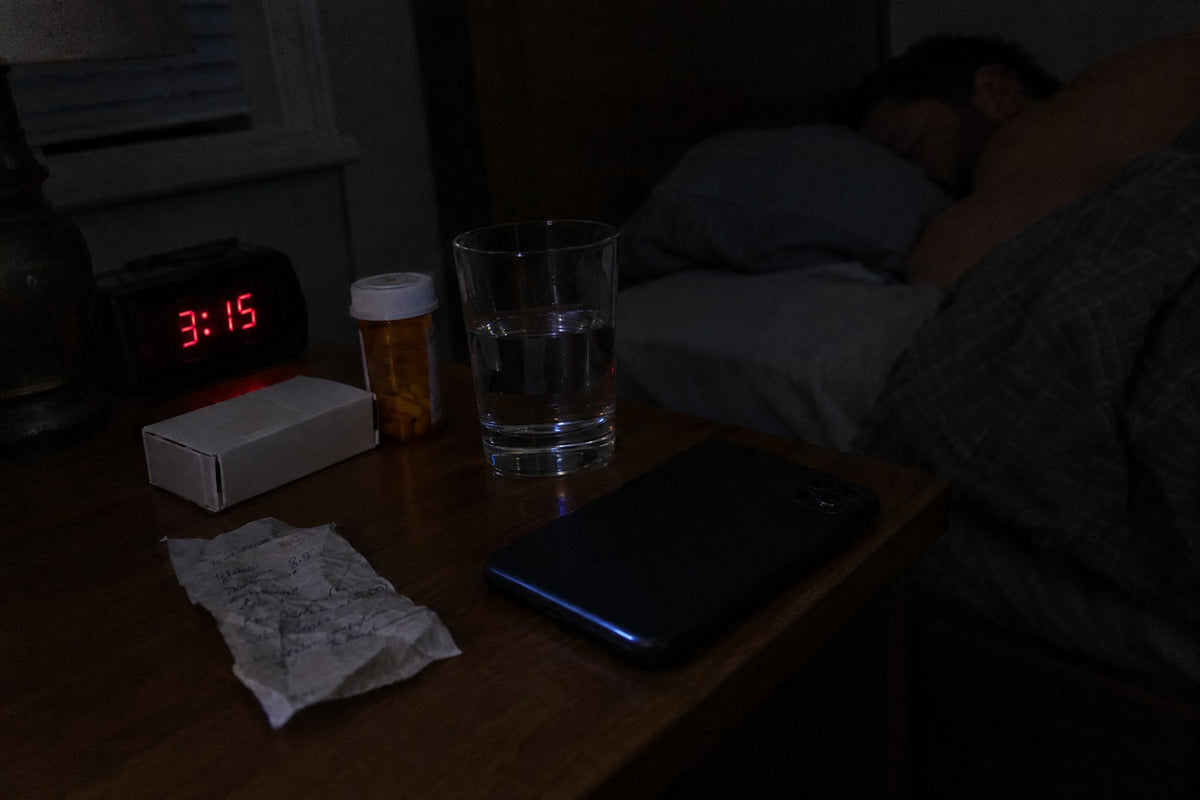
My nightstand, most nights for the last two years. That's my husband's shoulder. He sleeps through it.
Two years on HRT. The hot flashes are gone. I still wake up at 3:15 every night.
For a long time I thought that made me the problem.
I'd done everything right. I asked for the hormones, I got them, I took them on time. My numbers were good. My doctor was pleased.
You might be doing everything right too, and still be awake at 3.
So I want to tell you what I finally understood, because nobody told me. Not my doctor, not the forums, not the bottles in my drawer.
It started with one question, asked over pie at Thanksgiving.
The HRT worked. I want to say that first.
I'm 54. I run the front desk at a veterinary clinic outside Grand Rapids. I check in Labradors with ear infections and cats who hate the carrier, and I'm good at it, when I've slept.
I got on HRT at 52, after a year of asking for it.
A patch twice a week. Progesterone at night, next to my face cream, so I don't forget.
And I'll say this clearly, because I believe it: it worked.
The hot flashes went from a dozen a day to maybe one. The rage went. The crying in the car on the way home went. By Christmas my husband Ron had stopped asking me if I was okay.
I felt like myself in the daytime again.
But the nights didn't come back with the rest of me.

Work. I'm good at it, when I've slept.
3:15, and the math I never won
At 3:15, my eyes opened. Not drowsy. Awake.
Heart already going, like someone had said my name in the dark.
I'd lie still. Then I'd look at the clock. Then the arithmetic started.
Asleep by 3:30, that's two hours and forty-five minutes. Asleep by 4, two and a quarter. Asleep by 4:30…
I was never asleep by 3:30.
Some nights I gave up and went to the kitchen. One night I was standing at the counter at 3:15 eating a bowl of cereal in the dark, and I thought, my gynecologist was thrilled with my numbers last week. This is what thrilled looks like.
Most nights I drifted off again around 5:30. The alarm went at 6:15.
Ron slept through all of it. I don't blame him. I'd have slept through it too, if I could.
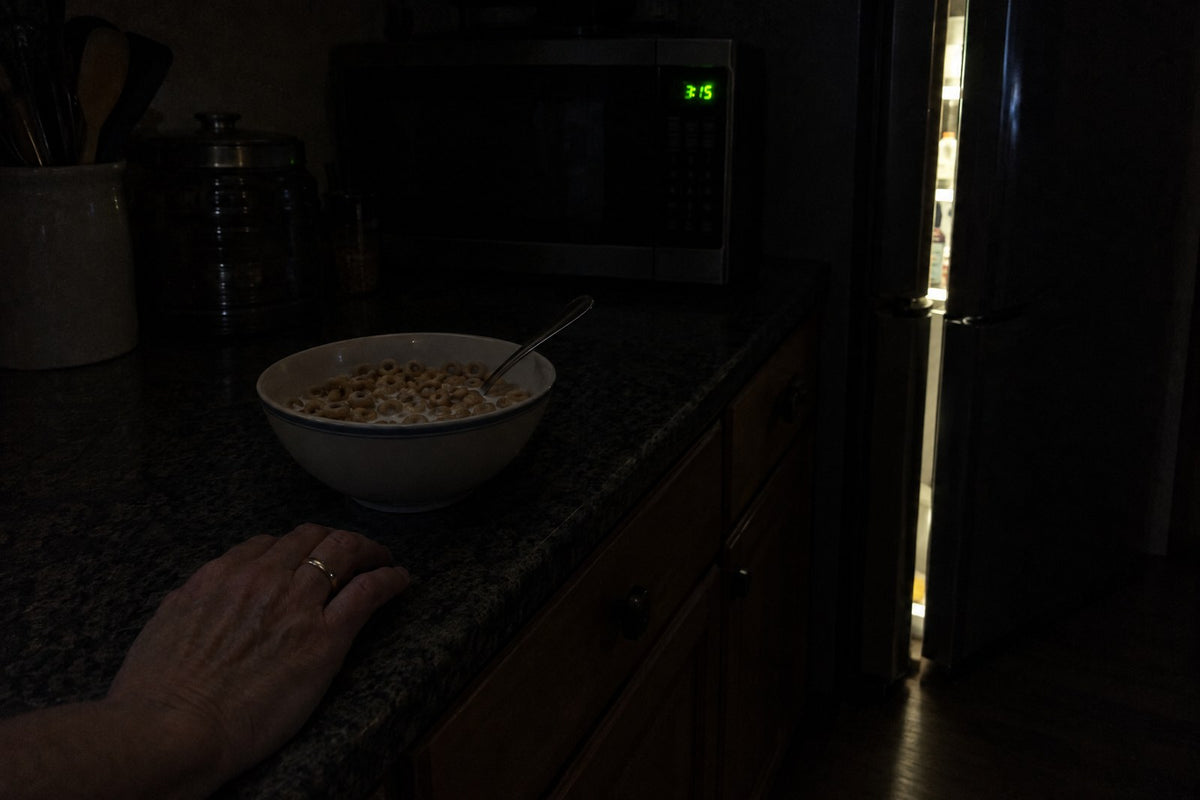
3:15, kitchen. My gynecologist had been thrilled with my numbers that week.
My levels looked great. So then what was I?
I went back to my doctor. She's a good doctor; I want to be fair to her.
She moved my progesterone from 100 to 200. Two good weeks. Then 3:15 again.
We switched the patch for the gel. Nothing changed at night.
She checked my thyroid. Normal. My iron. Normal.
"Your levels look great," she said. And they did.
So I started reading forums at 3 a.m., which is its own kind of lonely.
Woman after woman writing the same sentence: on HRT, still awake every night.
And under every post, the same three answers. Up the dose. Switch the brand. Try magnesium.
I had already done all three. And then I'd done the rest of the drawer.
Magnesium glycinate, $24 a bottle.Took the edge off at bedtime. Then 3:15.Melatonin, $9.Asleep by 10:30. Wide awake at 3.A "cortisol support" blend a coworker swore by, $87 a month.Three months. Nothing. (Later I found out the "3 a.m. cortisol spike" it was built for isn't really a thing: cortisol is near its lowest in the small hours and only starts its slow climb toward morning. 6 )A CBN gummy, $45 a jar.Groggy till ten. Up at 3:10 anyway.A white-noise machine, $39.It had a little blue light. I put a sock over it.
That's $378, give or take, of things that worked at bedtime and quit by 3.
My nightstand drawer was full of them. Every one of them was aimed at falling asleep.
Falling asleep was never my problem.
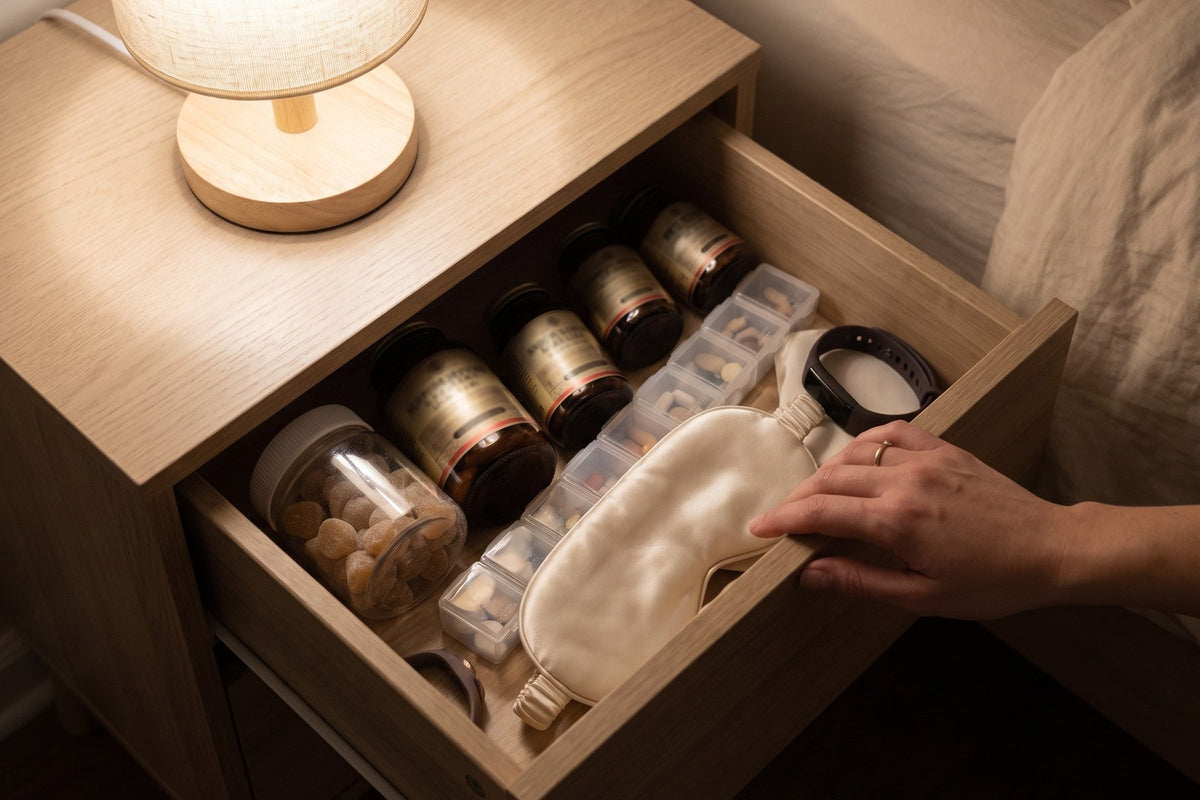
The drawer. About $400 of bedtime.
The question at Thanksgiving
My sister-in-law Denise works nights as a tech in a hospital sleep lab. She wires people up at 9 p.m. and watches their brains until morning.
At Thanksgiving, after the dishes, I asked her, half joking, why my HRT fixed everything except the one thing I most wanted fixed.
She didn't laugh. She put her coffee down and asked me a question.
"When you wake up at 3, do you wake up hot and then can't sleep? Or do you wake up, and then get hot?"
I had never once thought about the order.
That week I paid attention. Five nights in a row I noticed the same thing: I woke up first. The heat came a minute later, when it came at all. Two nights it didn't come.
I called her on the Sunday. "Awake first," I said. "Then hot."
"That's common late in the night," she said. "That's what I wanted to know."
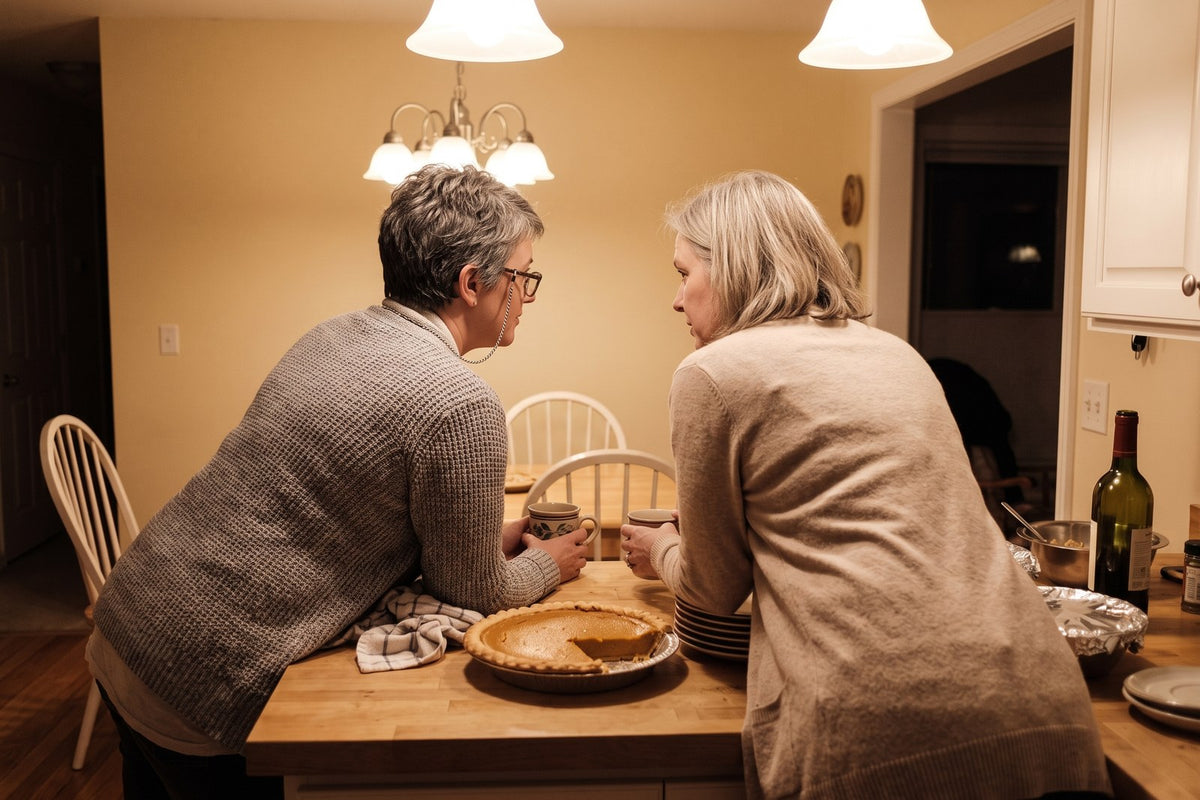
Thanksgiving. Denise, two coffees in, asking the only question nobody had asked me.
Awake first, then hot: it's not only your hormones
Here's what Denise told me, and I've since read it myself.
In one sleep-lab study, women past menopause were watched all night. Early in the night, the hot flash came first and woke them up. Later in the night, it was the other way round. The waking came first.5
"So it's not only your hormones," she said. "Your hormones are being treated. The wake is something else."
I want to be careful here, because this is the part people get wrong. She didn't say my HRT wasn't working. It was. It did exactly what it was supposed to do.
It just wasn't built for the thing waking me up at 3:15.
If you did everything right and you're still up at 3:15: you're not doing it wrong. Keep your HRT. The 3 a.m. wake is a different problem, and nobody treated it.
Then she told me the thing that sounds made up and isn't.
Everybody wakes at 3
Everyone wakes up about five times a night. Kids. Ron. Denise. You. Between every cycle of sleep, the brain surfaces for a moment. 1
Almost nobody remembers it. A wake has to last about four minutes before you remember it the next day.1 The short ones are gone by morning, as if they never happened.
And the night isn't the same all the way through. The deep sleep gets used up early, in the first few hours. After 2 or 3 a.m., sleep is lighter, and a wake is easier to stay in. 2
Denise drew it for me on a napkin. Five little wakes. Four of them closed by themselves.
The one at 3:15 didn't.
So the question isn't why you wake at 3. Everybody wakes at 3. The question is why yours doesn't end.
She put it like a door. Every wake is a door that swings open and shuts on its own in a minute or two. Unless something props it open.
I started calling mine the propped-open wake. It's the most useful thing anyone has said to me since this started.
Five wakes a night is normal. The problem is the one that stays open. (Drawn after the sleep studies in the sources.)
Two questions for tonight
Before you read another word about me, try this tonight. It costs nothing.
- When you wake at 3, which comes first: the heat, or the waking? Don't decide now. Notice it tonight.
- What does your hand do first? Reach for the clock? The phone? Or just lie there, trying?
In the morning, write two times on any scrap of paper: when you woke, and when you were back asleep. A guess is fine.
If you wake first, and your hand goes to the clock or the phone, you have a propped-open wake. Most of us do. And there's a part of it you can work on, without touching your prescription.
What props the door open
- The clock. You look, and you start counting. People who check the clock in bed worry more and take longer to fall back asleep. 3
- The phone. Even ordinary room light during the night cuts melatonin by more than half. 4 A phone held a foot from your face at 3 a.m. is not ordinary room light.
- Trying. Lying there willing yourself back to sleep. Sleep researchers have a name for it, sleep effort, and it keeps people awake.
I did all three. Every night. For years.
I wrote Denise's three on the back of a receipt and stuck it in the drawer with the bottles.
Then I said what everyone says. "So what am I supposed to do, not look?"
She shrugged. "Give your hand something else to do."
I thought about that for a week.
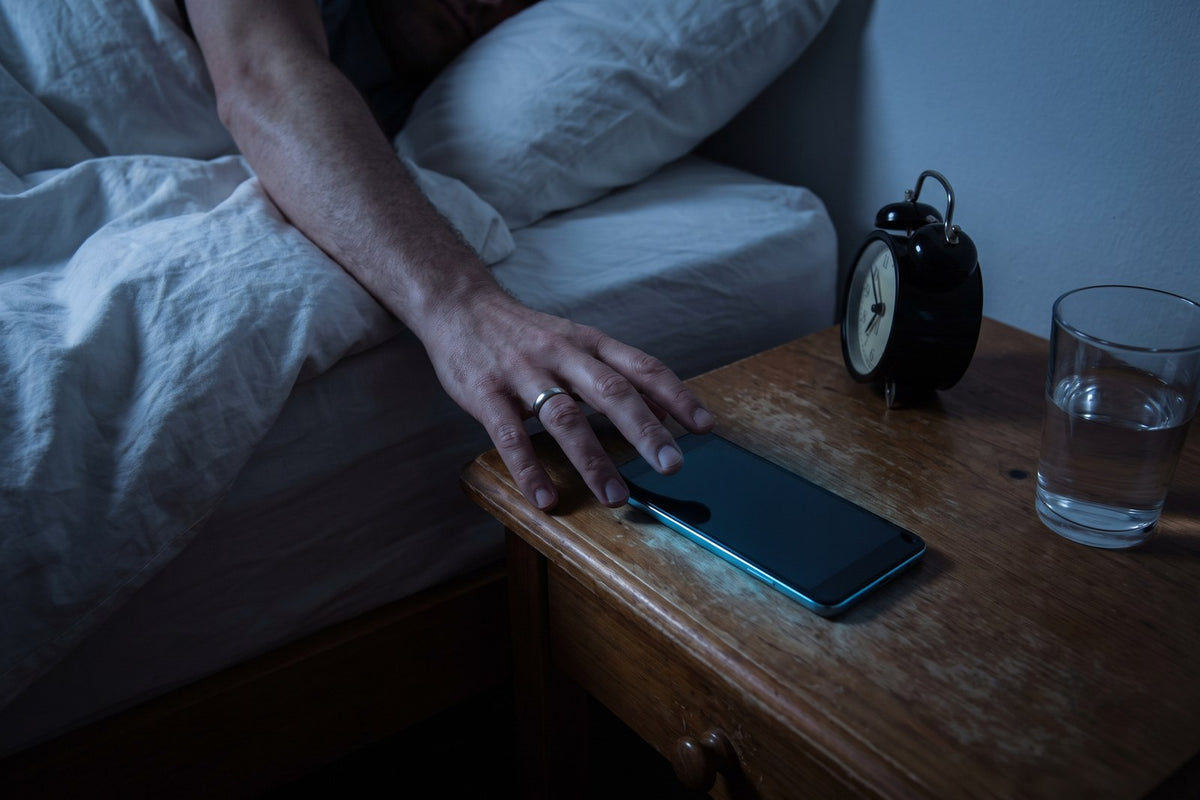
The clock, the phone, and the trying. All three, every night.
An engineer medicine forgot
That's how I found the disc. Not from Denise. From me, the next week, awake at 3:15 with my phone, which I know, looking for anything that wasn't one more thing to swallow.
I ended up reading about an engineer named Georges Lakhovsky.
In January 1925, in Paris, he set an open ring of copper around a sick geranium, its two ends not joined, and wrote down what happened next. He spent the rest of his life on open copper rings.
His 1929 book, The Secret of Life, has a preface by Arsène d'Arsonval, one of the fathers of medical electricity. In 1934 the US Patent Office granted his open-ring design: patent 1,962,565. You can look it up; I did. Nature reviewed the English edition in 1940.
That year he fled France through Lisbon to New York. In 1942 he was hit by a car there and died, his work unfinished. His rings were mostly forgotten.
"Lakhovsky's theories constitute what Claude Bernard called 'working hypotheses.'"
Arsène d'Arsonval, preface to The Secret of LifeI liked that d'Arsonval said it straight: a hypothesis. I won't pretend I understand the theory. I'm not sure anyone fully does.
What I understood was the object.
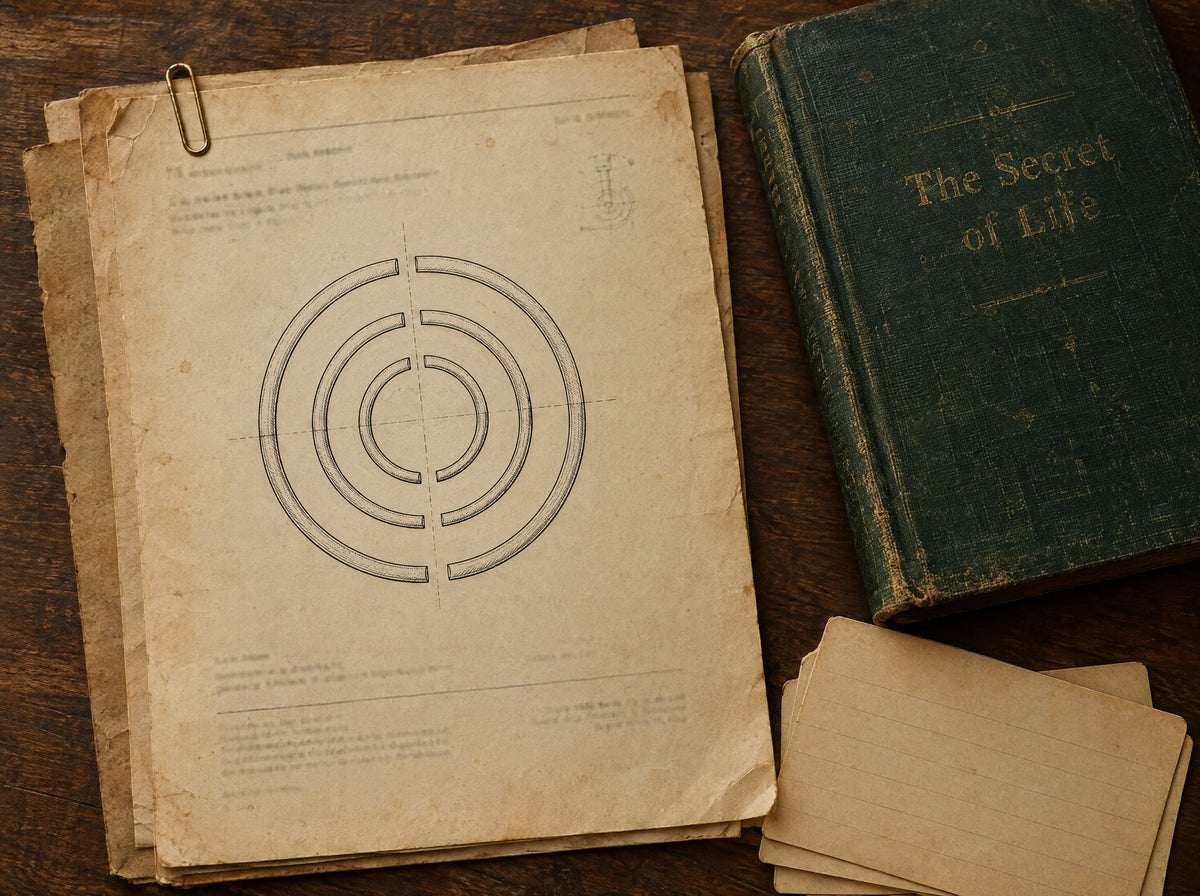
His 1934 US patent and the English edition of his book. Both are public; you can read them.
What it is, and what it isn't
A company called Spirad makes his ring pattern into a disc for under the pillow, the Lakhovsky Disc. I read their page twice looking for the catch. Here's exactly what it is.
It is:
- a flat disc 3.9 inches across (10 cm), about 1.2 ounces
- open copper rings, gold-plated, on a thin fibreglass board, one inside the other
- every ring cut by a purple band, so it never closes on itself, the way his patent drew it
- in a soft pouch, under your pillow, and you leave it there
It isn't:
- something to swallow, wear or rub on
- powered: no battery, no light, no cord, no app, no sound
- sending anything out. It just sits there.
- a medicine, or instead of one
And yes, it's a circuit board. That was my first thought too, and Spirad says so plainly: it's the most precise way to make what the patent describes. There's a $9 version online with no pouch, no diary and nobody to email. I wanted the 60 nights.
Here's why I said yes. Nothing to swallow. Nothing to remember at 10 p.m. Nothing to charge or check. And at 3:15, a little pouch under my pillow for my hand instead of the phone.
And it isn't instead of anything. I kept my patch. I kept my progesterone. I'd tell you to keep yours.
They sell it with a 60-night trial and pay the return if it doesn't help, opened or not. So the worst case was a return label.
I bought two. One for my pillow, one for Ron's, because when I'm up at 3, he's half up too.
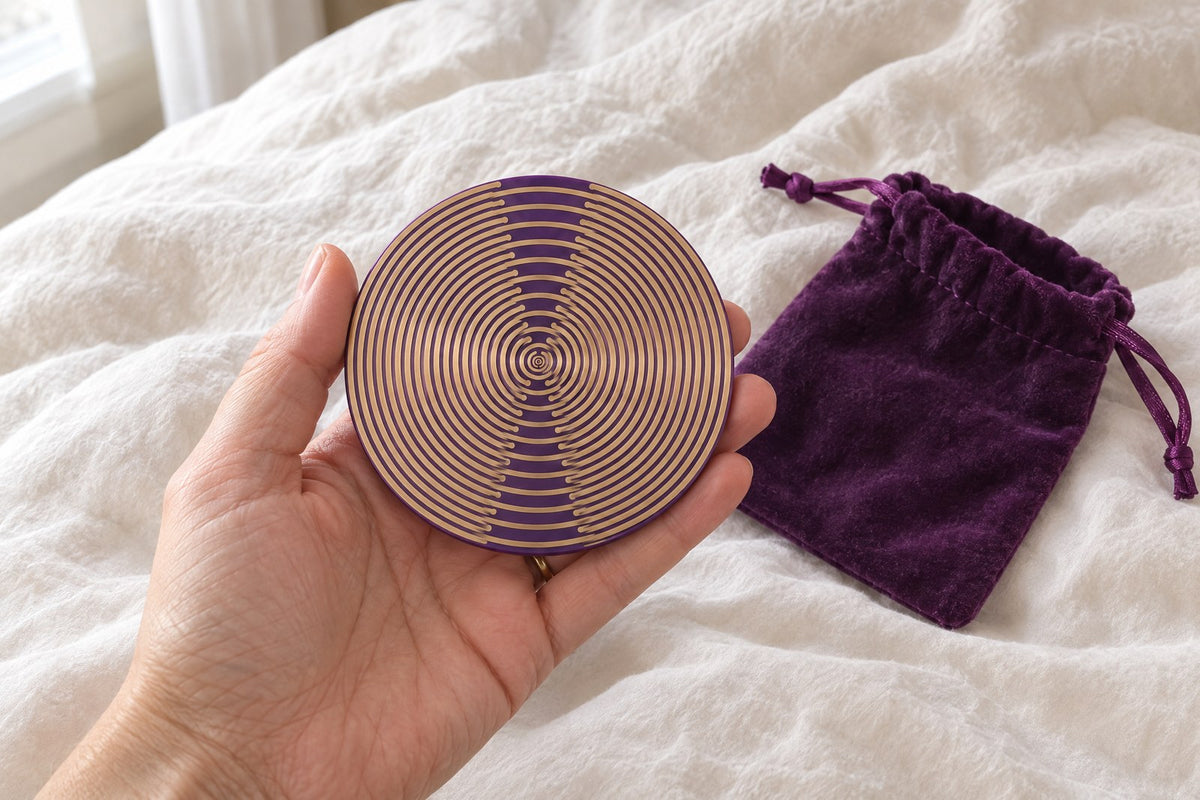
The disc and its pouch, the day it came. About four inches across. You can't feel it through a pillow.
See the Lakhovsky Disc and the 60-night trial →Night 1 to week 3, boring parts included
Night 1, nothing. I woke at 3:10 and lay there annoyed with myself for spending the money.
Night 4, I woke at 3:20. I didn't look at the clock. I slid my hand under the pillow onto the pouch, and the next thing I knew it was 5:50.
Week 2 was mixed. Two bad nights, a work thing, a dog that didn't make it. I kept the diary anyway.
Week 3, I saw it in my own handwriting. 3:15, back at 3:40. 2:55, back at 3:20. One night with just a dash, because I didn't remember waking at all.
I still wake up. I want to be honest about that.
I'm just back asleep before I can do the math.
I don't know exactly why it helps me. Maybe it's the rings. Maybe it's that my hand finally had somewhere to go at 3 a.m. that wasn't the clock or the phone. I've stopped needing to know.
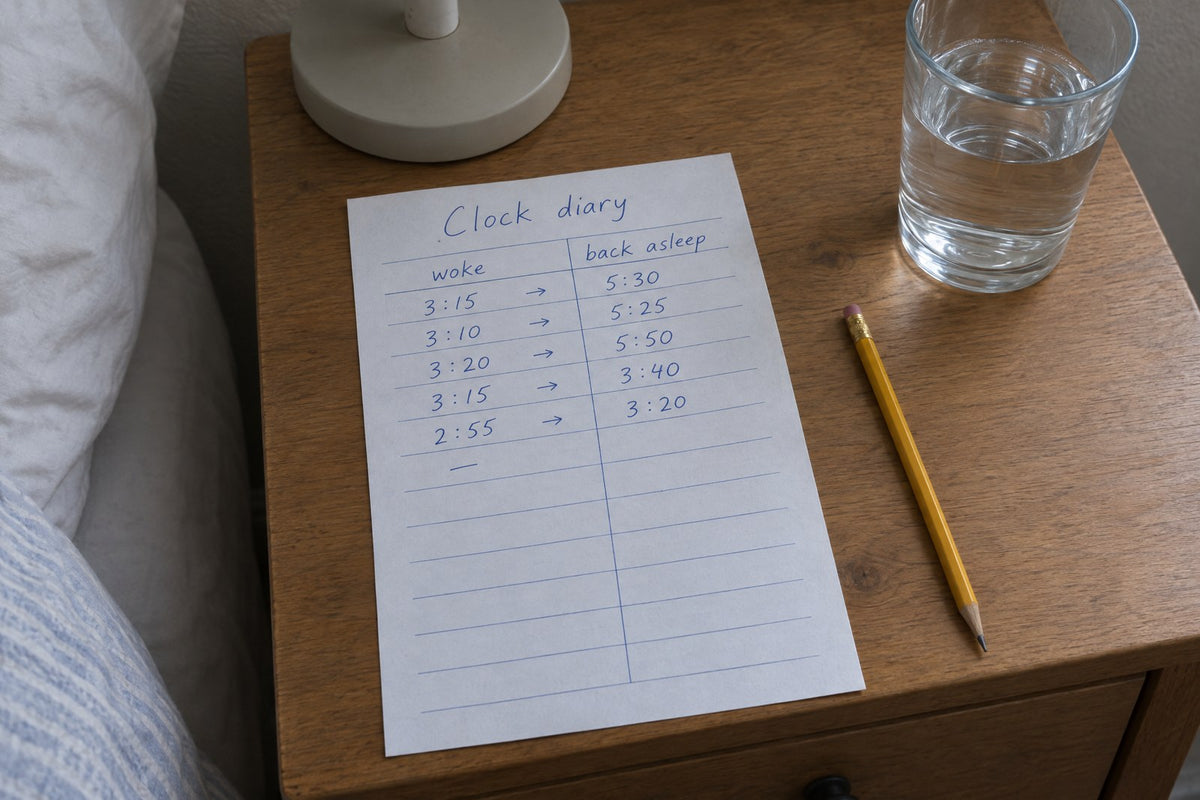
My diary, week 1 at the top, week 3 at the bottom. I kept the bad nights in.
Read how the 60-night trial works →The one who noticed
I didn't tell Ron what was under his pillow. He'd have made a joke about fifty-dollar coasters.
One Saturday in the third week, he was making coffee, and he said, without turning around: "You're not getting up anymore."
He's right. I'm not.
He noticed before I said a word.

A Saturday in week 3.
For the women who can't take hormones
A note from Diane: Since Joanne's letter ran, the letters I get most are from women who can't take HRT at all. Their doctors said no, for reasons that are their own. They asked me if any of this is for them. Maria answered better than I could. — Diane, updated October 2026
"Every answer about 3 a.m. starts with 'Have you tried HRT?' I can't. For four years, nobody had anything for me.
I'm 61. I taught second grade for 31 years in Albuquerque. I've woken at 3 almost every night since I was 52. My medical history is mine, and it's the most boring part of this.
I read every label in the supplement aisle and put them back. Half the 'menopause' ones are plant estrogens, exactly what I've been told to avoid.
What changed things was the fact Joanne writes about: late in the night, the waking came first. So my 3 a.m. wasn't only about the hormones I can't have. There was a part I could work on.
My sister found the disc. Nothing to swallow. No pill, no patch, no plant estrogen, no cream. Not powered. Not a medicine. No label to read and put back.
I'll give you my actual lines, because I don't trust anybody who doesn't. The week before: 3:05, back at 5:10. 3:20, back at 5:30. Week 3: 3:10, back at 3:35. 3:00, back at 3:30. One night 3:25, and I lay there until 4:40, because nights vary and I won't pretend they don't.
I still wake some nights. But I'm back asleep before the list in my head gets going.
Nothing to swallow. That was the whole point for me."
Maria L., 61, New Mexico
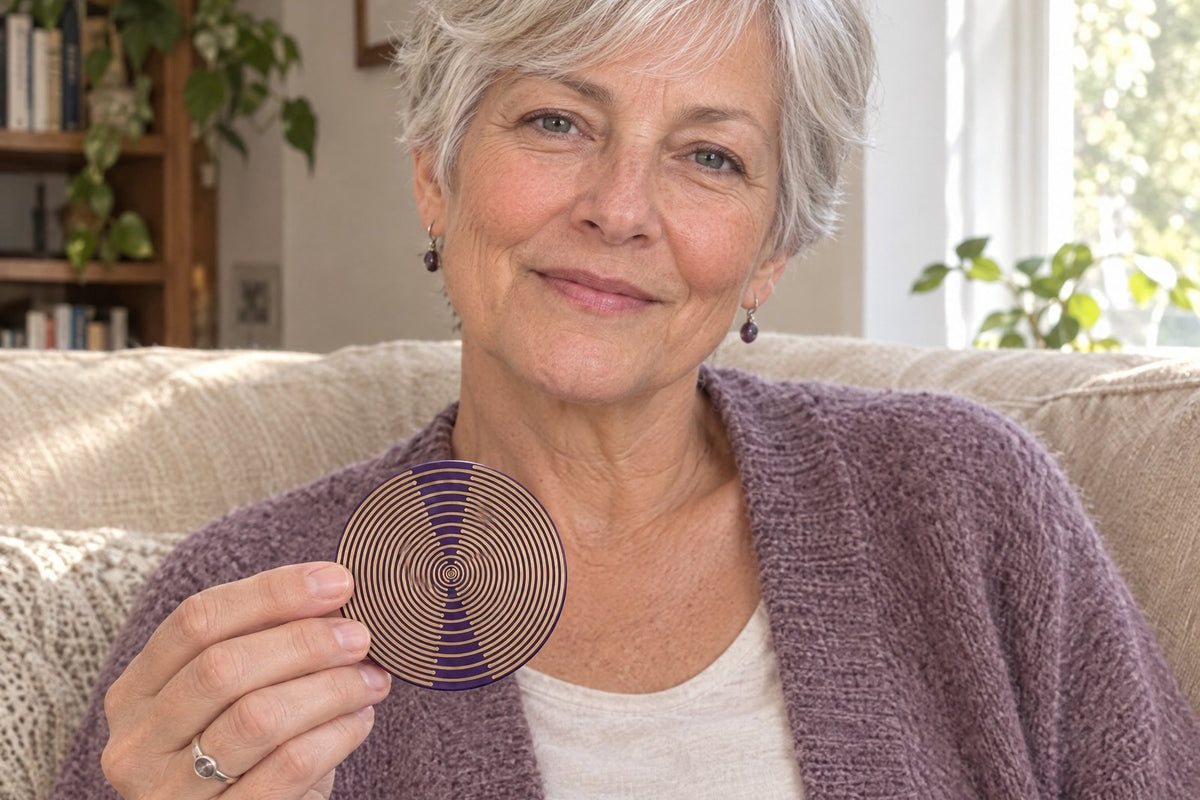
Maria, in Albuquerque. "There was no label to read and put back."
What other readers wrote back
After Joanne's letter, other women wrote to me about their own diaries. A few, with their permission:
"I don't buy the theory. I bought the 60 nights. I wake less long, which is all I wanted. Four stars because I can't tell you why."
Ellen B., 52 · ★★★★☆"I've been a 3:05 person for four years. I kept the diary like the email said. Nights 1 to 6, nothing. Then a run of wakes that were over before I'd looked at the clock."
Karen W., 57"My diary went 3:12, 3:40, 2:55, then two blank nights. I cried a little."
Sharon T."I loved my frequency box but hated the light and the hum. This does its job silently. The box is in the drawer now."
Gail W., 66Spirad says 4,900+ women have tried the disc, rated ★ 4.8 from 612 reviews, and in a survey of 214 buyers at night 60, 74 % say they get back to sleep sooner.
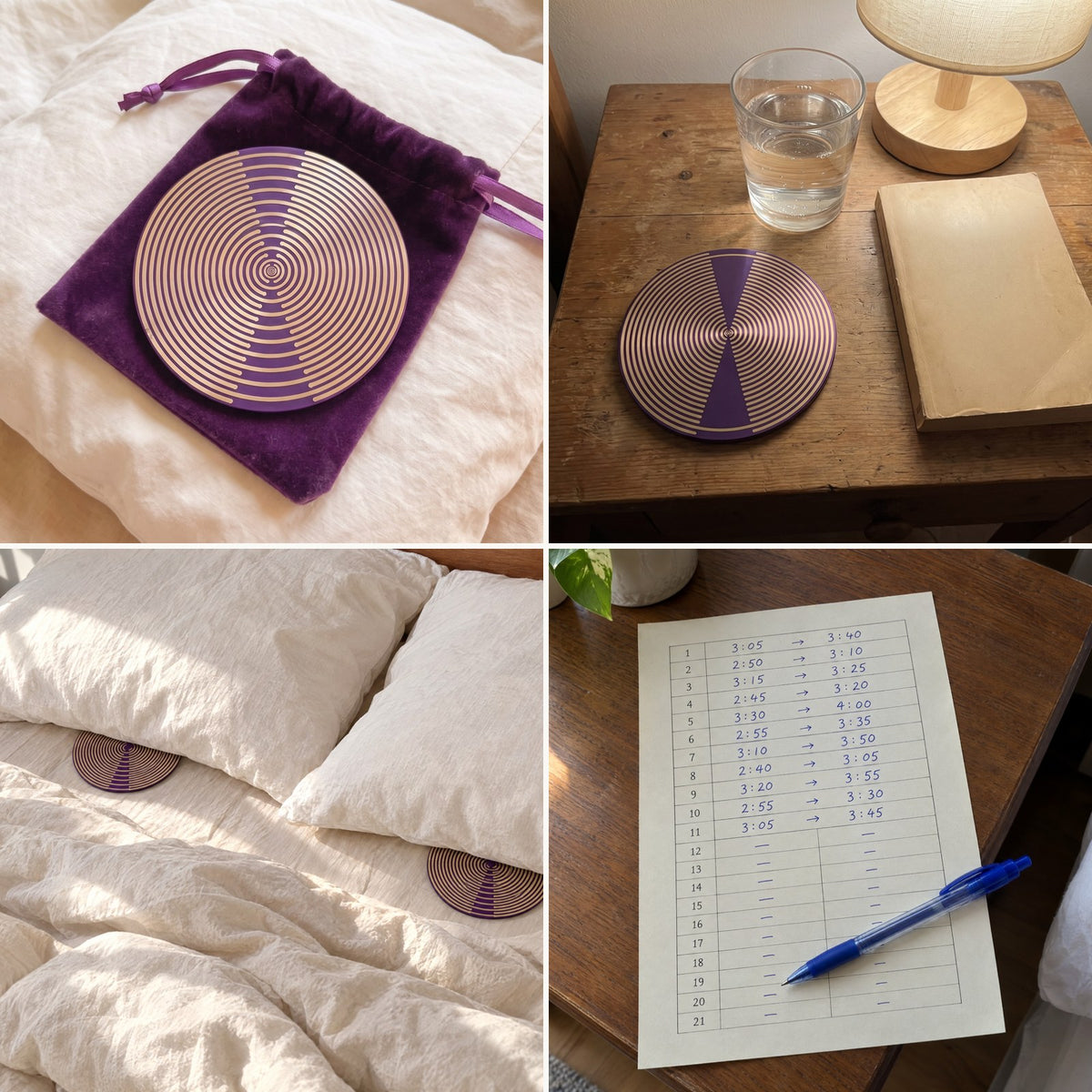
Photos readers sent with their letters.
One for each pillow
If you want to try what I tried: Spirad has just opened the disc to everyone this fall, and they want new buyers to keep the diary and tell them how it goes. So launch orders of the pair come with this:
- Two discs, "Both Sides of the Bed", one for your pillow and one for his, each in its pouch. When you're up at 3, he usually is too.
- The 3am Field Guide, 16 calm pages on everything Denise told me, with the sources.
- The Back-Under Audio, 12 minutes of a slow voice for the moment you wake.
- The 21-night clock diary to print, the same one I kept.
- Free shipping, at your door in 5-7 business days.
The guide and the audio are launch gifts. They end on Saturday, October 17.
And the part that made me say yes: the 60-Night Pillow Trial. Sleep on it for 60 nights and keep the diary. If your nights don't change, they send a prepaid label and refund every cent, opened or not. No subscription. The gifts are yours to keep.
I'd spent $378 on things that worked for a week. This one has to work for two months, or it costs you nothing.
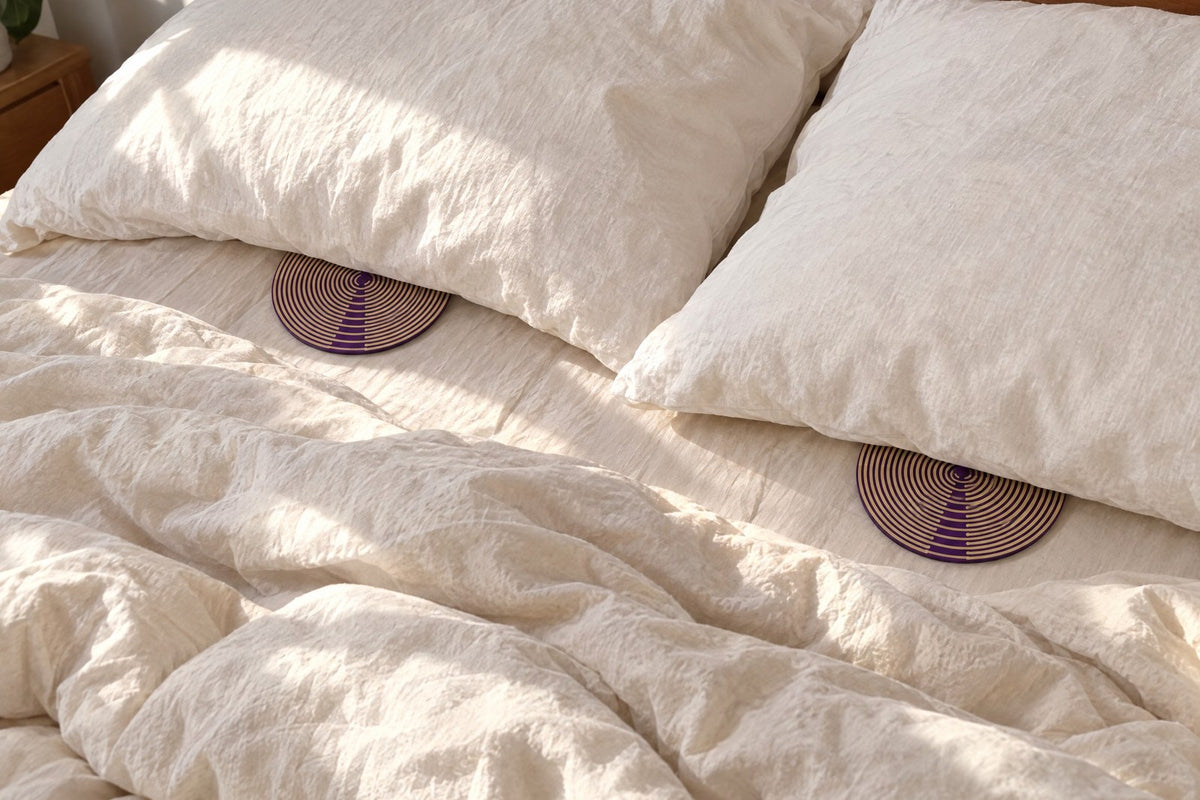
Both sides of the bed.
What happens when you click:
- The button opens Spirad's page with the two-disc pair, "Both Sides of the Bed", already selected.
- Check out. Your launch gifts come by email with your order.
- Tonight, print the diary and write your first two times tomorrow morning. The discs arrive in 5-7 business days.
60 nights on your own pillow. If your nights don't change, they pay the return and refund every cent. Nobody has to know you tried.
Tonight at 3:15
Tonight at 3:15 you'll probably be awake. I was, for two years.
You can do the math again, with the clock and the phone and the trying.
Or tonight can be the first of sixty, with a pouch under your pillow, a diary on the nightstand, and your HRT exactly as it is.
I'm not telling you a copper disc fixes menopause. I'm telling you that if you did everything right and you're still up at 3:15, you're not doing it wrong. Your hormones may be handled. Your 3 a.m. wake is a different problem.
Keep your HRT. Keep your doctor. Add the one thing that doesn't need anything from you.
Everybody wakes at 3. Mine just ends now.
60 nights on your own pillow, or they pay the return and refund every cent.
— Joanne P., Michigan
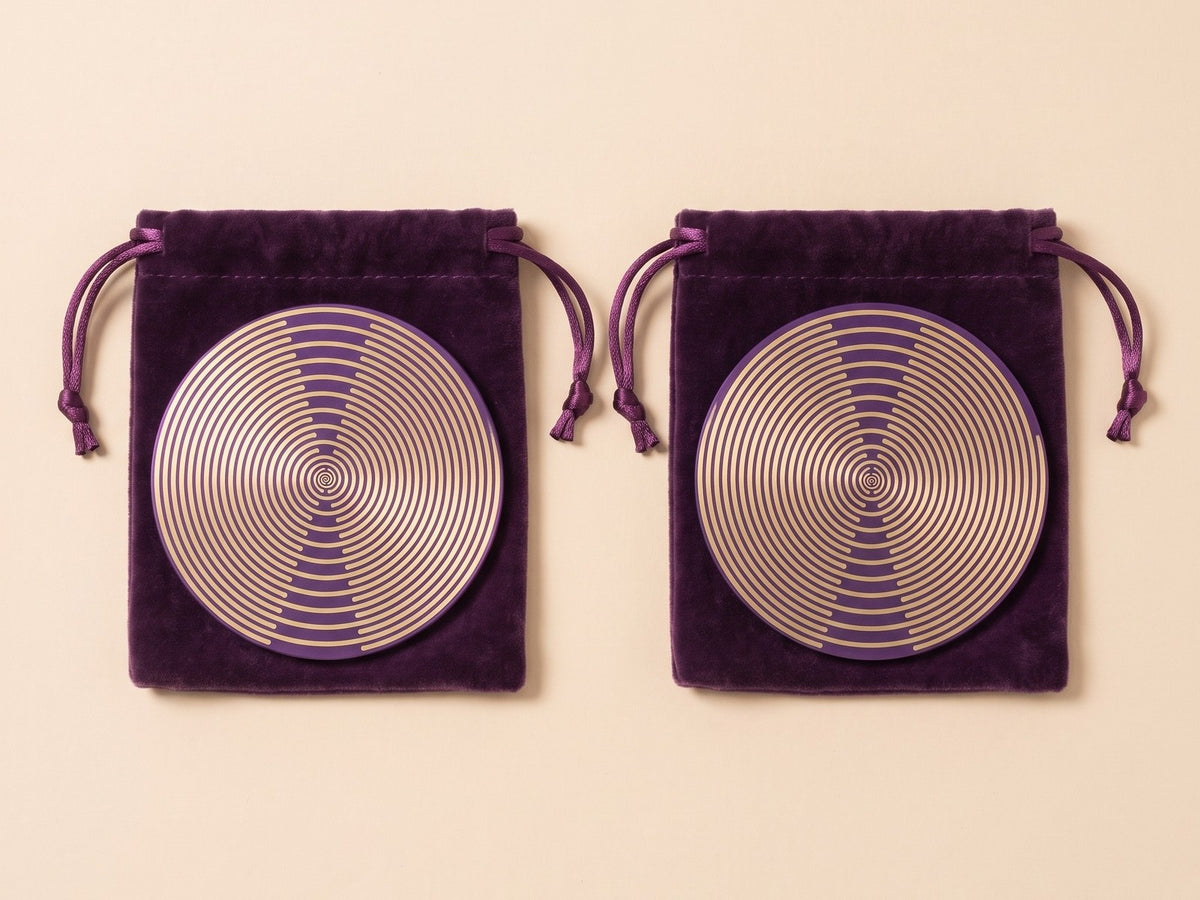
- 2 discs, one for each pillow, each in its pouch
- Launch gifts: the 3am Field Guide + the Back-Under Audio
- The 21-night clock diary, ready to print
- Free shipping · at your door in 5-7 business days
- 60 nights, returns paid, refund in full, opened or not
Questions readers asked Joanne
How can something with no battery do anything?
Fair question. It isn't a device; it's a passive antenna: open copper rings, the design Georges Lakhovsky patented in 1934. It sends nothing out and has nothing to switch on. Spirad doesn't ask you to believe his theory (medicine calls it a hypothesis). They ask you to put it under your pillow, keep the clock diary for three weeks, and judge by your own column of times. If the column doesn't move by night 60, they pay the return and refund you.
Is this the $9 disc I can find online? Is it a circuit board? Is it real copper?
Yes, it's a circuit board, and yes, the rings are copper, gold-plated. A fibreglass board is the most precise way to make what the patent describes: open rings, insulated from each other. Similar discs sell online for $9 without a pouch, a guide, a diary, a 60-night trial or anyone to answer an email.
Can I keep my HRT, progesterone or sleep medication?
Yes, always. The disc goes beside your treatment, never instead of it. It adds nothing to your body and takes nothing away. Don't change a prescription because of anything you read here.
I can't take hormones. Is there anything in it?
Nothing you swallow, wear or absorb: copper rings under a gold layer, in a pouch, under your pillow. Nothing is released and nothing touches your skin.
How do I know it's working if I can't feel anything?
You won't feel it; there's nothing to feel. You'll see it on paper. Write two times each morning (when you woke, when you were back asleep) and look at three weeks, not one night. A watch or a sleep tracker works too. Most buyers notice nothing on night 1; what they report usually shows up between week 1 and week 3, and some people notice nothing, which is why there are 60 nights.
Where does it ship from, how long does it take, and is it a subscription?
Orders arrive in 5-7 business days, with tracking. US shipping is free on 2 discs or more. You pay once: nothing renews. Returns are on Spirad: email within 60 nights for a prepaid label and a full refund, opened or not.
Is it safe with a pacemaker, a metal bed frame or a nickel allergy?
It's passive and non-magnetic: nothing in it reacts with a pacemaker, a metal bed frame or a mattress. The gold sits on a thin layer of nickel, so if you're allergic to nickel, keep it in its pouch under the mattress edge or on the nightstand. Not for children's beds.