

How to Choose an Orgonite Pyramid: Real vs Fake (and What's Inside)
The best orgonite pyramid is the one with real materials you can see: metal in the resin, natural stone (not dyed glass), a true copper coil, and a solid weight for its size. A "fake" is usually crystals or glass in plain resin with no metal, or a painted wire posing as copper. Below are seven checks you can run on any pyramid, from any shop, plus a look inside one of ours.

Amethyst Orgonite Pyramid
Handmade · Brazilian amethyst, smoky quartz, copper spiral · 60 mm base · rated 4.9 out of 5 by Spirad customers
See it · $49You can use this list on our own orgonite pyramids too. We would rather you buy with your eyes open. The same checks work for orgonite pendants and smaller pieces.
Real vs fake: the 7 checks at a glance
| Check | Good sign | Red flag |
|---|---|---|
| 1. Metal | metal you can see: shavings, flakes or a coil | no metal at all, only stones or glitter in resin |
| 2. Stone | uneven natural color, small inclusions, each chip different | every chip the same bright color, glassy and perfect |
| 3. Copper coil | copper color on every side of the wire | copper on the outside, silver where it is cut or seen from behind |
| 4. Weight | feels dense for its size | feels like plastic; light as a toy |
| 5. Bubbles | a few tiny ones, deep inside | many large bubbles, holes or voids at the surface |
| 6. Finish | flat base, smooth faces, clean edges | wobbly base, sticky surface, cracks, rough seams |
| 7. Seller | names every material, gives size and weight, shows real photos | only promises, no materials, no size, no return policy |
What "real orgonite" means
Orgonite is resin, metal and crystal together. The resin is the organic part, the metal is the inorganic part, and a crystal sits inside. That is the whole definition. If you want the history, read orgone vs orgonite.
So "real" here means real materials. It does not mean one pyramid "works better" than another. Orgonite's energy is a belief, not something anyone can measure, so be wary of any shop that says it can prove theirs is stronger. What you can check is what is inside.
There are two honest styles you will meet:
- Dense, traditional orgonite. Packed with metal shavings, often half the piece or more. It looks dark and earthy, and you see more metal than stone.
- Clear-resin orgonite. Clear resin so the stones show, with metal as flakes, shavings and a copper coil. It looks lighter and more like decor.
Both are orgonite. A piece with no metal at all is something else: a crystal resin pyramid. It can be pretty, but it is not orgonite in the traditional sense.
What's inside our pyramid
Most shops show the outside. We wanted to show you the inside. Here is an illustration of what a cross-section of our Amethyst Orgonite Pyramid, would show, top to bottom.
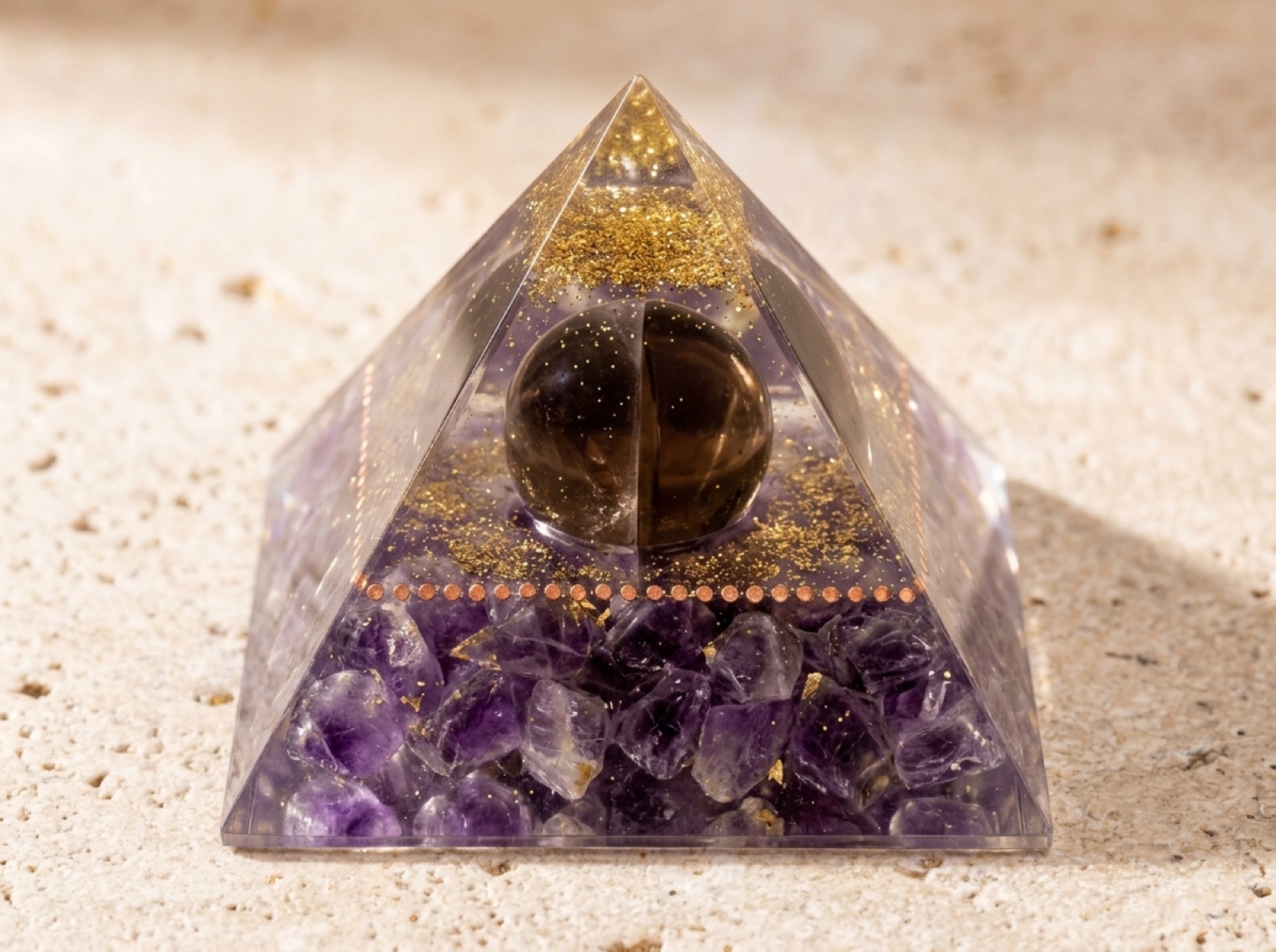
From the base to the tip, this is what a cut would show:
- The base layer: Brazilian amethyst. Real amethyst chips, packed into the bottom of the mold. Look at the color: deep purple in one chip, paler in the next, with tiny white lines. That variation is how you know it is stone.
- The copper spiral. Wound by hand and laid flat above the amethyst. In a cut, it would show as a row of small copper dots.
- The smoky quartz sphere. A round smoky quartz sits at the center, held by the resin as it cures.
- Metal flakes and shavings. Spread through the resin from the stones up to the tip.
- Clear resin. It binds everything, then each pyramid is polished by hand.
The finished piece has a 60 mm base (about 2.4 inches), stands about 55 mm tall and weighs about 120 g. It is poured by hand in small batches, so no two are the same. Ours is the clear-resin style: we chose to let the amethyst show.
The 7 checks, explained
1. Look for visible metal
This is the big one. Hold the pyramid up to the light and look for metal: shavings, flakes, a coil, a ring. Dense pieces will show a lot. Clear pieces will show less, but it should be there. If all you see is stones floating in resin, it is a crystal resin pyramid, not orgonite.
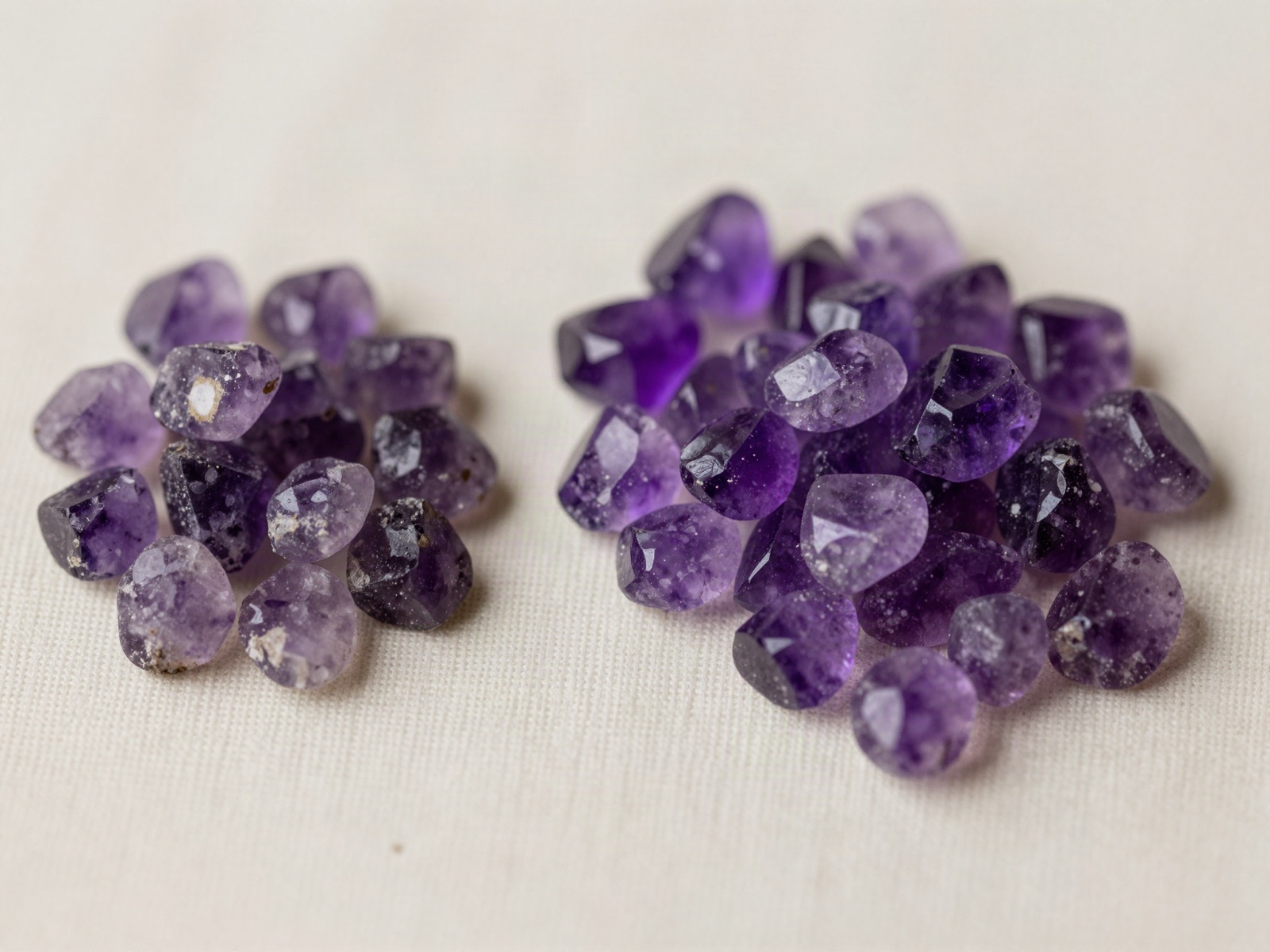
2. Real stone vs dyed glass
Natural stone is never perfect. Amethyst shifts from deep purple to lavender within one chip and often has white or clear zones. Lapis lazuli is deep blue with tiny gold specks of pyrite and some white calcite. Dyed glass and plastic are too even: every chip is the same bright shade, glossy, sometimes with round bubbles inside. Lapis is also often copied with dyed howlite or sodalite, which show a paler blue and no gold.
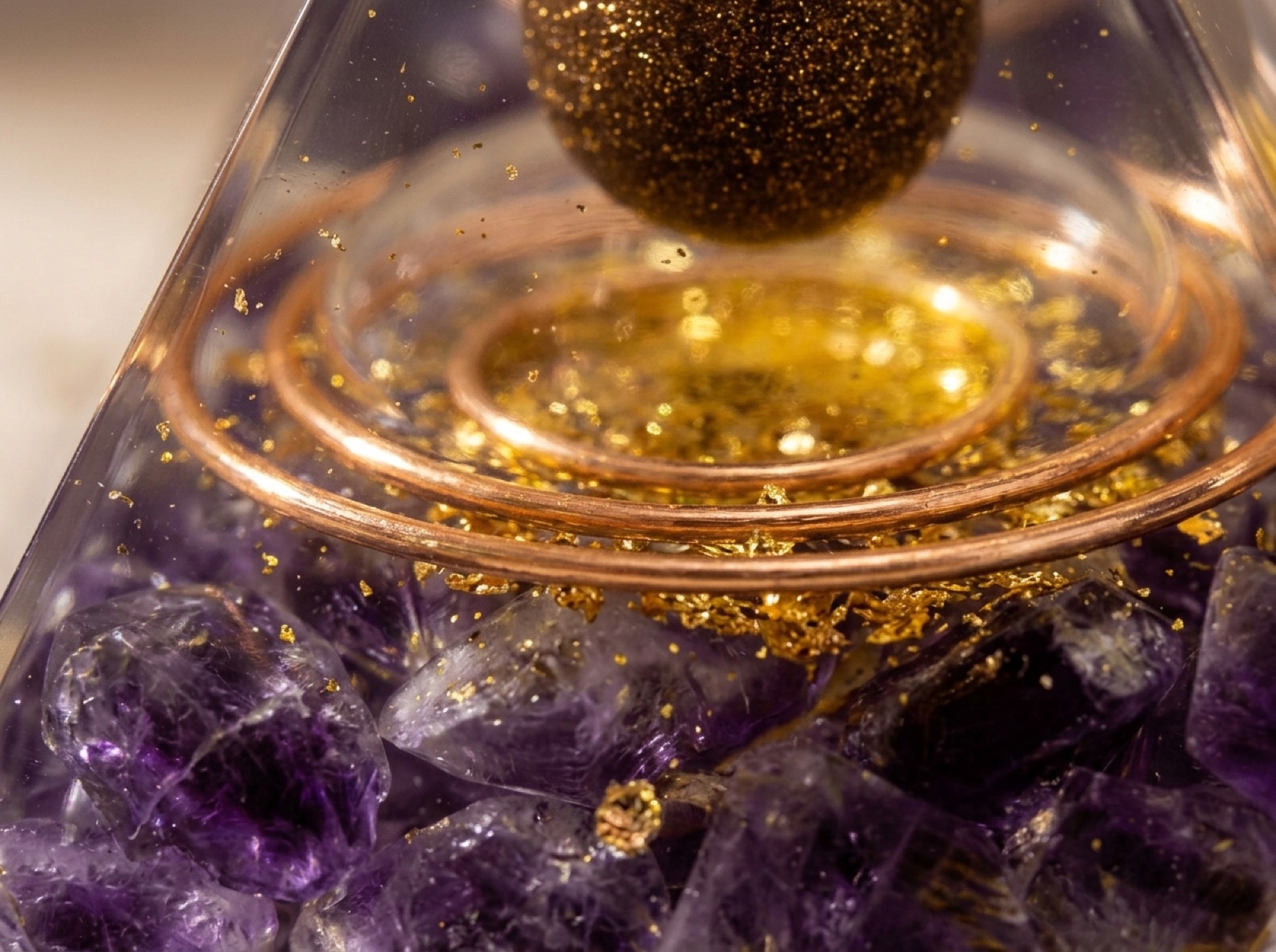
3. Check the copper coil
A copper coil is part of many orgonite pyramids. Look at the wire from more than one side, especially through the back face. Solid copper is copper-colored all the way around and at any cut end. Some cheap wire is only coated on the outside and shows silver underneath. That is a small detail, but it tells you how carefully the rest was made.
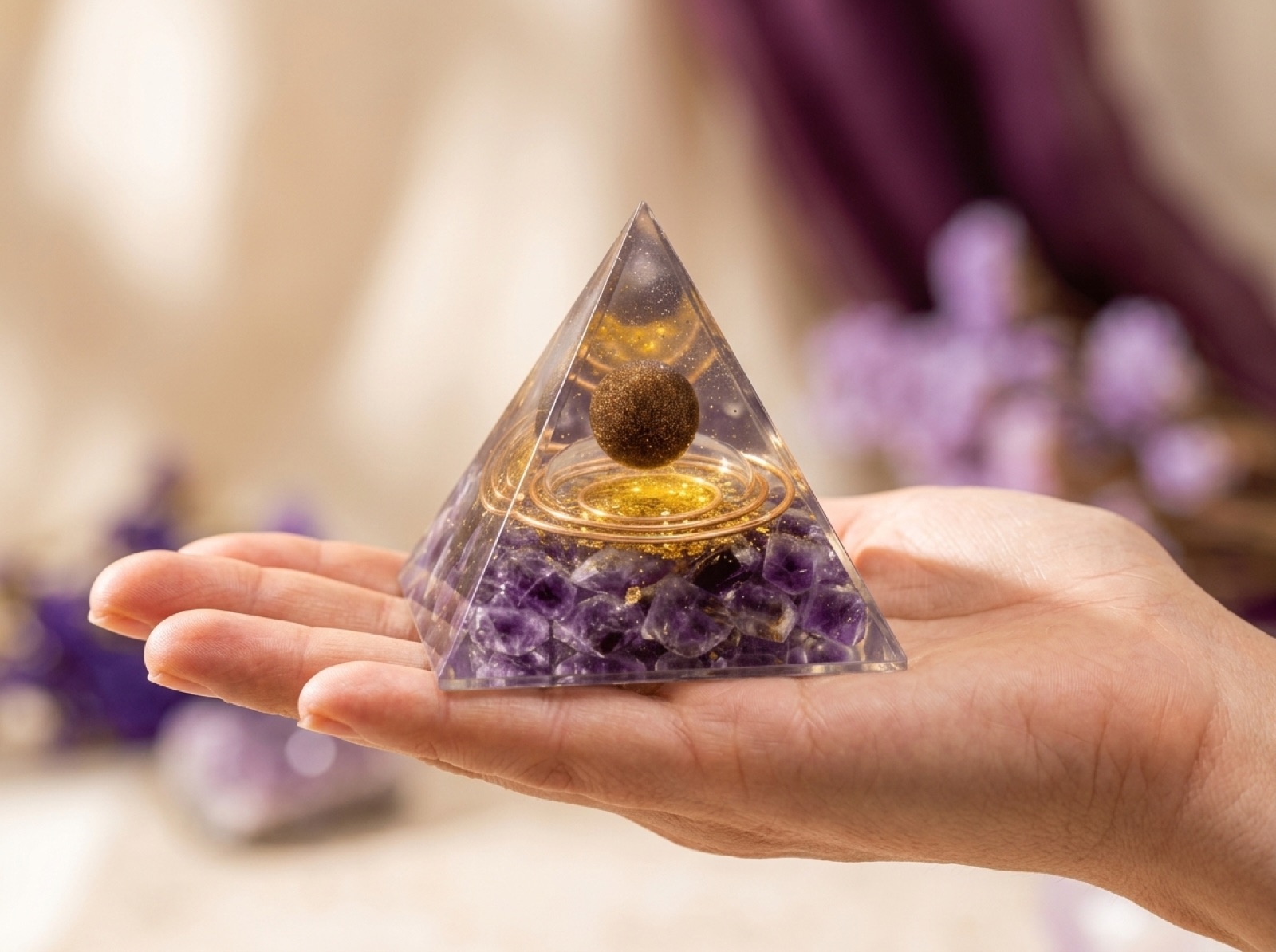
4. Weigh it in your hand
Here is a simple way to think about weight. A pyramid with a 60 mm base and 55 mm height holds about 66 cubic centimeters. Poured in resin alone, it would weigh roughly 70 to 80 g. Stone and metal are heavier than resin, so a pyramid that size with real amethyst and metal inside should feel clearly heavier. Ours comes in at about 120 g. If a pyramid of that size feels like a toy, it is likely mostly resin.
5. Count the bubbles
A few tiny bubbles deep in the resin are normal in a handmade piece. They are part of hand-pouring. Many big bubbles, or holes and pits at the surface, mean the pour was rushed or the resin was not handled well.
6. Check the finish
Set it on a table. The base should sit flat without rocking. The faces should be smooth and the edges clean. A slightly sticky surface means the resin never fully cured. Cracks in the resin are a sign of a bad pour or heat damage.
7. Read the seller's page
A good seller tells you what is inside, by name: which stones, which metals, the size and the weight. They show photos of the real piece, say that natural stone varies, and offer returns. Be careful with pages that list only promises and no materials. We also think a good seller tells you what orgonite is not: it is not a shield and it will not change the reading on an EMF meter.
How to choose the best orgonite pyramid for you
Once the materials check out, the "best" pyramid is personal. Three questions help:
- Which stone are you drawn to? Amethyst is traditionally linked with calm and intuition; lapis lazuli with wisdom and truth; rose quartz with love. Our comparison of amethyst and lapis lazuli pyramids goes deeper. You can also browse by stone: amethyst or lapis lazuli.
- Which style do you like? Dense and earthy, or clear with the stones on show.
- Where will it go? A 60 mm pyramid fits a nightstand or desk. See where to place an orgonite pyramid.
Frequently asked questions
How can you tell if an orgonite pyramid is real?
Look for metal in the resin, natural stone with uneven color, a copper coil that is copper on every side, and a solid weight. A piece with no metal is a crystal resin pyramid, not orgonite.
What should a real orgonite pyramid contain?
Resin, metal and at least one crystal. Many also include a copper coil. Ours holds Brazilian amethyst, a smoky quartz sphere, a hand-wound copper spiral and metal flakes and shavings.
Is there a test that proves orgonite works?
No. You may read about freezing water over orgonite or using a pendulum, but these are folklore, not proof. What you can check is the materials and the craft.
Does a real orgonite pyramid need copper?
It needs metal. Copper is the most common choice, as a coil, a ring or shavings, but brass, iron and other metals are used too. Our Sovereign Abundance Orgonite, for example, uses copper, brass and iron shavings with gold flakes.
Why does my orgonite have bubbles?
A few small bubbles are normal in a hand-poured piece. Large bubbles or holes at the surface point to a rushed pour.
Is a more expensive orgonite pyramid better?
Not always. Price says less than what is inside. Use the seven checks above and buy from a seller who names the materials and offers returns.
Where to start
If you want a pyramid that passes every check on this list, start with our Amethyst Orgonite Pyramid: real Brazilian amethyst, a smoky quartz sphere, a hand-wound copper spiral and metal through clear resin, about 120 g, with 60-day returns. If you prefer deep blue and gold, the lapis lazuli pyramid is made the same way. To learn what people use them for, read orgonite benefits.

Sovereign Abundance Orgonite
Handmade · lapis lazuli, malachite, amethyst, gold flakes and copper · same size as our amethyst pyramid
See it · $49